As an Amazon Associate I earn from qualifying purchases. This post may contain affiliate links at no extra cost to you.
The best dovetail markers for beginners remove guesswork from layout: a fixed slope that registers against the end of the board, the same angle every time, with no bevel gauge to set or drift. If you are cutting your first through dovetails, the Newkiton Dovetail Marker is the simplest place to start, because one aluminum body carries four slopes for softwood and hardwood work. The HNBun two-piece set is the budget alternative, the Housolution adds an etched scale for spacing, and the YOSELIN magnetic saw guide goes one step further and steadies the saw itself.
Slope is the decision that matters most. The traditional rule is a 1:6 slope for softwoods such as pine, where the steeper angle gives the joint more mechanical lock, and a 1:8 slope for hardwoods such as oak and maple, where the shallower angle keeps short grain from crumbling. A marker that covers both slopes lets you learn on cheap pine and move to hardwood drawer boxes without buying a second tool. Every pick below is a fixed-slope design, so the angle on the first tail is the angle on the last one.
As an Amazon Associate, we earn from qualifying purchases.
For a first dovetail marker, choose a four-slope aluminum model such as the Newkiton, which covers the 1:6 softwood and 1:8 hardwood slopes in one tool. The HNBun two-piece set suits anyone who wants a spare, the Housolution adds an etched scale, and the YOSELIN magnetic guide helps shaky first sawing stay on the line.
Newkiton Dovetail Marker
Top Pick
Newkiton Dovetail Marker
Slopes: 1:5, 1:6, 1:8 and 1:10
Material: solid billet aluminum, CNC machined
Markings: slope proportions marked for hardwood and softwood
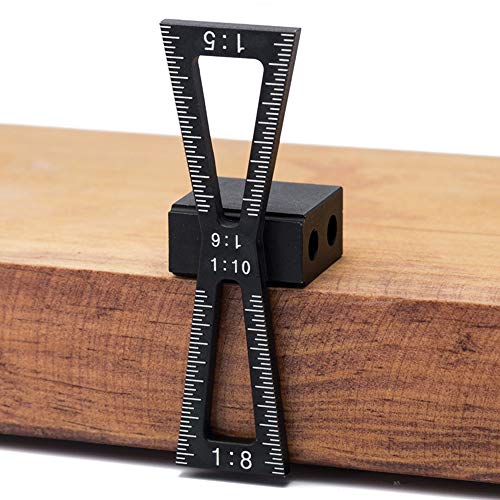
The Newkiton is the most complete starter marker in this group because it carries four slopes on one CNC-machined body: 1:5, 1:6, 1:8 and 1:10. That range covers the two slopes a beginner actually needs, plus a steeper 1:5 for chunky work in thick pine and a shallow 1:10 for fine joints in thin stock. The proportions are marked for hardwood and softwood, so you pick the face that matches your material instead of doing ratio math at the bench.
The body is milled from a solid billet of aluminum, which keeps it light and immune to rust. A saddle-style marker like this hooks over the end of the board, so one placement lets you scribe the slope down the face and carry a square line across the end grain. The one real gap is documentation: the maker includes no instructions, so a first-time user has to learn the tails-first sequence from a book or video before the tool makes sense.
The HNBun set takes the opposite approach to value: instead of one marker with four slopes, you get two aluminum alloy markers that together cover 1:5, 1:6, 1:7 and 1:8. A second marker is genuinely useful for a learner: one lives at the bench and one in the toolbox, or each stays set for a different slope during a project instead of flipping one tool between the tail board and the pin board.
Both markers carry graduated imperial scales on both sides, so you can read spacing from whichever face is up and mark from either direction, which also makes the set friendly to left-handed users. Published listing data puts the set at 2.44 by 2.44 by 2.05 inches and 1.13 ounces, so the markers are small and light enough for an apron pocket, though large hands may find them fiddly. Like the Newkiton, the set ships without step-by-step instructions.
The General Tools marker jig, sold as the No. 47, covers the same four slopes as the Newkiton: 1:5, 1:6, 1:8 and 1:10, in a black-finished body. For a beginner, that slope set is the whole story: it handles softwood practice joints, hardwood drawer sides and finer work in thin stock without a second purchase, and it does so at the budget end of the range.
Beyond the slopes and the black finish, the listing publishes little else: material, dimensions and weight are not stated. That matters less for a layout tool than for most purchases, because a fixed marker either holds its machined angle or it does not, and the check is simple: compare both faces against a known-good square and bevel before your first project. Buyers who want published dimensions and a stated body material should look at the Newkiton or the Housolution instead; buyers who just want the four standard slopes covered for the least commitment will find this one adequate.
Housolution Dovetail Marker
The Housolution marker is a flat template rather than a saddle marker, built from stainless steel and copper and laser-cut to shape. Its two template faces split the four slopes into pairs: one face carries 1:5 and 1:6, the other carries 1:7 and 1:8. An etched measuring scale runs along the template, giving a beginner a spacing reference built into the same tool that sets the angle, instead of reaching for a separate rule while laying out a row of tails.
The flat format has real trade-offs. A template lies on the face of the board and is quick to trace around, and the steel and copper construction resists bending if it gets dropped or buried under bench clutter. What it does not do is hook over the end of the board, so carrying the line squarely across the end grain takes a separate square, where a saddle marker does both jobs in one placement. One more quirk: the tool carries few markings beyond the scale, so label the slope faces with a marker pen on first use to avoid grabbing the wrong pair.
Specs
Slopes: 1:5 and 1:6 on one face, 1:7 and 1:8 on the other
Material: stainless steel and copper
Scale: etched measuring scale on the template
Forming: laser-cut
Dimensions: not stated
Weight: not stated
Tier: mid-range
YOSELIN Dovetail Saw Guide
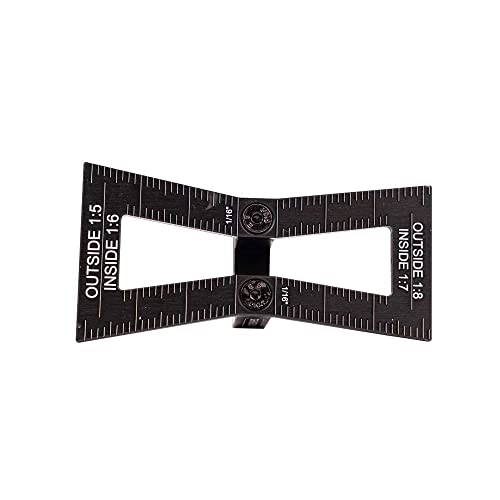
YOSELIN Dovetail Saw Guide
Slopes: 1:6 and 1:8
Type: magnetic saw guide for hand-cut dovetails
Material: aluminum
Magnet: built-in, holds the blade against the guide face
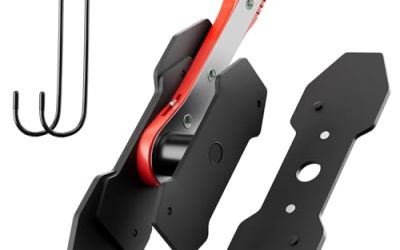
The YOSELIN is the different tool in this roundup: not a marker at all, but a magnetic saw guide. It offers the two classic slopes, 1:6 for softwood and 1:8 for hardwood, in an aluminum body with a built-in magnet that holds the saw blade against the guide face while you cut. For a beginner whose layout is fine but whose saw wanders off the line, that is the more useful half of the skill to automate.
The limits follow from the design. Two slopes is enough for almost all first projects, but there is no 1:5 for heavy softwood work and no shallow slope for fine box joinery, and the guide does not mark anything by itself: you still lay out tail spacing with a rule, a marking gauge and one of the markers above, then cut to those lines with the guide keeping the blade honest. Think of it as the second purchase, after a basic marker, for learners who find sawing straight harder than marking straight. It sits at the premium end of this group, reflecting the magnet and machining rather than extra slopes.
How to Choose a Dovetail Marker as a Beginner
Start with slopes. A first marker must cover 1:6 and 1:8, because those two handle the standard softwood and hardwood pairings taught in every introductory joinery course. Extra slopes are a bonus: 1:5 suits thick, soft stock, 1:7 is a middle option some makers prefer, and 1:10 is a fine-work slope for thin box sides. If a marker covers the core pair, it covers your first year of projects.
Next, choose the format. Saddle markers hook over the end of the board and mark the slope and the end-grain line in one placement, which removes a whole class of beginner errors. Flat templates often add an etched scale, but they need a separate square to carry lines around the corner. Neither is wrong; saddle designs forgive more while you are learning.
Material is the third call. Aluminum bodies are light, rust-proof and easy to read against pale pine. Steel and copper templates feel denser and shrug off drops. Finally, be honest about instructions: most budget markers ship with none, so budget ten minutes with a joinery video before your first layout, whichever one you buy.
Who Should Skip These Markers
Skip fixed markers entirely if you already own and can set a sliding bevel gauge accurately; a marker only repeats one angle faster. Skip the budget sets if you plan to mark dovetails weekly for years: a premium brass or hardwood marker will hold its edges longer. And skip the YOSELIN guide if your problem is layout rather than sawing, since it cannot mark a single line on its own.
FAQ
What slope should a beginner use for dovetails?
Use 1:6 for softwoods such as pine and 1:8 for hardwoods such as oak, maple and cherry. The steeper 1:6 slope gives soft fibers more mechanical lock, while the shallower 1:8 slope keeps hardwood short grain from breaking out. Every marker here covers both slopes.
Do I need a different marker for hardwood and softwood?
No. You need both slopes, not both tools. A four-slope marker such as the Newkiton or the General Tools No. 47 carries 1:6 and 1:8 on one body, and the HNBun and Housolution split the same slopes across two pieces. One purchase covers both material groups.
Can a dovetail marker replace a sliding bevel gauge?
For dovetail layout, mostly yes. A fixed marker repeats one slope with no setting step and no chance of the blade drifting mid-layout, which is exactly where beginners lose accuracy. A bevel gauge still wins for copying odd angles from existing furniture, where the slope is unknown.
Should a beginner buy a marker or a magnetic saw guide first?
Buy the marker first. Accurate layout is the foundation skill, and a saw guide cannot fix tails marked in the wrong place. Add a magnetic guide such as the YOSELIN second, once your layout is consistent and sawing drift is the remaining source of gaps.
Conclusion
For most beginners, the Newkiton is the buy: four slopes, a solid billet aluminum body and both the softwood and hardwood standards in one tool. The HNBun pair is the budget route to the same coverage with a spare included, the Housolution suits anyone who prefers a flat template with an etched scale, and the General Tools No. 47 covers the four classic slopes with the least fuss. Add the YOSELIN magnetic guide when your marking is solid and your sawing is not, and the pair will carry you from practice pine joints to hardwood drawer boxes.
Product and ASIN Reference
Product
ASIN
Newkiton Dovetail Marker
B071935Y39
HNBun 2 PCS Dovetail Marker Guide
B0856W2911
General Tools Dovetail Marker Jig (No. 47)
B09RQ6PX4P
Housolution Dovetail Marker
B0793R211K
YOSELIN Dovetail Saw Guide
B0D3TM293G
J
JD's Woodworks Editorial Team
We compare specs, warranty terms, long-term owner feedback and street pricing before anything earns a spot. Rankings are never paid.
Affiliate disclosure. As an Amazon Associate we earn from qualifying purchases at no extra cost to you. Prices accurate as of the date shown.
Find the best tools for car wrapping, from felt squeegees and wrap knives to heat guns and complete kits, and choose the right set for a smooth finish.
Find the radiator hose clamps best for leak-free cooling: worm-gear, T-bolt and spring picks sized for upper and lower radiator hoses, plus a sizing guide.
Find the best brake caliper press tool for smooth, even piston compression. Compare ratcheting presses, dual-piston tools, and spreaders for your brake job.
Compare three Japanese water stones for chisels and plane irons, from a King combination stone to a splash-and-go Shapton, with grit and soaking guidance.
Compare three carving knife kits built around basswood blanks, with guided projects, stropping gear and safety extras, plus criteria for choosing well.
Compare four chip carving knives for lettering by edge shape, steel and handle, from a skewed BeaverCraft C6 to a Swiss Pfeil, for plaques, signs and lids.
The best spindle sanders for guitar making shape cutaways, waist curves, and neck heels cleanly. Compare five benchtop and portable picks by drum size.


 YOSELIN Dovetail Saw Guide