Best Spindle Sanders for Guitar Making: 5 Luthier Picks
The best spindle sanders for guitar making shape cutaways, waist curves, and neck heels cleanly. Compare five benchtop and portable picks by drum size.
The best spindle sanders for guitar making shape cutaways, waist curves, and neck heels cleanly. Compare five benchtop and portable picks by drum size.
As an Amazon Associate I earn from qualifying purchases. This post may contain affiliate links at no extra cost to you.
Table of Contents
Quick Answer
Grizzly G0538
POWERTEC OS1000
ShopSeries RK9011
Triton TSPSP650
EJWOX Portable
How to Choose a Spindle Sander for Guitar Making
Who Should Skip a Spindle Sander
FAQ
Conclusion
Product and ASIN Reference
A guitar body spends much of its shaping life against curves: the tight waist of an acoustic, the horn cutaways of an electric, the heel where the neck meets the body. An oscillating spindle sander is the machine built for that work. The drum spins while it travels up and down, so the sleeve wears evenly, runs cooler, and leaves a surface needing far less hand sanding before binding and finishing. For luthiers, what matters is drum diameter for tight radii, a table that keeps edges square to the top, and speed control for figured woods that scorch under an aggressive cut.
As an Amazon Associate, we earn from qualifying purchases.
Quick Answer
For most guitar builders, the Grizzly G0538 is the best spindle sander for guitar making: its fixed table keeps body edges square for clean glue joints, and its drums reach the small sizes tight cutaways need. The POWERTEC OS1000 covers the widest drum range on a budget, the ShopSeries RK9011 adds spindle speed, and the Triton TSPSP650 and EJWOX handhelds bring variable speed to neck heels and clamped blanks.
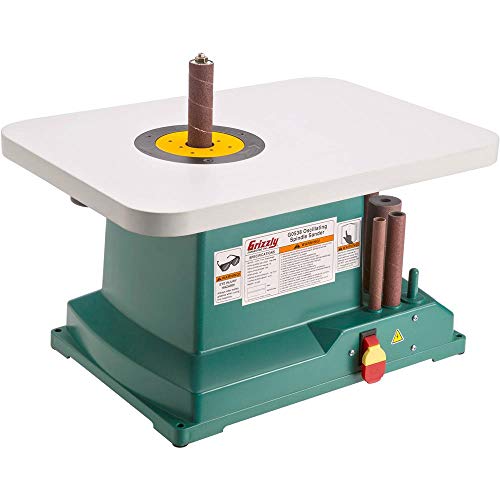
The G0538 is a benchtop machine with a fixed laminate table, and that fixed table is its guitar-making strength. Body sides, rim stock, and template-guided blanks need edges that stay square to the top so glue joints close without gaps, and a table that cannot tilt removes one source of drift. The drum set reaches small diameters for the inside of a cutaway horn, while the 3 inch drum fairs the long sweep of an acoustic waist. At 72 strokes per minute, its oscillation rate is the highest among the benchtop picks here, spreading wear across the sleeve when truing thick blanks. It sits in the mid-range tier.
Choose the G0538 when square edges matter more than bevel work: solid-body blanks, acoustic rims, and neck blanks all benefit. Builders who sand many angled transitions will need a tilting table or another machine for that step.
The OS1000 is the budget-tier benchtop pick, built around a round cast iron table and a quiet 2.6 amp induction motor. Its six drum sizes run from 1/2 inch to 3 inches, the widest spread in this roundup, so one machine covers both the tightest inside curve of a Venetian cutaway and the broad arc of a dreadnought lower bout. The 30 oscillations per minute and 5/8 inch stroke are gentler than the Grizzly’s action, suiting final truing passes on thin side material, where an aggressive drum can sand through a line quickly. Published sources disagree on table diameter, so confirm the current listing before ordering around a tight bench footprint.
Specs
Motor: 2.6 amp induction
Spindle speed: 1,725 RPM
Oscillations: 30 per minute
Stroke: 5/8 inch
Drums: 1/2, 3/4, 1, 1-1/2, 2, and 3 inches
Drum length: 4-1/2 inches
Table: round cast iron, fixed; diameter not stated consistently in published sources
Dust port: 2 inches
Weight: 52 pounds
The OS1000 fits builders who want one benchtop machine for electric and acoustic work without premium pricing. Its fixed speed means scorch-prone figured woods need a light touch and fresh sleeves.
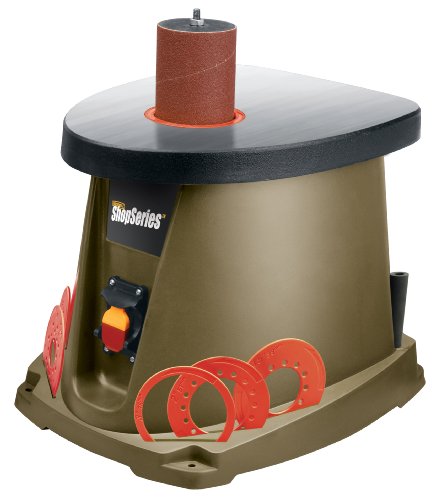
The RK9011, from Rockwell’s ShopSeries line, spins its drum at 2,000 RPM, the fastest fixed speed among the benchtop picks here, with 58 oscillations per minute. Faster rotation suits the light, frequent passes used to refine template lines on body blanks and clean up bandsaw marks on semi-hollow builds. The manual lists a maximum sanding height of 3-5/8 inches, enough for most solid-body blanks and acoustic rim stock on edge. Drum storage is built into the housing, and table inserts match each drum size, supporting thin workpieces near the drum. It sits in the mid-range tier.
Pick the RK9011 for solid-body electrics and smaller acoustic parts, where the faster drum and compact table earn their keep. Builders who true up tall stock should check the sanding height against their thickest workpiece first.
The TSPSP650 takes the spindle sander off the bench. This handheld unit weighs under five pounds and can be carried to a body blank clamped in a vise, often the only practical way to fair a carved top or reach a neck heel that will not sit flat on a table. Variable speed from 1,800 to 3,200 RPM is the feature luthiers will use most: slowing the drum reduces heat on figured maple, koa, and other woods that burn under a fast sleeve. The included inversion kit clamps the tool upside down on a bench, making a small stationary sander for bridges and headstock overlays. Drum changes are keyless, and the tier is mid-range.
The TSPSP650 suits builders whose bodies are too large, carved, or assembled for a benchtop table. Its largest sleeve is 1-1/2 inches, so wide curves take more passes than on a 3 inch bench drum, and sleeves load faster on resinous woods.
The EJWOX is the budget-tier portable, sharing the handheld format: a 5 amp variable speed motor driving four sleeve sizes, with an adjustable edge guide that limits how much material the drum takes from an edge. That guide helps keep binding channels and body edges consistent while the blank stays clamped. Inversion clamps and a bench mat are included, so the tool can be fixed upside down for small parts such as bridge blanks. The keyless locking bolt speeds sleeve swaps between coarse shaping and finer finishing grits on the same curve.
Choose the EJWOX when a handheld is an occasional helper rather than the main shaping station: touching up cutaways, fairing a heel, or cleaning template lines. Shops shaping bodies weekly will outgrow its small sleeve set and want a benchtop machine as the primary tool.
How to Choose a Spindle Sander for Guitar Making
Start with drum diameter, because it decides which curves you can sand at all. A 1/2 inch drum reaches the tight inside radius at the tip of a cutaway horn; a 3 inch drum fairs long waist curves without scalloping. A set spanning 1/2 inch to 3 inches covers nearly every radius on a guitar body.
Next, decide between a fixed and a tilting table. A fixed table holds edges square to the top with no setup drift, which is what glue joints on rims and stacked blanks need. Tilting tables help with beveled edges, but every tilt setting risks sanding an edge out of square, so many luthiers prefer fixed tables and handle bevels elsewhere.
Speed control matters most on figured wood. A single-speed drum at full pace can scorch curly maple or load up on resinous rosewood; variable speed lets you slow the sleeve for final passes. Oscillation rate spreads wear along the sleeve: higher counts keep the abrasive cutting evenly on thick blanks, while the short strokes of handheld units suit detail work.
Finally, match the format to the workpiece. Benchtop machines give a reference table that keeps large blanks honest. Handheld units go to the work, suiting carved tops, assembled bodies, and neck heels. Many small shops end up with one of each.
Who Should Skip a Spindle Sander
Skip the spindle sander if your builds are mostly flat work. Kit builders assembling pre-shaped bodies, and players setting up finished instruments, will get more from scrapers, rasps, and sanding blocks. Builders who shape bodies entirely with templates and a router table may find it duplicates a step they already own, though the sander is kinder to tear-out-prone grain than a spinning bit.
It is also the wrong tool for flat surfaces: it cannot level a fretboard, flatten a top, or thickness a plate. Those jobs belong to planes, scrapers, and thickness sanders. And if your only curve work is the occasional headstock profile, a handheld pick from this list covers it without dedicating bench space to a stationary machine.
FAQ
What size drum is best for guitar body cutaways?
The inside of a cutaway horn is one of the tightest curves on a guitar, and a 1/2 inch or 3/4 inch drum follows it without bridging across the radius. Use the smallest drum that matches the curve: too large a drum contacts only the edges and leaves the middle unsanded, while a drum close to the radius sands evenly.
Can a spindle sander keep body edges square for glue joints?
Yes, provided the table is square to the drum and the workpiece is held flat against it. A fixed table, like the one on the Grizzly G0538, removes tilt drift. Feed slowly, keep even pressure, and check the edge with a square before gluing rims or stacked body layers.
Is variable speed worth it for figured maple?
For most builders, yes. Figured maple scorches and glazes quickly under a fast, loaded sleeve, and burn marks can sit deep in the curl. A variable speed handheld, such as the Triton TSPSP650 or the EJWOX, lets you slow the drum for finishing passes and keep the figure clean for staining or a clear finish.
Should a luthier choose a benchtop or handheld spindle sander?
Choose a benchtop machine if most shaping happens before assembly, when blanks and rims can still ride on a table. Choose a handheld if you often sand carved tops, neck heels, or bodies already glued up. The two formats solve different problems, which is why many guitar shops eventually keep one of each.
Conclusion
The best spindle sander for guitar making is the one whose drums match your tightest curves and whose table keeps your glue edges honest. The Grizzly G0538 leads for its fixed table and fast oscillation, the POWERTEC OS1000 covers the widest drum range for the least commitment, and the ShopSeries RK9011 adds spindle speed for template work. When the workpiece cannot come to the machine, the Triton TSPSP650 and EJWOX handhelds bring variable speed to the blank instead. Match the format to your build stage and keep fresh sleeves in several grits on hand.
Find the best tools for car wrapping, from felt squeegees and wrap knives to heat guns and complete kits, and choose the right set for a smooth finish.
Find the radiator hose clamps best for leak-free cooling: worm-gear, T-bolt and spring picks sized for upper and lower radiator hoses, plus a sizing guide.
Find the best brake caliper press tool for smooth, even piston compression. Compare ratcheting presses, dual-piston tools, and spreaders for your brake job.
Compare three Japanese water stones for chisels and plane irons, from a King combination stone to a splash-and-go Shapton, with grit and soaking guidance.
Compare three carving knife kits built around basswood blanks, with guided projects, stropping gear and safety extras, plus criteria for choosing well.
Compare four chip carving knives for lettering by edge shape, steel and handle, from a skewed BeaverCraft C6 to a Swiss Pfeil, for plaques, signs and lids.


 EJWOX Portable Oscillating Spindle Sander