Key takeaways
- Compare three Japanese water stones for chisels and plane irons, from a King combination stone to a splash-and-go Shapton, with grit and soaking guidance.
What's inside
As an Amazon Associate I earn from qualifying purchases. This post may contain affiliate links at no extra cost to you.
The real decision with a Japanese water stone is not which single stone sharpens best, because almost any of them will raise a burr on a chisel. It is which routine you will actually keep up at the bench. A stone that needs a long soak will be skipped on busy days, a single medium grit leaves a scratch pattern your plane iron shows in the shaving, and a stone narrower than the iron makes flat backs a fight. The right pick matches its grit span, its water routine and its face size to the tools you own.
This roundup is for woodworkers buying a first water stone for bench chisels and plane irons, for sharpeners whose hard modern tool steels feel slow on soft stones, and for anyone who wants a splash-and-go routine with no soaking tub living on the bench. Every pick was chosen from the product names and specifications published on its Amazon page, and the specs below quote those listings rather than outside sources.
Quick Picks
As an Amazon Associate we earn from qualifying purchases.
| Product | Best for | Key spec from title |
|---|---|---|
| KING KW65 1000/6000 Grit Combination Whetstone with Plastic Base | A first water stone for routine bench-tool upkeep | 1000/6000 grit combination |
| Shapton K0702 Blade, #1000, Medium, Orange | A hard single-grit stone for frequent sharpening | #1000 medium grit, 210 x 70 mm stone |
| King KDS 1000/6000 Combination Whetstone | Harder steels and a stone-only step up from the KW65 | 1000/6000 grit, stone only |
How to Choose
Match the Grit Span to the Whole Job
A bench edge needs three kinds of work over its life: setting or repairing the bevel, refining it, and polishing the back and bevel so the edge lasts. A 1000 grit face does the forming work, raising a burr and removing wear, while a 6000 face refines the scratch pattern and leaves a keener, longer-lasting edge. A single medium stone sharpens but leaves the finishing step undone, and a fine stone alone cannot rescue a dull or nicked edge. Decide whether one combination block covers your cycle or whether you are buying one step of a longer progression.
Choose Soaking or Splash-and-Go Around Your Routine
Traditional soaking stones go into water before the session and are kept wet while you work, which suits a planned sharpening session at a sink or pond board. Splash-and-go ceramics ask only for water on the face, so a two-minute touch-up between tasks stays realistic. Neither is better in the abstract; the wrong match is the one whose prep you resent. If a soaking tub on the bench will stop you sharpening mid-project, pay for the harder splash-and-go format. If you sharpen in batches and like a forgiving, muddy cutting feel, a soaking stone earns its soak time.
Check the Stone’s Size Against Your Widest Iron
Width decides how a stone handles plane irons. A two-inch iron worked straight across a stone that is barely wider leaves no room for the side-to-side movement a honing guide needs, and rocking on a narrow face rounds the very corners you are trying to keep crisp. Longer faces give a longer stroke, which means fewer passes and a more consistent bevel angle. Read the listing’s stone dimensions rather than the box dimensions, because several of these listings headline the storage case size. If your widest iron is close to the stone’s width, plan to skew the stroke.
Budget for Flattening and a Holder, Not Just the Stone
Every water stone dishes with use, and a dished stone quietly rounds bevels and leaves backs hollow in the wrong places. Keeping one flat takes a lapping plate or a coarse flattening stone, so the real purchase is a small system, not a single block. A base or holder matters for the same reason: it raises the stone so your knuckles and the honing guide clear the bench, and it stops the stone skating on a wet surface. When a listing sells the stone alone, price the holder and flattening gear into the comparison before judging it cheaper.
The 3 Best Options
KING KW65 1000/6000 Grit Combination Whetstone with Plastic Base
The KW65 is the classic first Japanese water stone, and its appeal is coverage: the 1000 face restores a working edge on chisels and plane irons, and flipping the block gives a 6000 face that polishes the bevel and the back in the same session. The listing includes a plastic base, so the stone arrives ready to sit at working height without a separate holder purchase. As a soaking stone it asks for a tub of water nearby, which fits batch sharpening well. For a first water stone that carries the whole maintenance cycle, this is the straightforward pick.
Specs
- Grit: 1000 and 6000 combination
- Model: KW65 (item type HT-65)
- Material: ceramic, per the listing
- Stone size: 8 x 2.5 x 1 inches per the product description; the dimensions field reads 8 x 2 x 1 inches
- Item weight: 1 pound
- Included: plastic base
- Water use: soak in water and keep wet while in use, per the listing
Best for: a first Japanese water stone that covers sharpening and polishing in one block.
Watch out for: the listing’s dimensions field and its own description disagree on the stone’s width, and the page summary showed no featured offer at research time, so confirm the seller and the width before ordering.
ASIN: B001DT1X9O
Shapton K0702 Blade, #1000, Medium, Orange
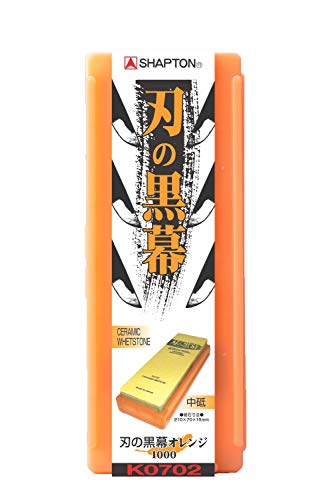
The K0702 is a dedicated medium stone for people who sharpen often and want the bevel-setting step done quickly. Shapton’s Kuromaku line is a hard ceramic format, and this orange #1000 is the working grit of that line: it forms edges and removes wear, then hands over to a finer stone or a strop for polishing. There is no second face and nothing else in the box per the listing, so it suits a bench that already owns a finisher. Choose it when your routine is frequent, short sessions and you would rather own one excellent medium stone than a combination block.
Specs
- Grit: #1000 (medium)
- Item number: K0702
- Stone size: 8.3 x 2.8 x 0.6 inches (210 x 70 mm) per the listing bullets
- Color: orange
- Brand: Shapton
- Weight: not stated reliably; the listing’s weight field conflicts with the stone’s size
- Included components: none listed
Best for: frequent sharpeners who want one hard, fast medium stone alongside a separate finisher.
Watch out for: the listing’s Product Dimensions describe the storage case rather than the stone, and its weight field is wrong for a full-size bench stone, so verify the K0702 item number at checkout.
ASIN: B001TPFT0G
King KDS 1000/6000 Combination Whetstone
The KDS is King’s harder step up within the same 1000/6000 format, sold under a listing title that pitches it at harder steels. That makes it the natural second King for woodworkers whose A2 or similar irons felt slow, or wore grooves, on the softer KW65. The grit span is identical, so the sharpening cycle you already know carries over unchanged. The difference is in the box: this listing is the stone alone, with no base, so it assumes you already own a holder or a pond. Buy it as a deliberate upgrade stone, not as a complete first kit.
Specs
- Grit: 1000 and 6000 combination
- Model: KDS
- Dimensions: 8 x 2 x 1 inches per the listing’s dimension field
- Item weight: 2 pounds
- Included: stone only, no base
- Soak requirement: not stated
Best for: woodworkers with harder tool steels who found the KW65 slow-cutting or fast-wearing.
Watch out for: King sells several look-alike 1000/6000 listings, including the base-mounted KW65 and bundled starter sets, so confirm the KDS name and the stone-only contents on the listing before ordering.
ASIN: B01BB1ZDVW
Which One Fits Your Situation
You Are Buying Your First Water Stone
Start with the KING KW65. It pairs the forming grit and the polishing grit in one block, includes its base, and asks nothing of you except a tub of water and a flattening routine. You will learn the full sharpening cycle on it, and if you later add specialty stones, it still serves as the bench’s general maintenance stone.
You Sharpen Little and Often
The Shapton K0702 fits a bench where sharpening happens in short gaps between cuts. A hard single-grit stone stays flat far longer between lappings and is ready when you are, with no soaking step to plan around. Pair it with a strop or one fine stone for polishing, and accept that heavy edge repair will be slow work at #1000 alone.
Your Irons Are Hard Modern Steels
Reach for the King KDS, with the Shapton as the bevel-setting alternative. Hard, wear-resistant steels punish soft stones: cutting slows and the face grooves. A harder combination block keeps its pace and its shape better across a set of A2 irons, while the K0702’s hard ceramic face handles the forming work before the KDS’s fine side polishes.
Your Edges Are Sound and Just Need Maintenance
Any of the three maintains a healthy edge, but the KW65 is the least fuss for pure upkeep, because its 6000 face refreshes a bevel in a few strokes after the 1000 side does a light pass. Be honest about condition, though: none of these stones is the right tool for grinding out a chip, which needs a coarser step first.
Common Mistakes
- Storing a water stone permanently soaking, which softens the bond and shortens the stone’s life.
- Trying to grind out a nick or rebuild a bevel on the 6000 face instead of starting coarse.
- Letting the stone dish unchecked, then blaming technique for rounded bevels and hollow backs.
- Pressing harder on the fine side, which digs the edge into a soft stone and rounds it.
- Buying a stone narrower than your widest plane iron and never learning to skew the stroke.
Frequently Asked Questions
Are Japanese water stones only for knives, or do they suit chisels and plane irons?
They suit bench tools well, and many woodworkers use nothing else. The flat faces, the grit range from forming to polishing, and the feedback through the slurry all transfer directly to bevels and flat backs. The one check that matters is width: pick a stone at least as wide as your widest iron, or learn to skew the stroke across a narrower face.
How long should a combination stone soak before sharpening?
Soak it until the stream of fine bubbles rising from the stone stops, which for most soaking stones takes somewhere between five and fifteen minutes depending on density. Keep the face wet while you work and top up the water as it dries. Splash-and-go stones skip this step entirely. Whichever type you own, store it dry between sessions rather than leaving it in the tub.
How often does a water stone need flattening?
Check it far more often than you flatten it. A pencil grid drawn across the face disappears unevenly when the stone has dished, and that test takes seconds. Soft soaking stones can dish within a handful of heavy sessions, while hard ceramics hold flat much longer. Flatten little and often with a lapping plate; rescuing a deeply dished stone wastes a lot of good abrasive.
Is one 1000/6000 combination stone enough for all bench tools?
For routine maintenance, yes: the 1000 face restores a working edge and the 6000 face refines it, which covers the cycle most chisels and plane irons live on. The gaps are at the extremes. A chipped edge or a re-ground bevel needs a coarser stone first, and the very finest mirror polish some woodworkers chase sits a step above 6000, usually finished on a strop.
Related guides
More from Amazon
Programs that pair well with the guide above. Offers and eligibility are set by Amazon and may change.
A free business account with business pricing and bulk-buying tools for work, shop or home office.
Create a business accountFree shipping on eligible items, Prime Video and more. Eligible new members can start with a free trial.
Start a Prime free trialAudiobooks and podcasts to listen to on the go. Eligible new members can start with a free trial.
Try Audible freeAd-free music streaming. Eligible new subscribers can start with a free trial.
Try Music Unlimited freeAs an Amazon Associate we earn from qualifying purchases.