As an Amazon Associate I earn from qualifying purchases. This post may contain affiliate links at no extra cost to you.
A cut-resistant glove guards the hand, but many bench slips land higher up, on the wrist and forearm of the arm that holds the work. The real decision here is how much of that arm to cover and at what rating: a long, high-rated knit for carving sessions, a Kevlar sleeve that also tolerates heat, or a light sized sleeve you will actually keep on all day.
This roundup is for carvers whose holding forearm works close to the edge, turners handling rough stock, and bench workers who sharpen, fit and carry sharp tools. Every pick below comes from the product names and specifications published on its Amazon page, and the five split into clear lanes: maximum cut rating, heat tolerance, bulk spares, and light everyday wear.
Quick Picks
As an Amazon Associate we earn from qualifying purchases.
Product
Best for
Key spec from title
Schwer ANSI A6 Cut Resistant Sleeves, 22 Inch
Long forearm coverage for carving and bench work
22 inch length, ANSI A6
Schwer PRO-SKIN ANSI A6 Cut Resistant Sleeves
Sleeves that slide down and need a strap
ANSI A6, detachable hook and loop straps
Mechanix Wear Kevlar Heat Sleeves
Cut cover that also shrugs off heat
All-Kevlar knit, ANSI A3
G & F 58123-6 Kevlar Cut Resistant Knit Sleeve
Stocking a shared shop with spares
Cut Level 3, 6-piece pack
Evridwear Cut Resistant Sleeves
A light, sized sleeve for long sessions
HPPE knit, sized fit
How to Choose
Read the ANSI cut level before anything else
Cut resistance is graded on the ANSI/ISEA 105 scale, which runs from A1 at the light end to A9 at the top, based on the load a blade needs to cut through the material. For woodworking, A3 is a sensible floor for general bench work, while A6 suits the higher-risk moments: carving toward the holding arm, parting off on the lathe, or handling freshly sharpened edges. Older listings sometimes print a plain Level 3 instead of A3, which comes from an earlier version of the standard, so compare like with like before ranking two sleeves by number alone.
Match the length to the gap your glove leaves
Sleeves in this roundup run 18 or 22 inches, and the right choice depends on where your glove cuff ends. An 18-inch sleeve covers the forearm of most adults, but a short glove cuff can still leave a band of bare wrist where slips often land. A 22-inch sleeve reaches further up the arm and overlaps more glove styles, which matters when you reach across a bench or brace stock against your forearm. Measure from wrist to above the elbow, then pick the shortest length that closes the gap, because extra bunched fabric near the elbow crease gets uncomfortable over a long session.
Pick a fiber for the work you actually do
Most modern sleeves are knitted from HPPE, sometimes blended with steel wire for higher ratings, and they feel cool, light and smooth against the skin. Kevlar and other aramid knits feel warmer and drier, tolerate heat that would damage polyethylene fibers, and suit shops where sleeves meet hot glue, steam bending or freshly sharpened tool steel warmed by grinding. The trade-off runs both ways: HPPE blends reach the highest cut ratings in this group, while the all-Kevlar picks top out lower but add heat and abrasion behavior the slick fibers do not claim. Match the fiber to your dominant hazard, not the headline number.
Check how the sleeve stays in place
A sleeve only protects the skin it stays on top of, and three closure styles appear in this group. A thumb hole anchors the wrist end and keeps the knit from rotating as your hand turns. Hook and loop straps at the top arm let you set tension for your arm size and, on one pick here, detach fully for washing. Plain elastic knits rely on a sized fit, which feels clean and low-profile but can creep down a tapered forearm during long reaches. If your arms sit between sizes, a strap or thumb hole usually beats sizing up and hoping friction does the work.
The 5 Best Options
Schwer ANSI A6 Cut Resistant Sleeves, 22 Inch
Top Pick
Schwer ANSI A6 Cut Resistant Sleeves, 22 Inch
Best for: carvers and turners who want the longest, highest-rated coverage in this group.
Cut level: ANSI A6, rated by the listing at over 3,000 grams of cutting load
Length: 22 inches
Material: HPPE, metal wire, polyester and spandex
Closure: thumb hole and adjustable hook and loop strap
This is the coverage-first pick for carvers and bench workers whose holding forearm stays close to the work. The 22-inch length reaches further up the arm than standard sleeves, closing the gap between a glove cuff and the elbow, and the ANSI A6 rating is the highest in this roundup. A thumb hole keeps the wrist end anchored while your hand rotates, and an adjustable hook and loop strap sets the fit at the top arm. The HPPE and steel wire knit is fiberglass free per the listing, which suits skin that reacts to glass-filled yarns during long sessions.
Schwer PRO-SKIN ANSI A6 Cut Resistant Sleeves
Runner-Up
Schwer PRO-SKIN ANSI A6 Cut Resistant Sleeves
Best for: workers whose sleeves keep sliding down a tapered forearm mid-task.
The PRO-SKIN is Schwer’s strap-first design, built for arms that plain elastic sleeves will not stay on. Its detachable hook and loop straps, in the listing’s 2.0 version, let you set the top-arm tension precisely and remove the straps entirely when the sleeves go in the wash. The 13-gauge HPPE knit carries the same ANSI A6 rating as the longer Schwer above, so you give up length rather than protection. At 18 inches in a grey knit, it suits bench work where sleeves ride down during overhead reaches, assembly, or repeated passes at the sharpening station.
Mechanix Wear Kevlar Heat Sleeves
Mechanix Wear Kevlar Heat Sleeves
Best for: woodworkers whose sleeve has to tolerate heat as well as stray edges.
Mechanix Wear builds this sleeve from Kevlar rather than HPPE, and that fiber choice defines its lane. The ANSI A3 cut rating sits below the A6 picks, but the same knit adds ANSI heat resistance and EN 407 certification, which matters around steam bending, hot glue work, and tool steel warmed at the grinder. The 18-inch, one-size pull-on has no straps or thumb hole, so it goes on fast and layers under a shop shirt. A Fibreshield treatment repels oils and fluids per the listing, and the knit is machine washable for shops where sleeves pick up finish and grime.
G & F 58123-6 Kevlar Cut Resistant Knit Sleeve
G & F 58123-6 Kevlar Cut Resistant Knit Sleeve
Best for: stocking a shared bench, a class, or several workstations with serviceable spares.
Cut level: Level 3
Length: 18 inches
Material: aramid fiber, described in the listing headline as Kevlar fiber by DuPont
stocking a shared bench, a class, or several workstations with serviceable spares.
Watch out for
the listing’s fabric-type field names an HPPE fiber while the headline and material field describe aramid Kevlar, so confirm the fiber on the pack when it arrives.
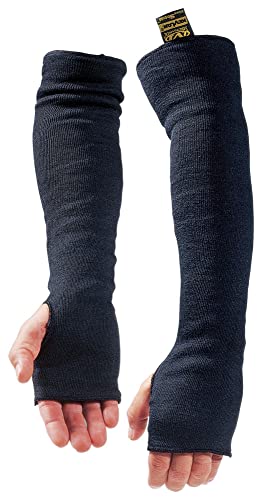
G & F sells this 18-inch aramid knit sleeve as a six-piece pack, which changes who it suits: teaching benches, shared shops, and anyone who wants a spare in the truck, the apron pocket and the sharpening drawer. Each sleeve carries a Cut Level 3 rating and a thumb slot that keeps the wrist end from rotating while you work. The yellow knit is the classic industrial Kevlar look, easy to spot across a crowded bench. Per-piece simplicity is the point here, so there are no straps or adjustments, just a medium-stretch knit that pulls on and goes.
Evridwear Cut Resistant Sleeves
Evridwear Cut Resistant Sleeves
Best for: long, low-bulk sessions where comfort decides whether protection gets worn at all.
Evridwear takes the opposite approach to the one-size picks: this HPPE sleeve is sold by size, and the Medium listing here weighs just 2.89 ounces, which makes it the lightest option in the roundup. The smooth, solid knit has no thumb hole on this variant and no straps, so it sits flat under a long-sleeve shirt and stays out of the way during detail carving and finishing work. It suits the woodworker who finds rated industrial sleeves bulky enough that they end up draped over the bench instead of worn, because a lighter sleeve that stays on protects more than a heavier one in a drawer.
Which One Fits Your Situation
You carve handheld work for hours at a time
Choose the 22-inch Schwer A6. Carving puts the holding forearm beside the blade path for entire sessions, and this pick pairs the highest rating here with the longest reach, so the wrist gap a short glove leaves is covered. Its thumb hole keeps the knit aligned through the constant small rotations of knife work.
Your sleeves creep down and bunch at the wrist
Choose the PRO-SKIN A6. Its detachable hook and loop straps set top-arm tension that a plain elastic cuff cannot match on a tapered forearm, and the straps come off for washing. You keep the same A6 rating as the longest pick here while trading four inches of length for a fit that stays where you put it.
Your bench work mixes sharp edges with heat
Choose the Mechanix Wear Kevlar sleeves. Steam bending, hot glue, and steel warmed by grinding all punish HPPE knits, while this all-Kevlar sleeve adds certified heat behavior to a mid-range A3 cut rating. It pulls on in seconds, tolerates machine washing, and shrugs off the oily grime that finishing areas produce.
You outfit a shared shop or teach at several benches
Choose the G & F six-piece pack for coverage everywhere, and add the Evridwear pair for the person who runs the detail bench. The G & F sleeves put a rated spare at every station for very little fuss, while Evridwear’s sized, lightweight knit suits the long, close work where bulk gets protection taken off.
Common Mistakes
Treating cut-resistant as cut-proof: every sleeve here resists slicing to a rated load, and none will stop a hard stab or a chisel driven with body weight.
Leaving a bare gap between glove cuff and sleeve: measure the overlap with your actual carving glove on, not against a product photo.
Buying by the headline number alone: a plain Level 3 from the older scale and a modern A3 are not cross-brand guarantees, and fiber and fit change real protection.
Wearing a loose sleeve near rotating tools: bunched or dangling knit can catch, so pick a closure and size that keep the sleeve flat to the arm.
Keeping a cut or frayed sleeve in service: once the knit is sliced, thinned or stretched out, its rating no longer describes the fabric on your arm.
Frequently Asked Questions
Do cut-resistant sleeves replace cut-resistant gloves?
No. A sleeve covers the wrist and forearm, while the fingers and palm of the holding hand stay exposed, and those digits take many carving slips. Pair a sleeve with a cut-resistant glove or a thumb guard on the holding hand. The sleeve closes the gap above the glove cuff, which is the zone gloves alone leave bare during long reaches.
Which ANSI cut level is enough for carving knives?
For controlled knife work, A3 is a reasonable floor, and A6 adds margin for slips that arrive with more force, such as a blade skating off end grain. The ANSI test drags a blade across the fabric under measured loads, so higher letters mean more load resisted. No level makes a sleeve cut-proof, and technique, sharp tools and a stable grip still matter more than the number.
How should cut-resistant sleeves be washed and stored?
Most sleeves in this roundup are machine washable per their listings, including the Kevlar and HPPE knits. Wash them like other shop textiles, let them dry fully before storing, and keep them flat rather than balled in a drawer. Inspect the knit before each use for slices, thinning or stretched cuffs, and retire any sleeve whose fibers are cut, because damage concentrates the next slip in the same weak spot.
Should you wear one sleeve or a pair?
Many carvers wear a single sleeve on the arm that holds the work, since that forearm sits in the blade path while the tool hand stays behind the edge. A pair makes sense when both arms cross sharp stock, as in carrying rough lumber, reaching into offcut bins, or roughing out blanks. Most picks here come as pairs or multi-packs, so the second works as a rotation spare.
J
JD's Woodworks Editorial Team
We compare specs, warranty terms, long-term owner feedback and street pricing before anything earns a spot. Rankings are never paid.
Affiliate disclosure. As an Amazon Associate we earn from qualifying purchases at no extra cost to you. Prices accurate as of the date shown.
Find the best tools for car wrapping, from felt squeegees and wrap knives to heat guns and complete kits, and choose the right set for a smooth finish.
Find the radiator hose clamps best for leak-free cooling: worm-gear, T-bolt and spring picks sized for upper and lower radiator hoses, plus a sizing guide.
Find the best brake caliper press tool for smooth, even piston compression. Compare ratcheting presses, dual-piston tools, and spreaders for your brake job.
Compare three Japanese water stones for chisels and plane irons, from a King combination stone to a splash-and-go Shapton, with grit and soaking guidance.
Compare three carving knife kits built around basswood blanks, with guided projects, stropping gear and safety extras, plus criteria for choosing well.
Compare four chip carving knives for lettering by edge shape, steel and handle, from a skewed BeaverCraft C6 to a Swiss Pfeil, for plaques, signs and lids.
The best spindle sanders for guitar making shape cutaways, waist curves, and neck heels cleanly. Compare five benchtop and portable picks by drum size.


 G & F 58123-6 Kevlar Cut Resistant Knit Sleeve
 Evridwear Cut Resistant Sleeves