Find the radiator hose clamps best for leak-free cooling: worm-gear, T-bolt and spring picks sized for upper and lower radiator hoses, plus a sizing guide.
Find the radiator hose clamps best for leak-free cooling: worm-gear, T-bolt and spring picks sized for upper and lower radiator hoses, plus a sizing guide.
As an Amazon Associate I earn from qualifying purchases. This post may contain affiliate links at no extra cost to you.
A radiator hose clamp has one job, and it is not a forgiving one. It must hold a hot, pressurised coolant hose tight on its neck through heat cycles, vibration, and years of coolant exposure, without cutting into the rubber or loosening when the hose shrinks as it cools. When the clamp is right, you forget it exists. When it is wrong, you get a slow weep at the hose end, a coolant smell under the bonnet, and a dropping reservoir level.
Searching for radiator hose clamps best is less about finding a single famous brand and more about matching clamp type, size range, and material to the hose in front of you. The quick answer is simple: measure the outside diameter of your hose where it sits on the fitting, choose a clamp whose stated range covers that measurement in the middle of its range, and choose 304 stainless steel throughout where you can.
Measure the outside diameter of the hose after it is pushed fully onto the radiator neck, thermostat housing, or water pump inlet. That is the diameter the clamp must close around. Do not measure the hose on the bench, and do not rely on the inside diameter printed on the hose alone, because wall thickness varies between rubber, silicone, and reinforced hoses. Choose a clamp whose range covers your measurement in the middle. If your hose measures 38 mm, a clamp rated 32-44 mm is a better fit than one rated 27-51 mm used near its lower end, or one rated 36-44 mm used at its limit. Write down both the upper and lower hose measurements before ordering, because they are often different sizes on the same vehicle.
2. Worm-Gear, T-Bolt, or Spring Clamps
Worm-gear clamps use a screw in a housing to drive a band tighter as you turn it with a screwdriver or nut driver. They adjust over a wide range, they are reusable, and they are easy to fit in tight engine bays. Their weakness is that they apply a fixed diameter. As a rubber hose expands when hot and shrinks when cold, a fixed worm-gear clamp can feel tight when warm and slightly loose when cold, which is one reason a weep sometimes appears on a cold morning and disappears once the engine warms up.
T-bolt clamps use a bolt and nut to pull a wider, heavier band tight. They spread force more evenly, suit larger hoses and higher pressures, and are a common choice for large radiator hoses, silicone hoses, and turbo hoses. They need a socket or spanner, and they are less forgiving if you choose the wrong size, because their adjustment range per clamp is narrower than a worm-gear clamp of similar size.
Spring clamps and constant-tension clamps are the third family. A spring band clamp squeezes the hose by spring force alone and expands and contracts with the hose as temperature changes. A constant-tension worm-gear clamp adds a spring under the screw head so it can take up slack as the hose changes size. Factory radiator hoses often use spring clamps for exactly this reason. They hold tension well through heat cycles, but they need the right pliers to open, and a spring clamp in the wrong size cannot be adjusted to fit.
3. Stainless Steel Grade and Corrosion Resistance
Coolant, road salt, condensation, and heat are a hard combination for metal. A clamp with a stainless band but a plated steel screw can look fine outside while the screw rusts in its housing. The next time you need to remove it, the screw seizes or the band snaps. Look for 304 stainless steel listed for the band, housing, and screw together, not just for the band. The products in this guide list 304 stainless steel as their material. Also check the band edges: a band with smooth or rolled edges is kinder to rubber than a band with sharp, burred edges.
4. Band Width and Clamping Force
Band width decides how clamping force is spread across the hose. A narrow band concentrates force on a thin ring and can cut into soft rubber, especially if overtightened. A wider band spreads the same force over more hose surface, which is one reason T-bolt clamps, with their wider bands, are favoured on larger hoses. Do not overtighten to compensate for a wrong size. A radiator hose clamp should be snug enough that the hose cannot be twisted on its fitting by hand, and the band should sit flat without buckling. If you have to force the screw to its limit to stop a leak, the problem is usually size, hose condition, or a damaged fitting neck, not a lack of force. An old hose that has gone hard, swollen, or cracked at the end will not seal reliably with any clamp.
5. Size Range and Kit Coverage
Assortment kits are attractive because they cover many sizes for one purchase, but coverage is only useful if the sizes you need are actually in the box in useful quantities. A 20-piece kit with five sizes gives you four clamps of each size. That is enough for a radiator hose job, which normally needs two clamps, plus a spare or two. Check the size breakdown before you buy, not just the headline range. A kit rated 6-51 mm sounds wide, but if most of its clamps are under 25 mm, only the largest size will suit a radiator hose. That is a partial fit, and this guide flags it where it applies. A kit rated 28-91 mm covers large radiator hoses well but will not help with a small heater hose. Match the kit to the job, and keep a note of which sizes you actually use.
6. Reuse, Vibration, and Fitting Access
Radiator hoses live with constant vibration. A T-bolt clamp with a nylon insert locknut is designed to resist loosening under vibration. A worm-gear clamp should be checked after the first heat cycle and again at the next service: with the engine cold, confirm the clamp is still snug and there is no coolant residue at the hose end. Reuse is possible with a good stainless worm-gear or T-bolt clamp if the band is straight, the screw turns smoothly, and the housing is undamaged. Do not reuse a clamp with a bent band, a stripped screw, a cracked housing, or rust that prevents smooth adjustment. Before you choose a clamp type, look at where it will sit. A lower hose clamp tucked behind a fan shroud may need a socket on an extension, while a worm-gear clamp with a hex-head screw may fit easily with a small nut driver. Spring clamps need their own pliers, and swivel-jaw or cable-operated pliers can reach a spring clamp in a tight spot that straight pliers cannot.
Best for small to medium radiator hoses, and for buyers who want a T-bolt clamp rather than a worm-gear clamp on a smaller hose. The PEROMI assortment is a 28-piece T-bolt kit in 304 stainless steel, covering 17-35 mm across six sizes. That makes it a T-bolt option for hoses at the smaller end of the radiator range, including many heater hoses, bypass hoses, and smaller radiator hoses on compact cars. The T-bolt design spreads clamping force through a wider band than a typical worm-gear clamp, and the listing describes the clamps as heavy duty and suitable for radiator hose use.
Who it suits: a home mechanic replacing a smaller radiator hose, a heater hose, or a bypass hose, and anyone who prefers the even pressure of a T-bolt clamp but does not need the very large sizes. Who should skip it: anyone whose upper or lower radiator hose measures more than 35 mm outside diameter. This is a partial-fit flag for the main radiator hoses on many larger cars and light trucks. If your hose measures 38 mm, 44 mm, or 51 mm, this kit will not fit it, and you need the larger T-bolt kit below instead.
Best for large upper and lower radiator hoses, and for silicone and turbo hoses that need a wide, even clamping band. The smseace kit is a 16-pack of T-bolt clamps in 304 stainless steel, covering 28-91 mm across eight sizes, for hose inside diameters from three quarters of an inch to three inches. The listed sizes run from 28-34 mm at the small end through 32-37 mm, 36-44 mm, 44-52 mm, and 50-57 mm, up to the largest sizes in the kit, so a single kit can cover the upper and lower radiator hoses on many cars, SUVs, and light trucks, as well as larger turbo intake and intercooler hoses.
The T-bolt construction suits this size range, giving a wider band and a more even pull around a large diameter. The eight-size spread means you are more likely to find a clamp whose range sits in the middle for your hose, rather than one at its limit.
Who it suits: buyers replacing a full-size upper or lower radiator hose, owners of larger vehicles, and anyone working with silicone radiator hoses. Who should skip it: anyone who only needs a small heater hose or bypass hose under 28 mm, as the smallest clamp here starts at 28 mm. Also skip it if you do not have a socket or spanner to tighten a T-bolt nut where the clamp will sit.
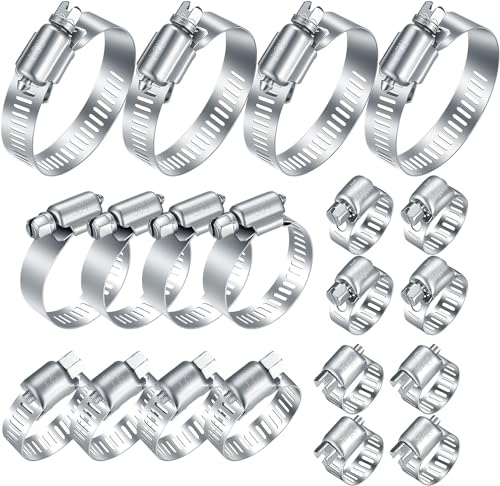
Best assortment for mixed hose work and spares, where radiator hoses are one job among several. The MUZHUPGUZ kit is a 20-piece worm-gear assortment in 304 stainless steel, adjustable from 6 to 51 mm across five sizes, with four clamps of each size. The sizes are 6-12 mm, 13-19 mm, 16-25 mm, 21-38 mm, and 27-51 mm. The worm-gear design tightens with a screwdriver, and the kit includes a storage box for carrying the clamps and keeping sizes separated.
This is a general-purpose kit that includes radiator hose sizes, rather than a radiator-only kit. It is useful if you want one box that covers fuel lines, plumbing, garden hoses, washing machine hoses, and automotive hoses, and you want spare radiator clamps on hand without buying a dedicated radiator kit.
Who it suits: a home workshop that does mixed hose and pipe work, a buyer who wants spares in several sizes, and anyone replacing a radiator hose in the 27-51 mm range who also wants smaller clamps for other jobs. Who should skip it, or treat it as a partial fit: anyone who needs only radiator hose clamps. This is a partial-fit flag. Only the largest size, 27-51 mm, suits a typical upper or lower radiator hose. The other four sizes are too small for a main radiator hose, although the 21-38 mm size may suit a smaller radiator or heater hose. Check that you have the 27-51 mm clamps in hand before you drain the coolant.
Start with the two measurements that decide everything: the outside diameter of the upper radiator hose where it sits on its fitting, and the same measurement for the lower hose. Compare them with the size breakdown of the kit you are considering, size by size, not just the headline range. A kit that covers your measurement in the middle of one of its sizes is a fit. A kit that only touches your measurement at the edge of its largest size is a risk.
Next, check the material for the whole clamp. Look for 304 stainless steel for the band, housing, and screw, and a smooth band edge. Then check the clamp type against the hose and the access. A T-bolt clamp suits a large hose and gives even pressure, but it needs a socket and a narrower size match. A worm-gear clamp suits a wider range of sizes and is easier to fit with a screwdriver, but it should be checked after the first heat cycle. Check the quantity per size, too: a radiator hose job needs two clamps, one at each end, plus a spare of the same size if possible.
Check the hose itself before you order. If the hose is hard, cracked, swollen, or soft at the ends, replace the hose as well. If the fitting neck is pitted or bent, clean it before fitting a new hose and clamp. Finally, plan the coolant work: drain and catch the coolant, refill with the correct coolant, and bleed air from the system. After refilling, check both hose ends hot and cold, and recheck the coolant level after the first drive.
FAQ
What size radiator hose clamp do I need?
Measure the outside diameter of the hose after it is pushed fully onto the fitting, at the point where the clamp will sit. Choose a clamp whose stated range covers that measurement in the middle of its range. For example, a hose measuring 38 mm suits a clamp rated around 32-44 mm better than one rated 27-51 mm used near its lower end. Measure both the upper and lower hoses, because they are often different sizes.
Are worm-gear clamps good for radiator hoses?
Yes, worm-gear clamps are widely used on radiator hoses, and they are easy to fit, adjust, and reuse when correctly sized and made from 304 stainless steel throughout. Their limit is that they hold a fixed diameter, so a rubber hose that expands when hot and shrinks when cold can feel slightly looser when cold. Check the clamp after the first heat cycle. For a hose that has wept before, a constant-tension clamp may be a better choice.
Are T-bolt clamps better than worm-gear clamps for radiator hoses?
T-bolt clamps are often a better choice on larger radiator hoses, because their wider band spreads force more evenly and their bolt and nut give firm clamping on a large diameter. Worm-gear clamps are often a better choice where access is tight, where a screwdriver is easier than a socket, or where the hose size falls between T-bolt sizes. The better clamp is the one that fits your hose size, your hose material, and the space you have to work in.
Should I use a spring clamp or a worm-gear clamp on a radiator hose?
Factory radiator hoses often use spring clamps because the spring maintains tension as the hose expands and contracts with temperature. That is a real advantage. A worm-gear clamp can also work well if correctly sized and checked after fitting. If you keep the factory spring clamp, you need the correct hose clamp pliers to open and fit it. If you replace it with a worm-gear or T-bolt clamp, choose the size carefully, because you lose the spring’s ability to take up slack.
Can I reuse an old radiator hose clamp?
You can reuse a stainless worm-gear or T-bolt clamp if the band is straight, the screw or nut turns smoothly, the housing is undamaged, and there is no rust that prevents adjustment. Do not reuse a clamp with a bent band, a stripped screw, a cracked housing, or a spring that has lost its tension. If you are already replacing the hose and draining the coolant, fitting a new clamp removes a known weak point.
Bottom Line
The radiator hose clamps best for your vehicle are the ones that fit your hose in the middle of their range, hold tension through heat cycles, and resist corrosion in a cooling system. For large upper and lower radiator hoses, the smseace 16-pack T-bolt kit, covering 28-91 mm in eight sizes, is the most direct fit in this guide. For small to medium radiator hoses and heater hoses, the PEROMI 28-piece T-bolt assortment, covering 17-35 mm, gives T-bolt clamping in a smaller range, but it will not fit a main radiator hose over 35 mm. For a mixed workshop drawer, the MUZHUPGUZ 20-piece worm-gear assortment, covering 6-51 mm, is a useful spares kit, but only its largest 27-51 mm size suits a typical radiator hose. Measure first, choose 304 stainless steel throughout, and check the joint hot and cold after fitting.
Disclosure: As an Amazon Associate, we may earn from qualifying purchases.
J
JD's Woodworks Editorial Team
We compare specs, warranty terms, long-term owner feedback and street pricing before anything earns a spot. Rankings are never paid.
Affiliate disclosure. As an Amazon Associate we earn from qualifying purchases at no extra cost to you. Prices accurate as of the date shown.
Find the best tools for car wrapping, from felt squeegees and wrap knives to heat guns and complete kits, and choose the right set for a smooth finish.
Find the best brake caliper press tool for smooth, even piston compression. Compare ratcheting presses, dual-piston tools, and spreaders for your brake job.
Compare three Japanese water stones for chisels and plane irons, from a King combination stone to a splash-and-go Shapton, with grit and soaking guidance.
Compare three carving knife kits built around basswood blanks, with guided projects, stropping gear and safety extras, plus criteria for choosing well.
Compare four chip carving knives for lettering by edge shape, steel and handle, from a skewed BeaverCraft C6 to a Swiss Pfeil, for plaques, signs and lids.
The best spindle sanders for guitar making shape cutaways, waist curves, and neck heels cleanly. Compare five benchtop and portable picks by drum size.