As an Amazon Associate I earn from qualifying purchases. This post may contain affiliate links at no extra cost to you.
A hand held welder asks you to make a different decision from a normal stick welder. Instead of choosing a power source and then a separate electrode holder, the machine, the control and the holder are one gun-style unit that you lift to the work. That makes the real questions practical ones: how much current the unit can actually deliver on a household circuit, which rod sizes it accepts, and whether its weight and cable arrangement suit the repairs you do away from a welding table.
OUR TOP PICK
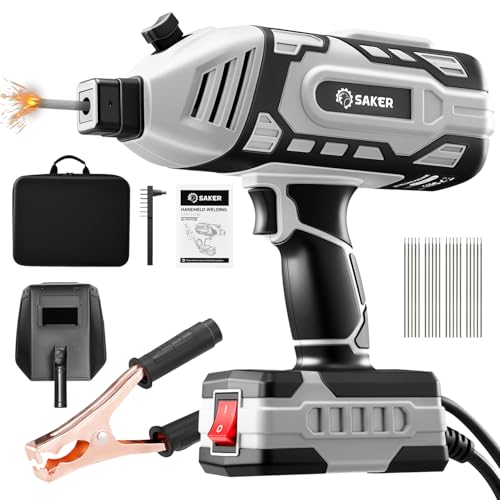
Saker Portable Electric Welding Machine, 110V Handheld Welder
This guide is for homeowners fixing gates and brackets, farmers and maintenance users making field repairs, and hobby welders who want stick welding without a full-size machine taking up bench space. Every pick below is a 110V gun-style or super-mini stick welder chosen from the details on its Amazon product page, and the guide is frank about the class limits: these are light repair tools, not replacements for a shop welder on thick steel.
Quick Picks
As an Amazon Associate we earn from qualifying purchases.
Product
Best for
Key spec from title
Saker Portable Electric Welding Machine, 110V Handheld
Simple repairs with stepped current settings
110V, IGBT inverter, fits 3/32″ rods
JZU Upgrade MMA 250A Handheld Welding Machine
Buyers who want a display and wide adjustment dial
110V, MMA, listed 250A class
GNI 250A Handheld Welding Machine, 110V
Field repairs with anti-stick and arc force control
110V, 20-250A listed range, LCD display
COPDUZI 180A Handheld ARC Welding Machine
A mid-output handheld unit for small repairs
110V, 180A class
Hpoouo 200Amp Super MINI Stick Welder, 110V
A starter kit with rods and hand tools included
110V, for 1/16″-1/8″ rods, 20 rods included
How to Choose
Treat the headline amperage as a class label, not a promise
Handheld welders are sold with large numbers in their titles, but a unit plugged into a household 110V circuit is limited by what that circuit can feed it. Read the title figure as the machine’s class and adjustment range, then look for the working details that matter: the rod sizes listed, the material thickness the seller states, and the duty the machine is presented for. A welder listed for thin material and small rods will do honest repair work inside that envelope and struggle outside it. Matching the machine to gates, brackets, furniture frames and light fabrication is the right expectation; thick plate and long production runs are not what this format is built for.
Check rod size support before anything else
The rod is the working end of a stick welder, and handheld units accept a narrower range than full-size machines. Listings in this group state support for 3/32 inch rods, or a span from 1/16 inch to 1/8 inch, and that range decides which jobs the welder can run properly. A 3/32 inch rod suits most light repairs and runs at current a 110V unit can supply. If a listing does not state a rod size, treat that as a question to answer on the product page before ordering, because a welder that cannot run the rods in your cabinet is the wrong welder however compact it is.
Weigh the unit and look at what the kit includes
You hold this machine in one hand at the joint, so weight is a working specification, not a comfort detail. The lightest units in this class are listed at only a few pounds, while a heavier gun tires your wrist on overhead or vertical repairs and makes a steady arc harder to keep. Kit contents also change the real comparison. Some listings include rods, gloves, a chip hammer or a case, while others supply the machine alone. Add up what you still need to buy, including proper eye and hand protection, before deciding which listing is actually complete.
Cover the safety basics every time you strike an arc
A handheld format does not reduce the hazards of arc welding, it just moves them closer to your hand. Wear a proper welding helmet or mask with the correct shade, welding gloves, and long sleeves, and keep skin covered against arc radiation. Work with ventilation that moves fumes away from your face, keep the area clear of flammable material, and let hot work cool before handling it. Check the ground clamp connection on every setup, never weld on a closed container, and stop if a cable, holder or plug is damaged. None of that is optional because the machine is small.
The 5 Best Options
Saker Portable Electric Welding Machine, 110V Handheld Welder
Top Pick
Saker Portable Electric Welding Machine, 110V Handheld Welder
Best for: Occasional home repairs with simple stepped current control.
The Saker is the straightforward option in this group: a gun-style ARC welder with an IGBT inverter and five variable current adjustments rather than a continuous dial, which keeps setup simple for occasional repairs. The title states it fits 3/32 inch wire rods, the size most light repair work uses, and the product information lists the machine at 6.82 pounds with model number GJ76085-X56135. For a homeowner who welds a few times a month on gates, brackets and furniture, stepped settings and a single stated rod size are easier to live with than a wide, vague adjustment range.
JZU Upgrade MMA 250A Handheld Welding Machine
Runner-Up
JZU Upgrade MMA 250A Handheld Welding Machine
Best for: DIY repairs and light maintenance where an on-unit display and dial matter.
The JZU presents the handheld format at its most fully featured, with the electrode holder, current control and display built into a compact pistol-style body. Its listing describes a 110V IGBT inverter welder aimed at home DIY, hardware repair, sheet-metal work, machinery maintenance and light automotive tasks, which is a fair map of what this class does well. The 250A figure is the machine’s listed class, so judge it by the thin and light work the seller describes rather than by the number alone. Buyers who want a readout and a dial on the unit itself, instead of stepped settings, are the audience for this one.
GNI 250A Handheld Welding Machine, 110V
GNI 250A Handheld Welding Machine, 110V
Best for: Field and farm repairs where anti-stick control helps occasional welders.
This GNI unit adds the control features that make small stick welders easier to live with: an LCD current display, IGBT inverter design, and arc-force and anti-stick functions that help the rod keep burning instead of freezing to the work. The seller states a 20 to 250 amp adjustment range on 110V input, and again that range is best read as the dial’s span rather than a guarantee at the top end on a household circuit. For repair work on brackets, frames and farm hardware, the anti-stick behaviour matters more in practice, because beginners and occasional welders stick rods most often on exactly those jobs.
COPDUZI 180A Handheld ARC Welding Machine
The COPDUZI sits in the middle of this class at a listed 180A, in a compact gun-style body instead of a box-style frame. Its listing positions it for small repairs, DIY metalwork and field use, which matches the honest envelope of a 110V handheld stick welder: hinges, brackets, frames, patch repairs and light fabrication rather than structural work. A mid-class unit like this suits buyers who find the smallest mini welders too limited but do not want to pay for features they will not use. Check the listing for its stated rod sizes and kit contents before ordering, as those details decide its day-to-day usefulness.
Specs
Brand: COPDUZI
Product type: Handheld ARC welding machine
Listed class: 180A
Input voltage: 110V
Form: Compact gun-style body
Best for: Small repairs and DIY metalwork in a mid-output handheld unit.
Watch out for: Verify rod size support and what is in the box on the product page, because the headline figure alone does not describe either.
ASIN: B0DX6RV1G1
Hpoouo 200Amp Super MINI Stick Welder, 110V
Hpoouo 200Amp Super MINI Stick Welder, 110V
Best for: First-time buyers who want rods and basic hand tools included.
The Hpoouo is the kit option: the listing, model ARC-200, includes the welder with 20 welding rods, two chip hammers and gloves, so a first-time buyer can start with the consumables in the box. It is a 110V IGBT inverter machine with hot start, arc force and anti-stick functions, and it is listed for rods from 1/16 inch to 1/8 inch, the widest stated rod span in this group. The seller states an output range in the 200 amp class. Supplied gloves in kits like this are a starting point, not a substitute for a proper helmet and full protective clothing, which you still need to arrange.
Which One Fits Your Situation
You fix things around the house a few times a month
The Saker fits this pattern best. Its five stepped current settings remove the guesswork from setup, the stated 3/32 inch rod size covers typical gate, bracket and furniture repairs, and the machine is light enough to carry to the job. Pair it with a proper helmet and gloves and it covers the honest workload of a household repair kit without a full-size welder occupying the garage.
You weld outdoors or away from the bench
Look at the GNI or the JZU. Both put the control and display on the unit, which helps when the work is a fence line or a machine in a yard rather than a bench in front of you. The GNI’s anti-stick and arc-force controls are the practical advantage on rusty, awkward field joints, while the JZU’s listed uses include machinery maintenance and light automotive tasks.
You are buying your first welder
The Hpoouo kit gives you the most complete start, with rods and a chip hammer in the box and hot start to make first arcs easier. Budget separately for a real welding helmet and protective clothing, because no kit in this group replaces those. If you would rather keep the machine itself as simple as possible while you learn, the Saker’s stepped settings are the calmer alternative.
Your repairs are mostly thin sheet and light frames
Any unit here can work, so choose on rod support and weight rather than headline amperage. Thin material needs low, controllable current and a small rod, and a lighter gun is easier to keep steady on sheet work. The COPDUZI’s mid-class output and compact body suit this pattern, and the Saker’s stepped settings make repeatable low settings easy to return to.
Common Mistakes
Believing the headline amperage is available continuously on a household 110V circuit.
Ordering before checking which rod sizes the specific listing actually supports.
Welding with the gloves from a kit but no helmet, shade or covered skin.
Using a handheld welder on thick structural steel it was never sized for.
Running long, light extension cords that starve the machine and overheat the cord.
Frequently Asked Questions
What can a hand held welder actually weld?
These machines are built for light stick welding: gates, brackets, hinges, furniture frames, sheet metal and general repair work on thin to light material. The listings describe home DIY, hardware repair and maintenance uses. They are not sized for thick plate, long production runs or structural work, and a conventional shop welder remains the right tool for those jobs.
Which rods do hand held welders use?
Most listings in this class state 3/32 inch rods, and some span 1/16 inch to 1/8 inch. The rod size matters because it sets the current the machine must deliver. Always match the rod to the range printed in the specific product listing, and keep a pack of 3/32 inch E6013 or E6011 rods as the general-purpose supply for a 110V unit.
Is a hand held welder safe for beginners?
The welding process carries the same hazards whatever the machine’s size: arc radiation, sparks, hot metal and fumes. A beginner can use one sensibly with a proper helmet, welding gloves, covered skin, ventilation and a clear work area. The anti-stick and hot start features on several models here make first arcs easier, but they do not replace protective equipment or basic instruction.
Can a hand held welder replace a regular stick welder?
For light repairs, it can take over the jobs a shop welder would be dragged out for, and it stores in a fraction of the space. It does not replace a full-size machine for thick material, long welds or high duty cycle work. Many owners keep a handheld unit for quick and remote fixes and still rely on a bench machine for fabrication.
J
JD's Woodworks Editorial Team
We compare specs, warranty terms, long-term owner feedback and street pricing before anything earns a spot. Rankings are never paid.
Affiliate disclosure. As an Amazon Associate we earn from qualifying purchases at no extra cost to you. Prices accurate as of the date shown.
Four hobby TIG welders compared for home shops: AC/DC picks for aluminum, a compact DC model for steel, listed specs, included gear and honest tradeoffs.
The best Creality Falcon engravers compared: Falcon A1 10W, CR-Laser Falcon 10W, Falcon2 Pro 22W and Falcon2 Pro S 40W, by power, work area and enclosure.
The best CNC machines for manufacturing compared: large-bed routers and closed-loop desktop mills with the work area, spindle and control for batch work.



 Hpoouo 200Amp Super MINI Stick Welder, 110V









