As an Amazon Associate I earn from qualifying purchases. This post may contain affiliate links at no extra cost to you.
A jointer machine does one job that no other shop tool does in quite the same way: it makes one face of a board truly flat and one edge truly straight and square to that face. That flat reference face is the starting point for accurate thicknessing, tight glue joints, and furniture parts that sit together without gaps or rocking. Without it, warped, cupped, or twisted lumber stays difficult no matter how carefully it is sawn or planed afterward.
This guide covers benchtop jointer machines for home and small professional shops, in both 6-inch and 8-inch widths and with both straight-knife and spiral or helical cutterheads. Each pick below is a dedicated jointer, listed with specifications taken from its product listing, so widths, table sizes, motors, and cutterhead details can be compared directly. Floor-standing jointers follow the same principles on a larger scale, and the buying guidance applies to them as well.
As an Amazon Associate, we earn from qualifying purchases.
How to Choose a Jointer Machine
Start with jointing width, because width is a hard limit. A 6-inch jointer can flatten boards up to 6 inches wide, which covers most furniture parts, face frames, drawer sides, and door stiles. An 8-inch model handles wider single boards, which matters for tabletop glue-ups, cabinet doors, and rough lumber bought in broader widths. If a board is wider than the cutterhead, it cannot be face jointed in one pass, so choose width based on the widest stock in regular use rather than on a rare exception.
Table length is the second major factor. Longer infeed and outfeed tables support a board before and after the cut, which helps keep the pass straight and reduces dips at the ends of the board. Benchtop tables are shorter than floor model beds, so some benchtop machines add pull-out or fold-out extensions that lengthen the support span for longer stock. For mostly short to medium parts, a standard benchtop table is workable. For long boards, extensions or a longer bed make control noticeably easier.
Cutterhead type shapes finish quality and maintenance. A straight-knife head uses two or three long knives. It is simple and proven, but the knives need careful alignment when changed, and a nick in one knife leaves a line along the board. A spiral or helical head uses many small inserts arranged around the head. On the models below those inserts are either high-speed steel blades or four-sided carbide tips. Four-sided inserts can be rotated to a fresh edge when one edge dulls or chips, which avoids a full knife change. Spiral and helical heads also tend to run more quietly and leave a smoother surface on figured grain, because each insert takes a small shearing cut.
Motor power and speed should match the width and depth of cut. The benchtop models in this guide use 10-amp motors, and cutterhead speeds range from about 10,000 to 12,000 revolutions per minute on spiral models and 6,000 to 11,000 revolutions per minute on the variable-speed straight-knife models. Variable speed is useful because slower settings suit wider or harder stock, while faster settings suit narrow softwood edges. For light passes of around one thirty-second of an inch, any of these motors is adequate. Deeper passes in wide hardwood are where stronger motors earn their place.
Check the fence next. The fence guides edge jointing and must lock square and stay put. A center-mounted fence can offer solid support, while a tilting fence allows bevelled edges, commonly up to 45 degrees or across a 90 to 135 degree range depending on the model. Positive stops at 90 degrees speed up the return to square after a bevel cut. Also confirm the maximum depth of cut, which is one eighth of an inch on the benchtop models below, and look for a clear depth scale at the infeed table.
Finally, consider dust collection and placement. Jointers produce long shavings rather than fine dust, and a 2-1/2-inch or 4-inch port that fits the shop hose keeps the cutterhead area clear. Weight matters on a benchtop machine: lighter models around 35 pounds can be lifted away for storage, while cast iron models near 55 to 65 pounds are better left mounted on a sturdy bench or stand. Measure the bench space, confirm the electrical supply is a standard household circuit for these benchtop models, and plan push blocks as part of safe face jointing from the first use.
The WEN JT833H is the widest benchtop pick in this guide, with an 8-inch cutting width that face joints boards too wide for a standard 6-inch machine. Its spiral cutterhead carries 16 staggered high-speed steel blades, so the cut is spread across many small edges rather than taken in one full-width bite. That arrangement is a sensible match for mixed hardwoods and for stock where a smoother surface straight off the jointer reduces later sanding.
Support is the other strength. The base table measures 33 by 8 inches, and pull-out support arms extend the span to 51 inches, which helps when jointing longer boards on a bench that would otherwise leave the ends unsupported. The fence measures 19-3/4 by 4-1/4 inches and bevels up to 45 degrees, and the listing includes two push blocks plus both 2-1/2-inch and 4-inch dust ports, so the machine connects to either a shop vacuum hose or a larger collector hose without an extra adapter search.
Who It Suits
This model suits woodworkers who regularly joint boards between 6 and 8 inches wide and want spiral cutterhead finish quality without giving floor space to a stationary machine. It is also a good fit for shops that joint longer stock, thanks to the extendable support. Buyers who mostly joint narrow parts may find the smaller 6-inch models below easier to store and move.
The Wahuda 8-inch benchtop jointer pairs the same useful 8-inch width with cast iron tables, which set it apart from benchtop models built around lighter table materials. Cast iron adds mass that damps vibration and provides a flat, durable reference surface. The spiral cutterhead uses four-sided carbide insert tips, and each insert can be loosened and rotated to a fresh cutting edge when one edge dulls, which simplifies upkeep compared with changing and aligning long knives.
Like the WEN above, the Wahuda addresses the short-table limitation of benchtop jointers with pull-out extensions. Its table length is listed at 34 inches and extends to 51 inches, giving longer boards support at both ends of the pass. The aluminum fence tilts across a 90 to 135 degree range for bevel work, the motor is rated at 10 amps, and the cutterhead speed is listed at 12,000 RPM. At 49.9 pounds in the Amazon listing, it remains movable, though its cast iron construction makes it better suited to a dedicated bench position than to daily lifting.
Who It Suits
This jointer suits buyers who want 8-inch capacity and prefer carbide inserts that rotate rather than high-speed steel blades that are replaced as a set. It fits small shops jointing wider cabinet and tabletop parts where cast iron tables and extendable support are worth more than the lightest possible weight. Anyone who needs a floor model bed length for very long lumber should still look at stationary jointers instead.
The CRAFTSMAN CMEW020 is a 6-inch benchtop jointer built around variable speed and a two-knife cutterhead. Its speed range runs from 6,000 to 11,000 RPM, and the cutterhead delivers up to 22,000 cuts per minute. That adjustability lets the operator slow the head for wider or harder stock and raise it for narrow edges, which is a practical feature in a shop that works with a mix of pine, oak, and other common furniture woods.
The listing describes a center-mounted fence, a cutterhead lock, and jackscrew knife leveling, details that matter when knives are changed and the head needs to be set accurately again. The 10-amp motor matches the other benchtop models in this guide, and the machine covers the core jointing tasks of flattening a face, straightening an edge, and squaring that edge to the face. As a 6-inch model, it will not face joint a wide single board, so its role is the high-volume work of dimensioning standard furniture parts.
Who It Suits
This model suits woodworkers whose stock is mostly 6 inches wide or narrower and who value variable speed control in a straightforward straight-knife machine. It is a logical choice for furniture parts, frames, and cabinet work in a compact shop. Buyers who frequently buy wide rough boards should choose one of the 8-inch models above instead of planning workarounds.
The PORTER-CABLE PC160JT is the lightest jointer in this guide at 35 pounds, which makes it the easiest to move between a bench and storage in a garage shop where the bench is shared with other work. It is a 6-inch variable-speed machine with the same 6,000 to 11,000 RPM range as the CRAFTSMAN, and its two-knife cutterhead produces 12,000 to 22,000 cuts per minute depending on the speed setting.
The product listing notes a jackscrew knife leveling arrangement and a built-in cutterhead lock, both aimed at making knife replacement and adjustment more controlled. The cast iron base material listed for the machine adds stability for its size, and the extra-long table and center-mounted fence described by the manufacturer are intended to support accurate cuts on typical furniture stock. Its dimensions of 32.1 by 12.4 by 11.2 inches keep the footprint modest, which is the main reason to choose it over the wider and heavier models.
Who It Suits
This jointer suits woodworkers in small or shared spaces who need a portable 6-inch machine for edging, flattening, and face jointing standard boards, and who expect to put the tool away between sessions. It also suits a first dedicated jointer purchase where variable speed and simple two-knife maintenance are priorities. Shops jointing wide or very long stock will outgrow its width and table sooner than the 8-inch picks.
FAQ
What size jointer machine do most home shops need?
A 6-inch jointer covers most furniture parts, including drawer sides, face frames, legs, and door components, and it fits the benchtop format that small shops can store. An 8-inch model is the better choice when wide single boards are jointed often, such as for tabletops and cabinet doors. Buying wider than the stock in regular use adds weight and bench space without adding useful capacity, so match the width to the lumber actually bought.
What is the difference between a spiral cutterhead and straight knives?
Straight knives are two or three long blades that take a full-width cut and need careful alignment when replaced. A spiral or helical head uses many small inserts or staggered blades, each taking a small shearing cut. That usually means a smoother surface on figured grain, quieter running, and simpler upkeep when the inserts are four-sided carbide that can be rotated to a fresh edge. Straight-knife models in this guide counter with variable speed and lower mechanical complexity.
Can a jointer replace a thickness planer?
No. A jointer makes one face flat and one edge straight and square, but it does not make the opposite face parallel or bring a board to a uniform thickness. The normal sequence is to joint one face, joint one edge against the fence, then use a thickness planer with the jointed face down to make the second face parallel, and rip the final width on a table saw. Each machine covers a step the others do not.
How deep a cut should each jointer pass take?
Light passes are the standard approach. The benchtop models in this guide list a maximum depth of cut of one eighth of an inch where a maximum is stated, and the WEN manual lists a recommended cutting depth of one thirty-second of an inch. Shallow passes give better control, a cleaner surface, and less load on the motor, especially on wide faces. Reserve deeper settings for removing a high spot on rough stock, and return to light passes for the final surface.
Final Verdict
For most small shops that want one benchtop jointer machine with room to grow, the WEN JT833H stands out for its 8-inch spiral cutterhead, extendable 51-inch support span, and dual dust ports. Buyers who prefer cast iron tables and rotating carbide inserts at the same width should choose the Wahuda 8-inch model. Where stock is consistently 6 inches or narrower, the CRAFTSMAN CMEW020 offers variable speed and a center-mounted fence, while the PORTER-CABLE PC160JT is the portable pick at 35 pounds for shops that must store the machine between projects. In every case, width, table support, and cutterhead type matter more than any single headline number, so choose against the boards and bench space in the shop today.
Four hobby TIG welders compared for home shops: AC/DC picks for aluminum, a compact DC model for steel, listed specs, included gear and honest tradeoffs.
The best Creality Falcon engravers compared: Falcon A1 10W, CR-Laser Falcon 10W, Falcon2 Pro 22W and Falcon2 Pro S 40W, by power, work area and enclosure.
The best CNC machines for manufacturing compared: large-bed routers and closed-loop desktop mills with the work area, spindle and control for batch work.

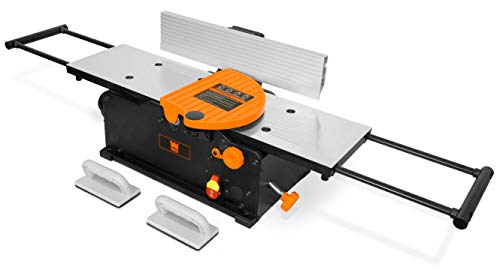 1. WEN JT833H 10-Amp 8-Inch Spiral Benchtop Jointer
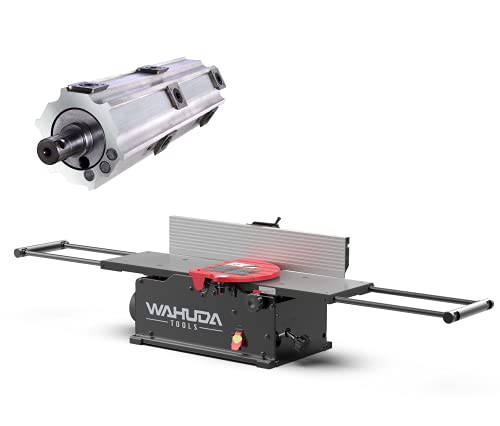 2. Wahuda Tools 8-Inch Benchtop Jointer (50180CC-WHD)
 3. CRAFTSMAN CMEW020 10-Amp Benchtop Jointer
 4. PORTER-CABLE PC160JT Variable Speed 6-Inch Benchtop Jointer









