4 Best Jointers for Flattening Boards (November 2026)
Four jointers compared for flattening boards: spiral and knife benchtop models from WEN, PORTER-CABLE and CRAFTSMAN, plus the JET long-bed floor jointer.
As an Amazon Associate I earn from qualifying purchases. This post may contain affiliate links at no extra cost to you.
The real decision behind a jointer purchase is not how fast the cutterhead spins. It is whether the machine can take a bowed, twisted board and give you one truly flat face and one square edge, because every glue-up, tabletop and door frame you build afterward inherits whatever the jointer leaves behind. Buy too small and long boards rock on the tables; buy the wrong cutterhead and figured grain tears out on every pass.
This roundup serves three kinds of buyers: garage woodworkers flattening boards on a bench, growing shops ready for a floor-standing machine, and anyone replacing a worn jointer who already knows their board widths. Every model below is a jointer and nothing else, and each one was chosen from the names, dimensions and cutterhead details printed on its Amazon product page, so the figures quoted here match the listing you will land on.
Quick Picks
As an Amazon Associate we earn from qualifying purchases.
Capacity is two numbers, not one. Cutting width decides the widest face you can flatten in a single pass, and six inches covers most furniture stock, from drawer sides to table aprons. Bed length is the quieter limit: the infeed and outfeed tables must support the board before and after the cutterhead, so a 30-inch benchtop bed handles short parts easily but lets a six-foot rail tip and dive. If your projects lean toward doors, bed frames and long tabletops, weight your choice toward the longest bed your shop can hold.
Choose a Cutterhead You Can Keep Sharp
Spiral heads carry rows of small square inserts. Nick one on a hidden staple and you rotate or swap that single insert instead of pulling the whole knife set, and the staggered shearing cut leaves less tear-out in figured maple or cherry. Straight knives cost less to replace as a set and resharpen on simple jigs, but each change demands careful height setting unless the machine offers jackscrew leveling. Decide honestly how often you will do this maintenance, because a dull head of either style turns flattening into sanding practice.
Match Motor and Speed Control to Your Stock
Benchtop jointers run universal motors, commonly 10 amps, that spin fast and loud but handle typical furniture stock without complaint. Floor machines switch to an induction motor, often 1 HP wired for 115 or 230 volts, that holds speed under a heavy cut and runs for decades. Variable speed, where offered, lets you slow the head for wide or tear-prone boards and raise it for narrow softwood edges. Whatever the motor, plan on shallow passes: most of these machines remove at most 1/8 inch per pass, and lighter cuts leave the better surface.
Check the Fence, Tables and Dust Connection
The fence is your square reference for every edge, so look for one that locks without drifting and tilts with positive stops at 90 and 45 degrees; a center-mounted design supports the board through the full cut. Tables should be flat and long enough for your stock, whether cast iron on a floor machine or coated aluminum on a bench model. Finally, match the dust port to your collector: benchtop machines usually carry a 2-1/2-inch port, floor machines a 4-inch port, and an adapter is a small extra worth ordering with the machine.
The 4 Best Options
WEN JT630H 10-Amp 6-Inch Spiral Benchtop Jointer
Top Pick
WEN JT630H 10-Amp 6-Inch Spiral Benchtop Jointer
Best for: Small and garage shops that joint boards up to 6 inches wide and want a spiral head.
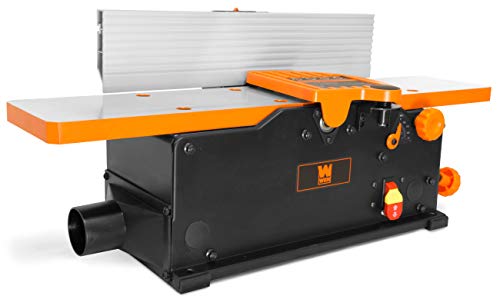
The WEN JT630H is the benchtop pick for woodworkers whose boards arrive rough and whose bench space is limited. Its spiral cutterhead carries 12 staggered HSS blades that shear rather than chop, which leaves a cleaner surface on figured stock and runs noticeably quieter than a two-knife head. The 30-by-6-inch table handles typical furniture parts, the fence bevels to 45 degrees for chamfers, and at 36.8 pounds the machine can move to a shelf when the bench is needed for assembly work.
Watch out for: The 30-inch bed limits how long a board you can flatten reliably; plan roller support for longer stock.
PORTER-CABLE’s PC160JT suits buyers who joint mixed species and want control over cutterhead speed. A dial sweeps the two-knife head from 6,000 to 11,000 RPM, so dense maple can run slower while soft pine takes the higher setting, and the jackscrew leveling arrangement makes knife changes a screwdriver job instead of a jig hunt. The cast iron base keeps the 35-pound machine planted on the bench, and the center-mounted fence supports the board through the whole cut.
Watch out for: Straight knives need periodic sharpening or replacement, unlike the rotating inserts on a spiral head.
CRAFTSMAN CMEW020 10-Amp Benchtop Jointer
CRAFTSMAN CMEW020 10-Amp Benchtop Jointer
Best for: Beginners who want variable speed and simple knife setup in a first jointer.
Cutting width: 6 inches
Motor: 10 amps, corded
Speed: variable, 6,000 to 11,000 RPM
Cutterhead speed: 12,000 to 22,000 cuts per minute
The CRAFTSMAN CMEW020 mirrors the variable-speed formula in a red housing: a 10-amp motor, the same 6,000 to 11,000 RPM range and up to 22,000 cuts per minute from a two-knife head. Its center-mounted fence stands 4-1/4 inches tall, tall enough to register narrow edges without flexing, and the built-in cutterhead lock holds the head still while the jackscrew arrangement levels each knife. At 40 pounds it stays portable between bench and storage.
Watch out for: Benchtop tables are short, so boards much past four feet need roller support to stay flat through the cut.
JET JJ-6CSDX 6-Inch Long Bed Jointer
JET JJ-6CSDX 6-Inch Long Bed Jointer
Best for: Shops with a permanent spot that flatten long boards and door parts.
Cutting capacity: 6-1/16 x 1/2 inches (width x depth)
Shops with a permanent spot that flatten long boards and door parts.
Watch out for
The current Amazon offer ships from a third-party seller, Jacks Small Engines, rather than Amazon.com, and the listing showed only a few left; at 237 pounds it also arrives as a heavy freight delivery, so plan help and floor space.
The JET JJ-6CSDX is the step up to a floor machine: a 1 HP induction motor inside an enclosed steel cabinet, pre-wired for 115 volts with a 230-volt option, turning three quick-set HSS knives at 6,000 RPM. Its cast iron bed runs 55-3/4 inches long, nearly double the benchtop models, so long rails and door stiles stay supported through the pass. A 4-inch dust port, a rabbeting ledge and two-way fence stops at 45 and 90 degrees round out a machine built to stay in one place and work daily.
Watch out for: The current Amazon offer ships from a third-party seller, Jacks Small Engines, rather than Amazon.com, and the listing showed only a few left; at 237 pounds it also arrives as a heavy freight delivery, so plan help and floor space.
Which One Fits Your Situation
Your Shop Is a Garage Corner
Pick the WEN JT630H. At 36.8 pounds it lifts onto a bench for a milling session and stores on a shelf afterward, and its spiral head leaves faces that need little sanding before glue-up. The 30-inch bed covers cabinet parts, cutting boards and small tabletops; add a roller stand at each end when an occasional longer board shows up.
You Mill Whatever Lumber Comes Your Way
Choose between the PORTER-CABLE PC160JT and the CRAFTSMAN CMEW020. Both vary cutterhead speed from 6,000 to 11,000 RPM, so a tear-prone cherry board can run slower while straight pine moves quickly, and both level their two knives with jackscrews. Take the PORTER-CABLE for its cast iron base, or the CRAFTSMAN for its center-mounted fence and 3-year limited warranty.
Your Projects Run Long: Doors and Tabletops
Go straight to the JET JJ-6CSDX. The 55-3/4-inch cast iron bed supports long rails and stiles that would seesaw on a benchtop machine, the 1 HP induction motor holds speed through full-width cuts, and the quick-set knives swap without a setting gauge. It needs a permanent patch of floor and freight delivery, which suits a shop that mills lumber every week.
This Is Your First Jointer
Start with the CRAFTSMAN CMEW020 or the WEN JT630H. Both keep setup simple: jackscrew knife leveling on the CRAFTSMAN, rotating inserts on the WEN, and clear depth scales on each. Either one flattens the boards a first furniture project needs, and the benchtop footprint means the machine can share space with everything else until the shop grows into a floor model.
Common Mistakes
Judging a jointer by cutting width alone, then discovering the short bed cannot keep a long board flat through the pass.
Setting the infeed table for a deep bite; several shallow passes leave a smoother face and strain the motor less.
Skipping the fence check after unboxing, so the first edges come off a fraction out of square and every joint shows it.
Face jointing a board wider than the cutterhead and expecting one flat surface instead of two stepped ones.
Feeding short offcuts that cannot rest on both tables at once; keep small parts for a sled or a different tool.
Frequently Asked Questions
Do I still need a jointer if I own a thickness planer?
Yes, because the two machines do different halves of the job. A planer makes one face parallel to the other, so it faithfully copies any bow or twist into the finished board. A jointer creates the first truly flat face and one square edge; the planer then uses that flat face as its reference to bring the board to an even thickness.
Can a 6-inch jointer flatten a board that is 8 inches wide?
Not in one full pass. The cutterhead only reaches six inches, so a wider face comes off with a stepped ridge unless you rip the board first or remove the guard for a partial-width technique, which many shops avoid. If wide panels are routine in your work, step up to an 8-inch or wider machine instead of fighting the limit.
Spiral cutterhead or straight knives: which should I pick?
Pick the spiral head if your lumber is figured, your shop shares walls with the house, or you dislike setting knives; individual inserts rotate to a fresh edge in minutes. Pick straight knives if you prefer inexpensive blade sets and own a setting jig, and choose a model with jackscrew leveling to make each knife change faster and more repeatable.
How long a board can a benchtop jointer handle?
A common working guide is about twice the total bed length, so a 30-inch benchtop bed manages boards near five feet when you support the overhang with roller stands at both ends. Past that, the board tips as it crosses the cutterhead and the face stops being flat. Long stock is the main reason shops graduate to a floor jointer with a bed near 56 inches.
J
JD's Woodworks Editorial Team
We compare specs, warranty terms, long-term owner feedback and street pricing before anything earns a spot. Rankings are never paid.
Affiliate disclosure. As an Amazon Associate we earn from qualifying purchases at no extra cost to you. Prices accurate as of the date shown.
Four hobby TIG welders compared for home shops: AC/DC picks for aluminum, a compact DC model for steel, listed specs, included gear and honest tradeoffs.
The best Creality Falcon engravers compared: Falcon A1 10W, CR-Laser Falcon 10W, Falcon2 Pro 22W and Falcon2 Pro S 40W, by power, work area and enclosure.
The best CNC machines for manufacturing compared: large-bed routers and closed-loop desktop mills with the work area, spindle and control for batch work.



 JET JJ-6CSDX 6-Inch Long Bed Jointer









