Best Powermatic Band Saw: 3 Picks for Serious Woodshops
Compare the best Powermatic band saw models by resaw capacity, motor power, blade size and table, so you can pick the right saw for resawing and curves.
Compare the best Powermatic band saw models by resaw capacity, motor power, blade size and table, so you can pick the right saw for resawing and curves.
As an Amazon Associate I earn from qualifying purchases. This post may contain affiliate links at no extra cost to you.
Powermatic builds band saws for shops that cut hard stock often and expect a machine to stay accurate for years. The line runs from a 14-inch floor saw that fits a serious home shop to 15-inch and 18-inch machines built around tall resaw work, wide throats, and heavy cast iron tables. Choosing between them is less about finding a weak option and more about matching wheel size, resaw height, motor power, and electrical requirements to the work that actually happens in your shop.
This guide compares three current Powermatic band saws, all from the same brand and all built for woodworking: the PWBS-14CS, the PM1500, and the PM1800B. Each section lays out the listed specifications, including motor, blade length and width range, cutting capacity, table size, and weight, followed by a plain account of who the saw suits and who should look at a different size. If resaw height is your main concern, the larger machines pull ahead quickly. If curves, general ripping, and a dual-voltage motor matter more, the smallest saw here earns its place.
As an Amazon Associate, we earn from qualifying purchases.
How to Choose a Powermatic Band Saw
Start with resaw capacity, because it is the figure that most often decides the model. Resawing means standing a board on edge and slicing it into thinner stock, bookmatched panels, or shop-made veneer. A saw with 6 inches of cutting height under the guide handles ordinary furniture parts, while a saw with 14 or 18 inches of height can open up wide boards that would otherwise need to be ripped down first. Buy for the tallest board you realistically expect to resaw, not the tallest board you can imagine, because extra capacity also brings extra weight, a longer blade, and a larger footprint.
Next, look at throat capacity, which is the distance from the blade to the frame. Throat width limits how wide a workpiece can pass to the left of the blade, so it shapes how large a curved part or panel section you can maneuver. A 14-inch class saw suits most cabinet and furniture work. An 18-inch throat gives noticeably more room for wide panels, template work, and awkward shapes that need to swing through the cut.
Motor power and voltage deserve a careful check before anything else is decided. The PWBS-14CS runs on 115 or 230 volts, which makes it the flexible option for shops without a dedicated high-voltage circuit. The PM1500 and PM1800B are 230-volt machines, and the 18-inch saw draws considerably more current. Confirm the circuit, breaker, and outlet in your shop can support the saw you want, and plan for an electrician if they cannot. A powerful saw that cannot be wired safely is not a bargain at any level.
Blade length and width range affect both running cost and versatility. Narrow blades turn tighter curves, while wide blades track straighter during resawing and resist wandering in thick stock. Each saw here takes a specific blade length, so check that length when ordering spares. A saw that accepts blades from a narrow minimum up to a full inch or wider gives you one machine for both scroll-style curves and serious resaw work, provided the guides adjust across that range.
Table size, fence quality, and guides decide how pleasant the saw is day to day. A large cast iron table supports long boards without tipping, and a rigid T-square style fence keeps rip cuts parallel without constant checking. Bearing guides above and below the table support the blade close to the work, which helps cut quality in thick material. Dust collection matters too: a 4-inch port connected to a collector with adequate airflow keeps the lower wheel housing and the cut line cleaner.
Finally, be honest about weight and placement. These are floor-standing cast iron and steel machines, and the largest model here weighs more than four times as much as the smallest. Measure doorways, plan how the saw will be unloaded and set in place, and decide on a permanent spot before ordering. A mobile base can help in a tight shop, but a heavy resaw machine works best when it is leveled, anchored by its own mass, and left set up.
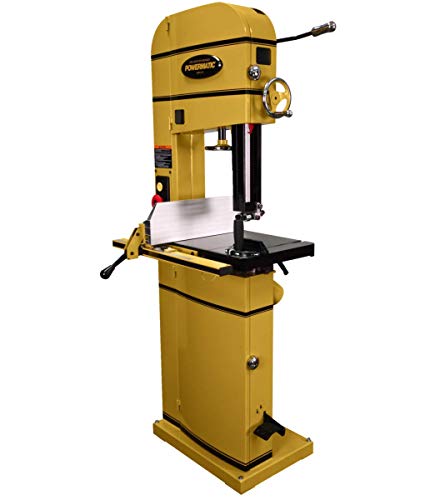
The PWBS-14CS is the entry point into the Powermatic band saw line, and it is built as a complete general-purpose shop saw rather than a stripped-down starter machine. Its precision-balanced nine-spoke cast iron wheels are intended to reduce vibration and keep blade travel smooth, and the two-piece cast iron table gives a working surface of 15 by 20 inches once the fixed extension is counted. A 6-inch riser block ships with the saw, which raises cutting height for occasional resaw work beyond the standard under-guide capacity.
The details lean toward convenience in daily use. A Carter quick-tension lever speeds up blade changes and includes a detension setting that extends blade life while the saw sits idle. A chip blower keeps the cut line visible, and a 60-watt adjustable lamp is built into the body to light the blade and workpiece. The dual bearing guide system adjusts above and below the table for close blade control, and the included T-square style rip fence comes with a resaw attachment. For a shop that cuts curves one day, rips parts the next, and resaws a modest board now and then, this is the most balanced package in the line.
Who It Suits
The PWBS-14CS suits serious home shops and small professional shops that need one band saw for mixed work: curves, joinery cuts, ripping, and moderate resawing. Its dual-voltage motor is a real advantage where only a standard circuit is available at first, since the saw can be converted to 230-volt operation later. Shops that resaw wide hardwood every week, or that regularly work stock taller than the riser setup allows, should step up to the PM1500 instead, because its extra motor power and fixed tall capacity are built for exactly that workload.
The PM1500 was designed to bring features from larger band saws into a 15-inch format, and resaw capacity is the headline. It offers 14 inches of cutting height and 14-1/2 inches of throat capacity, which is more of both than a traditional 14-inch saw provides. A 3-horsepower motor drives a 153-inch blade at 3,100 surface feet per minute, and the blade width range runs from 1/8 inch for tight curves up to 1 inch for stable resaw cuts.
The table and fence match the resaw brief. The cast iron table measures 21-1/2 by 16 inches, sits 40 inches from the floor, and tilts 10 degrees left and 45 degrees right. The sturdy cast iron table and trunnion assembly are built to stay rigid under heavy workpieces, and the Powermatic T-square style Accu-Fence is included to keep rip and resaw cuts accurate. The listing shows a fence assembly, miter gauge, resaw pin and handle, and a preinstalled blade in the box. A 4-inch dust port and a stated minimum dust collection requirement of 600 cubic feet per minute underline that this saw is expected to run with a proper collector, not a small shop vacuum alone.
Who It Suits
The PM1500 suits cabinet makers, furniture builders, and luthiers who resaw thick hardwood regularly and want that work to be routine rather than a strain. It fits shops with 230-volt power and a permanent spot for a 394-pound machine. Buyers whose work is mostly curves and general cutting in thinner stock will not use its capacity often enough to justify the step up from the PWBS-14CS, and shops that need to open boards wider than 14 inches tall should look at the PM1800B below.
The PM1800B is the heavy resaw machine in this comparison. Its 5-horsepower, 230-volt single-phase motor, 18 inches of cutting height, and 18 inches of cutting width put it in a different class from the two smaller saws. It runs a 160-inch blade, accepts blade widths from 1/8 inch up to 1-1/2 inches, and offers two blade speeds of 2,300 and 4,400 surface feet per minute, so the same saw can be set up for thick hardwood resawing or faster general cutting.
The supporting hardware is scaled to match. The cast iron table measures 24 by 27 inches, tilts 10 degrees left and 45 degrees right, and sits 38 inches from the floor. A foot brake is listed among its special features, which matters on a machine of this size because it brings the blade to a stop deliberately instead of letting heavy wheels coast. The listing shows a bandsaw, blade, fence, miter gauge, rails, and hardware included. At 840 pounds, this is a fixed installation: it needs freight delivery planning, a level floor, and a dust collector that can meet the stated 600 cubic feet per minute minimum at its 4-inch port.
Who It Suits
The PM1800B suits production-minded shops, timber framers working smaller sections, and furniture makers who resaw wide, tall hardwood as a core part of their work rather than an occasional task. Its throat and height handle stock that simply does not fit the smaller machines. It is the wrong choice for a small garage shop, for anyone who needs to move the saw often, or for a shop without the electrical capacity and floor space a machine of this weight demands. For those buyers, the PM1500 delivers most of the resaw benefit in a far more manageable package.
FAQ
Which Powermatic band saw is best for resawing?
For regular resawing, the PM1500 is the balanced pick, with 14 inches of cutting height, a 3-horsepower motor, and blade support up to 1 inch wide. For the tallest and widest stock, the PM1800B goes further, with 18 inches of height, a 5-horsepower motor, and blade support up to 1-1/2 inches wide. The PWBS-14CS handles occasional resawing, especially with its included 6-inch riser block fitted, but it is not built for daily tall resaw work.
Can these saws cut curves as well as straight work?
Yes. All three saws accept blades as narrow as 1/8 inch, and narrow blades are what allow tight curve cutting. The wider blades each saw also accepts are for straight ripping and resawing, where tracking stability matters more than turning radius. Choosing the blade for the task, and setting the bearing guides to suit that blade, matters more to cut quality than the size of the saw itself.
What electrical supply do these band saws need?
The PWBS-14CS runs on 115 or 230 volts, single phase, so it can start on a standard circuit and be converted later. The PM1500 needs 230 volts and draws 12 amps, and the PM1800B needs 230 volts with a considerably larger circuit to support its 5-horsepower motor. Check the product listing and your panel before ordering, and have a qualified electrician add a circuit if your shop does not already have a suitable one.
What blade length should be ordered as a spare?
Order the length that matches the saw: 93-1/2 inches for the PWBS-14CS, 153 inches for the PM1500, and 160 inches for the PM1800B. Blade lengths are not interchangeable between these models. Within the correct length, pick the width and tooth pattern for the work: narrow and fine for curves, wide with a low tooth count for resawing thick hardwood.
Final Verdict
There is no single best Powermatic band saw for every shop, because the three models are built for three different workloads. The PWBS-14CS is the right answer for a serious home or small professional shop that needs one versatile saw for curves, ripping, and occasional resawing, with the flexibility of a dual-voltage motor. The PM1500 is the pick for builders who resaw thick hardwood often and want 14 inches of capacity, a strong motor, and a rigid fence in a machine that still fits a normal shop footprint. The PM1800B is the specialist: maximum height, width, and power for shops whose work regularly exceeds what the smaller saws can swallow.
Match the saw to the tallest stock you cut regularly, the circuit you can actually supply, and the floor space you can permanently give up. Chosen that way, any of the three will serve as a long-term centerpiece rather than a stepping stone, and the specifications in the reference table below make the differences easy to confirm before ordering.
Product and ASIN Reference
Product
ASIN
Powermatic PWBS-14CS 14-Inch Woodworking Bandsaw
B00020BNOA
Powermatic PM1500 15-Inch Woodworking Bandsaw
B00A86U254
Powermatic PM1800B 18-Inch Woodworking Bandsaw
B00W37TCIY
J
JD's Woodworks Editorial Team
We compare specs, warranty terms, long-term owner feedback and street pricing before anything earns a spot. Rankings are never paid.
Affiliate disclosure. As an Amazon Associate we earn from qualifying purchases at no extra cost to you. Prices accurate as of the date shown.
Four hobby TIG welders compared for home shops: AC/DC picks for aluminum, a compact DC model for steel, listed specs, included gear and honest tradeoffs.
The best Creality Falcon engravers compared: Falcon A1 10W, CR-Laser Falcon 10W, Falcon2 Pro 22W and Falcon2 Pro S 40W, by power, work area and enclosure.
The best CNC machines for manufacturing compared: large-bed routers and closed-loop desktop mills with the work area, spindle and control for batch work.

 Powermatic PWBS-14CS 14-Inch Woodworking Bandsaw
 Powermatic PM1500 15-Inch Woodworking Bandsaw
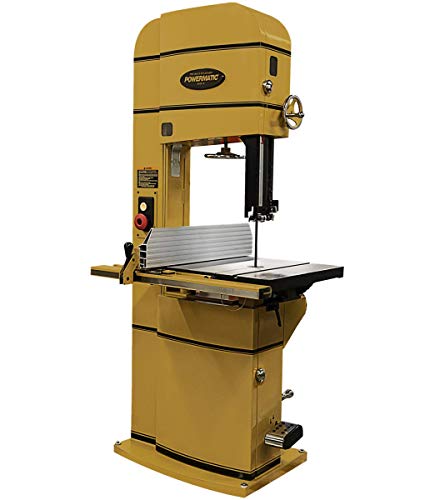 Powermatic PM1800B 18-Inch Woodworking Bandsaw









