
What's inside
- Who the Jet Table Saw JWTS-10 Suits — and Who Should Keep Looking
- Key Specifications at a Glance
- Rip Capacity: The Number That Decides Everything
- Fence Accuracy and Setup
- Blade Changes and Guard Access
- Dust Collection: Manage Your Expectations
- Portability and Real Floor-Space Requirements
- Ownership Realities: What Wears and What to Budget For
- Verdict
- FAQ
- Related Guides
As an Amazon Associate I earn from qualifying purchases. This post may contain affiliate links at no extra cost to you.
The Jet JWTS-10 is a solid choice if you want a compact 10-inch table saw with respectable fence accuracy and a small workshop footprint, but its roughly 25-inch rip capacity and limited dust collection mean it’s best suited to furniture-scale work and home shops rather than breaking down full sheet goods all day.
As an Amazon Associate we earn from qualifying purchases at no extra cost to you.

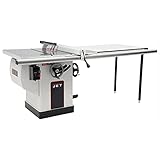


Who the Jet Table Saw JWTS-10 Suits — and Who Should Keep Looking
The jet jwts-10 table saw sits in an awkward but useful middle ground: more accurate and stable than a cheap jobsite saw, far smaller and cheaper than a cabinet saw. It makes sense for a specific type of buyer — check the matrix below before going further.
| Your situation | Is the JWTS-10 a fit? | Why |
|---|---|---|
| Garage shop, under ~150 sq ft of free floor space | Yes | Compact footprint; can be rolled aside on a mobile base |
| Occasional hobbyist (furniture, trim, small cabinetry) | Yes | Accuracy and cut quality are well above entry-level jobsite saws |
| Frequent plywood breakdown (4×8 sheets weekly) | Marginal | ~25″ rip capacity means no full crosscut of sheet goods; you’ll need a track saw or circular saw first |
| Pro site work / daily heavy ripping | No | Portable saws from DeWalt, Bosch, or SawStop’s jobsite model are designed for that duty cycle |
| Strict dust-control requirement (basement shop) | Caution | Stock dust port helps but won’t replace a dedicated extractor setup |
| Budget under typical entry-saw range | No | Jet pricing generally sits above bargain contractor saws |
Key Specifications at a Glance
| Spec | JWTS-10 | What it means in practice |
|---|---|---|
| Blade size | 10 in | Standard blades, cheap and easy to source |
| Motor | 15 amp, 120V | Runs on a household circuit; adequate for hardwoods up to ~2 in with a sharp blade |
| Rip capacity (right of blade) | ~25 in | Rips a 24-in cabinet side cleanly; full sheet crosscuts are out |
| Max depth of cut (90°) | ~3-1/8 in | Standard for the class |
| Dado capacity | Up to ~13/16 in wide | Handles most joinery dados with a stacked set |
| Table size | ~20 × 27 in class | Small; plan outfeed support for workpieces over 3 ft |
| Weight | ~70–80 lb class | One person can move it; two people should lift it onto a stand |
| Dust port | ~2-1/2 in class | Connects to a shop vacuum or small dust collector |
On price: the jet jwts-10 table saw price typically lands in the mid-range for contractor-style saws — above the cheapest jobsite units, well below hybrid and cabinet saws. Expect the general market range for this class, and factor in another meaningful chunk for a decent blade, since the stock blade is serviceable but not great.
Rip Capacity: The Number That Decides Everything
Roughly 25 inches to the right of the blade is the defining limitation. That covers:
- Ripping 24-in-wide cabinet sides — the most common carcass width
- Ripping a full sheet of plywood lengthwise into halves? No — you’d need 48+ inches
- Everything up to bookcase sides, drawer parts, face frames, and flooring
The practical workflow for sheet goods: break down 4×8 sheets with a circular saw and straightedge (or a track saw) into manageable pieces, then finish dimensions on the JWTS-10. If you already work that way, the capacity is a non-issue. If you imagined sliding full sheets across the table, this saw — and honestly most saws under cabinet size — isn’t the tool.
Fence Accuracy and Setup
The fence is the JWTS-10’s strongest argument over budget jobsite saws. It’s a front-and-rear locking design that stays reasonably parallel to the blade — but “reasonably” isn’t good enough, so plan on a one-time calibration:
- Check blade-to-miter-slot parallelism first. Use a combination square or dial indicator against a marked tooth, front and rear. Adjust the trunnion bolts if it’s out by more than ~0.003 in.
- Then square the fence to the miter slot, not directly to the blade. This keeps everything consistent.
- Set the fence micro-adjust so the scale cursor reads true against a measured test cut — rip a board at a nominal 6 in, measure with calipers, adjust the cursor.
- Lock the fence and re-check — some fences deflect a few thousandths when the lever clamps down. Know your saw’s deflection and compensate.
After calibration, expect repeatable rips within roughly 1/64 in — good enough for furniture joinery when paired with a quality blade.
Blade Changes and Guard Access
Blade changes are unremarkable in the good sense: standard 5/8-in arbor, wrenches stored on board, adequate throat clearance to spin the arbor nut without skinning your knuckles. The throat plate lifts out for dado swaps — you’ll need a dado throat plate (usually sold separately), which is a real added cost many buyers miss.
One ownership reality: many users remove the stock guard and splitter because the assembly can be fiddly to reinstall. If you do, at minimum use an aftermarket riving knife or splitter — kickback on a small saw with light table mass is genuinely dangerous.
Dust Collection: Manage Your Expectations
The ~2-1/2-inch port works with a standard shop vacuum hose, and a shrouded blade below the table captures maybe 70–80% of chips. What it doesn’t catch is the fine dust thrown off the top of the blade — there is no overarm collection. In a basement or attached garage shop, that means:
- Run a vac or small dust collector on the port and a room air filter
- Expect to vacuum the inside of the cabinet every few sessions — fine dust packs into corners and around the trunnion
- Seal gaps around the throat plate edges with tape if dust escapes upward
Portability and Real Floor-Space Requirements
At roughly 70–80 pounds, the JWTS-10 is “luggable,” not portable — you can carry it to a stand or truck, but you won’t want to daily. The bigger question is working footprint. The saw itself needs maybe 4 square feet; using it safely needs far more:
- Infeed: ~4 ft clear behind your workpiece for a 4-ft board, ~8 ft for full-length rips
- Outfeed: same again in front — an outfeed roller or table is effectively mandatory for anything over 3 ft
- Sides: ~2 ft minimum each side for fence adjustment and your stance
Realistic minimum: a clear rectangle of about 10 × 6 ft during use. In a single-car garage shop, a folding or wheeled stand lets you reclaim that space when you’re done — which is exactly the buying scenario this saw targets.
Ownership Realities: What Wears and What to Budget For
- Stock blade: first thing to upgrade. A quality combination blade noticeably improves cut quality and reduces motor strain.
- Belt/drive components: check tension after the first few hours; new belts settle and stretch.
- Fence faces and throat plate: consumables over the long term — zero-clearance inserts reduce tear-out and are worth making or buying.
- Miter gauge: typically the loosest stock accessory; a decent aftermarket gauge or a homemade crosscut sled transforms crosscut accuracy.
- Common mistake: skipping the initial parallelism calibration, then blaming the saw for burning and wandering cuts. Ninety percent of “bad fence” complaints trace back to setup.
Verdict
The jet table saw jwts-10 earns its place for space-constrained hobbyists who cut mostly solid wood and pre-dimensioned sheet goods: the fence and build quality are a clear step up from budget saws, and the footprint is honest. Buy elsewhere if you need 30+ inches of rip capacity, daily jobsite duty, or true shop-grade dust collection — those needs point toward a hybrid or cabinet saw instead.
FAQ
Can the JWTS-10 rip a full sheet of plywood?
No — at ~25 in of rip capacity you can’t crosscut a 48-in sheet. Break sheets down with a circular saw or track saw first, then finish on the table saw.
What size dust collector does it need?
A standard shop vacuum on the ~2-1/2-in port handles chip collection adequately; add a room air filter for the fine dust that escapes off the blade top.
Is it worth buying over a cheaper jobsite saw?
If the saw will live on a stand in a garage shop and accuracy matters more than site portability, yes — the fence and stability justify the price difference. If you haul it to jobsites, a purpose-built jobsite saw with a rolling stand is the better buy.