
Our Top Picks


What's inside
As an Amazon Associate I earn from qualifying purchases. This post may contain affiliate links at no extra cost to you.
Every furniture project I have built in my garage eventually hits the same wall: a joint that needs a clean, repeatable, dead-square recess. Mortises for a table apron. Sliding dovetails in a bookcase. A hinge mortise that has to sit flush or the door looks crooked forever. A fixed-base router will not start a cut in the middle of a board, and that is exactly where furniture joinery lives. Picking a plunge router for furniture making is less about horsepower bragging rights and more about whether the tool will drop straight down, stay where you set it, and not fight you at the end of a long day.
I bought the wrong router first. A cheap combo kit with a plunge base that had noticeable slop in the posts, and a depth stop that crept under vibration. I spent two years blaming my technique for sloppy mortises. So this is the guide I wish I had read, written from a one-car garage with a dust collector that is honestly undersized and a bench that is bolted to nothing.
As an Amazon Associate we earn from qualifying purchases at no extra cost to you.


What Actually Matters In A Plunge Router For Furniture Making
Furniture work has a specific profile of demands, and it is not the same as sign carving or laminate trimming. Here is how I rank the categories when I am shopping.
| Feature | Why It Matters For Furniture | What I Look For |
|---|---|---|
| Plunge action | Racking posts equal angled mortise walls | Smooth, low-friction travel with no side-to-side play |
| Motor class | Big joinery bits and hardwood | Mid-size 2 HP class for most work, full size for tables |
| Depth stop system | Repeatability across matching parts | Positive turret stops plus a fine-adjust knob |
| Base opening | Template guides and large bits | Accepts standard guide bushings and wide bits |
| Dust collection | Garage shops choke on router chips | Above-table port that actually shrouds the bit |
| Speed control | Big bits need slower RPM | Variable speed with soft start |
| Ergonomics | Long sessions, awkward positions | Handles you can plunge without twisting the tool |
Notice what is not on that list: brand loyalty. I own tools from three different companies because I bought each one for a reason, not because I wanted matching batteries. That said, if you already have a battery platform, the cordless options in the DeWalt XR, Milwaukee FUEL, and Makita LXT lines are genuinely good now, and I will get to whether cordless makes sense for furniture work.
Motor Size: The Trade-Off Nobody Talks About Honestly
Router power is usually sorted into three rough buckets. Compact trim routers, which are wonderful and mostly irrelevant here. Mid-size routers in the 1.75 to 2.25 HP class. And full-size 3 HP plus machines that mostly live under router tables.
For furniture, the mid-size class is the sweet spot, and I say that as someone who owns a big one. A 2 HP plunge router will cut mortises in white oak, run a half-inch spiral upcut bit all day, handle template work, and still be light enough that I can control it freehand on a case side. The full-size machines are more capable on paper and worse in practice for handheld joinery, because you are wrestling fifteen pounds of tool while trying to keep the base flat on a narrow rail.
The honest trade-off: if you only buy one router and you also want it for a router table, the big one wins, because table work rewards mass and raw power and you can lock the plunge for table duty. If you can buy two over time, get the mid-size plunge first and add a dedicated table motor later. That is the order I would do it again.
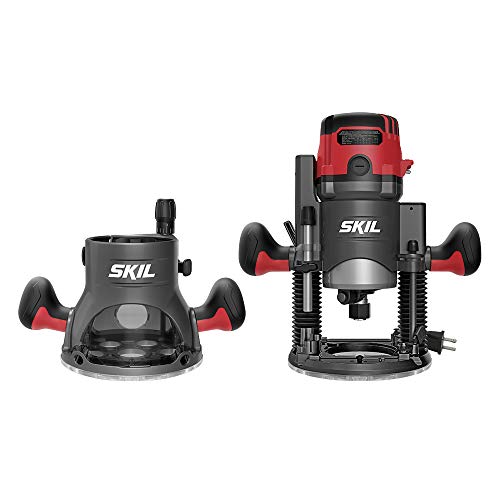
Mid-Size Variable Speed Plunge Router
This is the class I recommend to almost every furniture builder working out of a garage. Look for smooth plunge posts, a multi-stage turret stop, and a collet that takes both 1/4 and 1/2 inch shanks. Read the reviews for complaints about depth-stop creep specifically, since that is the failure that ruins matched parts.
The Base Is The Tool: Slop, Stops, And Guide Bushings
I am convinced that base quality separates a good router from a frustrating one more than the motor does. Three things to check.
Plunge Travel
Push the carriage down without the motor running and feel for grittiness or side play. Any wobble you can detect with your hands becomes a tapered mortise wall. On the router I regret buying, I could rock the motor maybe a sixteenth of an inch at full extension, and that is enough to make a loose-fitting tenon joint that needs shimming.
Depth Stops
A rotating turret with several stepped stops lets you take a deep mortise in passes without measuring each time. Add a threaded fine adjuster and you can sneak up on a hinge mortise depth in thousandths. This is the single feature I use most on furniture projects, because so much of the work is matched pairs and sets of four.
Guide Bushing Compatibility
Template routing is how you make eight identical parts instead of one good one and seven apologies. Standard Porter Cable style bushings are the de facto pattern in the US, and a base that accepts them without an adapter kit saves real money and hassle. Verify this before you buy, because some otherwise excellent routers use a proprietary subbase.
- ✔ Plunge action lets you start cuts mid-board for mortises and inlay
- ✔ Turret stops make repeatable multi-pass depths genuinely easy
- ✔ Guide bushings plus shop-made templates turn one part into a matched set
- ✔ Locks down for edge profiling and router table duty
- ✘ Heavier and taller than a fixed base, so freehand edge work feels tippy
- ✘ More moving parts means more places for grit and slop to develop
- ✘ Above-table dust collection on plunge bases is usually mediocre
- ✘ Full-size machines are genuinely tiring to control handheld
Cordless Or Corded For Garage Furniture Work
I resisted cordless routers for years and I was partly wrong. For hinge mortises on an installed cabinet, for trimming edge banding on a big panel that will not fit on my bench, and for any job where the cord snags on a clamp, a cordless plunge router is a genuine improvement. The brushless models in the major battery lines have enough power for typical joinery bits in hardwood.
Where corded still wins for me: long production runs of mortises, anything with a half-inch spiral bit taking full-depth passes, and router table work. Battery sag under sustained load is real, and swapping packs mid-cut is how you get a burn mark. If you have a cordless platform already and want a second router, cordless is a fine choice. If this is your only router and it will do everything, buy corded and spend the difference on bits.
One more garage-specific note. Corded routers with soft start are much kinder to a shop on a fifteen amp circuit shared with a dust collector. I have tripped that breaker more times than I want to admit.
Cordless Brushless Plunge Router Kit
Worth it if you already own batteries from the same platform, and especially good for on-site hinge work and trimming oversize panels. Check that the kit includes the plunge base rather than only a fixed base, since many kits ship fixed-base only and the plunge base is a separate purchase.
Bits, Dust, And The Setup That Made My Joinery Better
The router is maybe half the equation. Solid carbide spiral upcut bits transformed my mortising. They clear chips upward out of the cut instead of packing them into the bottom of a mortise, which is what causes the router to bog and the bit to burn. They cost more than straight two-flute bits and they are worth every dollar for joinery.
For dust, accept that handheld plunge routing in a garage is messy. An above-table shroud helps some. What helped me more was routing over a plywood sacrificial top with a shop vac hose taped near the cut and a fan pointed at the open door. Not elegant. Better than breathing walnut dust.
Two accessories I would buy again immediately: an edge guide with a fine adjuster for mortising rails and stiles, and a simple shop-made mortise jig from scrap plywood with stop blocks. The jig costs nothing and it made my mortises more consistent than any upgrade to the router itself.
Frequently Asked Questions
Do I need a plunge router if I already own a fixed-base router? If your furniture work involves mortises, stopped dadoes, inlay recesses, or hinge mortises, yes. A fixed base cannot safely start a cut in the middle of a workpiece. If you only profile edges and cut through dadoes at the edge of a board, your fixed base is fine and the money is better spent on bits or clamps.
Is a 1/4 inch collet enough, or do I need 1/2 inch? Get a router that takes both. Quarter-inch shanks flex and chatter in deep hardwood cuts, and they are more likely to snap. For mortising in oak, ash, or maple, half-inch shank spiral bits are noticeably more stable. The quarter-inch collet is still useful for small detail bits.
Can one plunge router handle both handheld joinery and a router table? Yes, with compromises. Locking the plunge for table use works, and many people do it. Above-table height adjustment is more awkward than a purpose-built table motor, and you will spend time mounting and unmounting the tool. If you find yourself doing that weekly, that is your signal to buy a second motor.
If I were starting over with the budget I had back then, I would buy a mid-size variable speed plunge router with good turret stops, add three or four solid carbide spiral bits, and build my jigs from scrap. That combination will build real furniture. The fancier router can wait until you know exactly which limitation you are trying to solve.
Check prices on Amazon →