
What's inside
As an Amazon Associate I earn from qualifying purchases. This post may contain affiliate links at no extra cost to you.
The M12 band saw is a one-handed, sub-compact band saw built for cutting metal conduit, threaded rod, copper pipe, steel strut, and small profiles where a full-size portable band saw is too large, heavy, or slow to position. Milwaukee is the only major brand using the M12 designation, so this category is essentially the Milwaukee M12 Sub-Compact Band Saw lineup versus its larger M18 brothers.
As an Amazon Associate we earn from qualifying purchases at no extra cost to you.


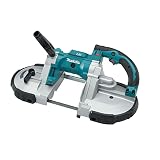
M12 Band Saw Models in 2026
Milwaukee currently offers two distinct M12 band saws that share the same battery platform but differ significantly in performance. Understanding which generation you are looking at is the first buying decision.
Milwaukee 2429 Sub-Compact Band Saw (Standard M12)
The original 2429-20 is the budget entry in the lineup. It uses a brushed motor, a 27-inch blade, and a fixed speed. It is the lightest and least expensive way into the M12 system, typically found in the $150-$200 range as a bare tool. It is now often sold as a kit with obsolete CP2.0 batteries, which makes it attractive if you already own M12 batteries but not a strong value as a first purchase in 2026.
Milwaukee 2529 M12 FUEL Sub-Compact Band Saw (Current Generation)
The 2529-20 / 2529-21 is the M12 FUEL brushless version and the model most buyers should compare. It uses a 30-9/16 inch blade, variable speed trigger, higher blade speed, and larger cut capacity while actually weighing slightly less than the 2429. It runs quieter, stalls less under load, and includes a blade guard and LED light the older model lacks. As a bare tool it generally sits in the $200-$280 range.
Both saws use the same 1/2-inch wide, 0.020-inch thick blades, but blade length is not interchangeable between the two. Always match blade length to the model number.
Size, Weight, and Cut Capacity Compared
The core trade-off of the M12 platform is portability versus capacity. This table shows how the two M12 saws compare to the two most common M18 portable band saws for reference.
| Model | Cut Capacity (W x H) | Blade Length | Blade Speed | Tool Weight (Bare) | Overall Length |
|---|---|---|---|---|---|
| Milwaukee M12 2429 (Standard) | 1-5/8 in x 1-5/8 in | 27 in x 1/2 in x 0.020 in | 280 SFPM (single speed) | 6.75 lbs | 12.0 in |
| Milwaukee M12 FUEL 2529 | 2-1/2 in x 2-1/2 in | 30-9/16 in x 1/2 in x 0.020 in | 0-550 SFPM (variable) | 6.0 lbs | 12.5 in |
| Milwaukee M18 FUEL 2829 Compact | 3-1/4 in x 3-1/4 in | 35-3/8 in x 1/2 in x 0.020 in | 0-540 SFPM (variable) | 7.7 lbs | 15.5 in |
| Milwaukee M18 FUEL 2729 Deep Cut | 5 in x 5 in | 44-7/8 in x 1/2 in x 0.020 in | 0-420 SFPM (variable) | 14.2 lbs | 21.0 in |
For woodworking and shop use, those capacities translate directly:
- 2429: Cuts 1-1/4 in EMT, 1 in black iron pipe, 1-5/8 in strut, and small brass or aluminum bar. It will not cut a 2×4 or a 2 in copper tee in one pass.
- 2529: Clears 2 in EMT, 2 in Schedule 40 pipe, 2-1/2 in strut, and most door hardware, hinges, and small tenons in non-ferrous metal. This is the threshold where it becomes useful for cutting woodworking jigs and aluminum extrusion.
- M18 Compact and Deep Cut: Required for 2x lumber, 3 in dust collection pipe, 4 in posts, or resawing. The M12 is not a wood resaw tool.
Handling: Where the M12 Wins
The M12 band saw is operated one-handed like a large pipe cutter, while M18 deep-cut saws require two hands and a braced stance. Three handling differences matter more than specs:
Overhead and ladder work: At 6 to 7.5 lbs with a CP4.0 battery, the M12 can be held overhead to cut all-thread for hanging shop lights, air lines, or shelving without a second person supporting the tool. An M18 Deep Cut at over 16 lbs with a 5.0Ah battery rapidly causes fatigue and is unsafe on a ladder.
Cut orientation: The M12 head is narrow enough to slide between studs on 16-inch centers, inside cabinets, or under a workbench to trim installed conduit or bolts flush. Larger saws need 6 to 8 inches of clearance around the material to swing the frame.
Vibration and finish: The lighter frame transmits more vibration to the hand than a heavy M18, so the cut line can wander on thin material if you push. Let the blade do the work and support the off-cut to avoid pinching. A pinched blade on an M12 will stall the motor rather than kick, but it will dull the teeth on one side.
Runtime Considerations and a Worked Calculation
Band saws draw constant current under load, so battery amp-hours directly determine cuts per charge. Milwaukee rates the 2529 FUEL at approximately 120-150 cuts in 3/4 in EMT per charge on a 4.0Ah battery. The brushed 2429 averages 20-30% fewer cuts for the same battery due to lower efficiency.
For planning, use this estimate instead of marketing claims:
Runtime formula: Cuts per charge = (Battery Wh x 0.75) / Wh per cut
A 3/4 in EMT cut takes about 0.8-1.0 Wh. A 1-1/2 in strut cut takes about 2.2-2.5 Wh. An M12 CP4.0 battery is 12V x 4.0Ah = 48Wh, but only about 36Wh is usable under load after efficiency losses.
- On a CP4.0 (48Wh): 36Wh / 1.0Wh = ~36 cuts in 1-1/2 in strut, or ~120 cuts in 3/4 in EMT
- On a CP2.0 (24Wh): ~18 cuts in 1-1/2 in strut, or ~60 cuts in 3/4 in EMT
- On an XC6.0 (72Wh): ~54 cuts in 1-1/2 in strut, but adds 0.4 lbs and makes the tool tail-heavy
Practical takeaway: If you are cutting more than 30 pieces of strut or threaded rod in a day, carry two CP4.0 batteries or step up to M18. For a woodworker who makes 5-10 cuts per session trimming brass rod, aluminum track, or shop hardware, a single CP4.0 lasts a week in the shop.
Heat is the other runtime limit. After 10-12 continuous cuts in steel, the blade and rubber drive tires heat up and the tool will thermally throttle. Pause 2-3 minutes to let the blade cool; this extends blade life far more than slowing feed rate.
Decision Matrix: Which Saw Fits Your Situation
| Your Situation | Best Choice | Why |
|---|---|---|
| Tight shop, occasional metal cuts for jigs, no dedicated metal bandsaw | M12 FUEL 2529 with one CP4.0 | Smallest footprint, stores in a drawer, handles 90% of shop metal tasks |
| Electrician, plumber, or HVAC installer doing daily conduit/strut | M12 FUEL 2529 + two XC4.0 or M18 Compact 2829 | M12 for overhead, M18 if you regularly cut over 2-1/2 in |
| Need to cut wood, plastic, or large aluminum profiles | M18 Compact 2829 or Deep Cut 2729 | M12 capacity is too small and wood clogs the fine-tooth metal blade |
| Lowest budget and you already own M12 batteries | M12 2429 bare tool | Functional for up to 1-5/8 in material, but less efficient and slower |
| First tool, no batteries yet, limited to shop use | M12 FUEL 2529 kit with CP4.0 | XC6.0 is unnecessary weight; CP4.0 is the best weight-to-runtime balance |
Durability and Ownership Realities
The M12 band saw is durable for its class, but it has consumables and failure points that do not appear on a spec sheet.
Blades wear first: Expect 100-200 cuts in steel conduit per blade with a 18 TPI blade, half that in stainless or hardened all-thread. A 24 TPI blade lasts longer on thin-wall EMT and copper but cuts slower on strut. Blades are the primary operating cost at $8-$15 each in the general market range. Keep at least three blades on hand.
Drive tires and guides: The rubber tires that drive the blade develop a groove after 6-12 months of regular use. If the blade starts walking off or squealing, clean the tires with isopropyl alcohol and check for embedded metal chips. Replace tires when the groove is deeper than 1/32 inch.
Common mistakes that kill blades:
- Twisting the saw mid-cut to correct drift. Stop and restart instead.
- Cutting without proper tension. The blade should deflect about 1/8 inch when pressed in the middle.
- Cutting wood with a metal blade. Wood pitch gums the gullets, overheats the blade, and strips teeth on the next steel cut. Use a separate portable band saw or jigsaw for wood.
- Not deburring. Metal chips left on the guide rollers embed in the next blade and cause premature wear.
Cleaning: After each session, blow out chips from the upper and lower wheel housings with low-pressure air, wipe the guide bearings, and retract the blade guard. Store without tension if you will not use the saw for more than a week to preserve tire shape.
When a Larger Saw Is Still Better
Choose an M18 Compact or Deep Cut over the M12 when you need to cut material larger than 2-1/2 inches, cut wood or dense plastics regularly, or make long, straight cuts where two-handed control and a larger table improve accuracy. The M12 is a complement to, not a replacement for, a stationary 14-inch wood bandsaw or a deep-cut portable saw for structural work. If your work is exclusively in a shop with a benchtop metal-cutting band saw, the M12 adds mobility but not capability.
FAQ
Can an M12 band saw cut wood for woodworking?
It can cut thin hardwood, plywood, and aluminum with a fine-tooth blade, but it is inefficient and slow compared to a wood bandsaw. The narrow 1-1/2 inch throat and fine 18-24 TPI metal blades clog quickly in wood and leave a rough edge. Use it for cutting metal hardware, brass, and aluminum extrusion for jigs, not for resawing or curves.
What blades does the M12 use?
Both M12 models use 1/2 inch wide, 0.020 inch thick blades. Length is model-specific: 27 inch for the 2429 and 30-9/16 inch for the 2529 FUEL. Common tooth counts are 18 TPI for general steel and 24 TPI for thin metal and conduit. Bi-metal blades last significantly longer than carbon steel.
Is the M12 FUEL worth the extra cost over the standard 2429?
For most buyers in 2026, yes. The 2529 cuts 60% larger material, cuts about twice as fast at 550 SFPM versus 280 SFPM, and runs longer per battery due to the brushless motor. The price difference as a bare tool is typically $40-$80, which is recovered in blade and battery savings within a few months of regular use.