
What's inside
- Quick comparison: useful capacity versus workshop burden
- Best choices by homeowner situation
- Head-to-head: 10-inch versus 14-inch band saws
- Noise and dust collection: the specifications leave out the important part
- Storage footprint and the real space calculation
- Blade choice matters more than a small motor upgrade
- Setup and maintenance that determine ownership costs
- Bottom line
- Related Guides
As an Amazon Associate I earn from qualifying purchases. This post may contain affiliate links at no extra cost to you.
The best band saw for a home workshop is usually a 10-inch benchtop model for occasional curved cuts, while a 14-inch floor-standing saw is the better choice for routine resawing, thicker stock, and quieter, more controlled work.
Your decision should be based less on the maximum throat size printed on the box and more on four practical questions: how much material you need to cut, how much noise your garage can tolerate, whether the dust port actually works with your extractor, and whether the machine can remain set up without consuming valuable floor space.
As an Amazon Associate we earn from qualifying purchases at no extra cost to you.
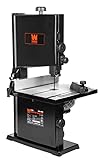
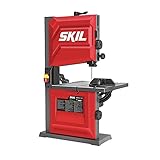

Quick comparison: useful capacity versus workshop burden
| Model | Useful capacity | Motor and speed | Approx. weight | Dust port | Typical market range |
|---|---|---|---|---|---|
| WEN 3962 10-inch | 9.75-inch throat; up to 6 inches resaw | 3.5 A; two speeds, approximately 1,520 and 2,620 fpm | About 75 lb | 3-inch port | $250–$350 |
| Rikon 10-305 | 10-inch throat; approximately 4.625 inches resaw | 1/3 hp; approximately 2,780 fpm | About 75 lb | 2.5-inch port | $450–$600 |
| JET JWBS-14L | 13.5-inch throat; approximately 12 inches resaw | 1.25 hp; approximately 1,500 and 3,000 fpm | About 275 lb | 4-inch port | $1,500–$2,000 |
| Laguna 14|12 | 14-inch throat; approximately 12 inches resaw | 1.75 hp; approximately 1,620 and 3,100 fpm | About 260–270 lb | 4-inch port | $2,000–$2,600 |
Specifications can vary slightly by production year and configuration, so confirm the manufacturer’s current sheet before buying. The important comparison is the gap between a 10-inch saw that is easy to move and a 14-inch saw that is much more capable but effectively becomes a permanent part of the shop.
Best choices by homeowner situation
| Your situation | Best fit | Why | What to accept |
|---|---|---|---|
| Limited budget and occasional curved cuts | WEN 3962 | Good throat and resaw capacity for its size, with a relatively manageable price | More vibration and less refined adjustment than larger machines |
| Small shop, but better build quality matters | Rikon 10-305 | Compact cast-iron design and straightforward controls | Less resaw height and only a 2.5-inch dust port |
| Frequent furniture parts or thick boards | JET JWBS-14L | Substantially greater resaw height, table area, and blade capacity | High cost, large footprint, and difficult relocation |
| Regular hardwood resawing and long-term ownership | Laguna 14|12 | Powerful motor, generous capacity, and substantial adjustment hardware | It needs dedicated floor space and a serious dust extractor |
Head-to-head: 10-inch versus 14-inch band saws
10-inch saws: the practical compact option
A 10-inch machine is suitable for cutting small furniture components, toys, boxes, templates, curves, and joinery blanks. Its table often fits on a sturdy mobile stand or workbench, and a homeowner can usually move it alone with care. For a garage that must still hold a vehicle, bicycle, or gardening equipment, this is often the best band saw for a home workshop.
The limitation appears when resawing. A stated 6-inch capacity does not mean every 6-inch hardwood board will pass easily. Blade sharpness, feed pressure, fence alignment, and motor power all matter. A 10-inch saw is happiest resawing narrower boards and making moderate cuts rather than processing thick stock all afternoon.
14-inch saws: more control, not merely more height
A 14-inch saw provides a larger table, wider blade options, better resaw stability, and more reserve power. These advantages reduce strain when cutting thick hardwood and make it easier to maintain a straight cut. However, the machine may weigh more than 250 pounds and occupy roughly 3 by 3 feet once the operator’s working space is included.
Noise is not automatically low just because the saw is larger. A properly aligned 14-inch machine may sound less strained than a small saw under load, but its motor, tires, blade, and dust extractor still produce substantial noise. In a residential garage, hearing protection remains sensible for either size.
Noise and dust collection: the specifications leave out the important part
Expect an unloaded benchtop band saw to produce roughly 75–85 dBA at the operator’s position, with larger machines often landing in a similar broad range once the dust collector is running. Actual sound depends on the blade, enclosure, stand, floor, and nearby walls. A steel stand can amplify vibration; a rigid, level stand with rubber feet can make the same saw feel noticeably calmer.
Dust collection is usually adequate for coarse chips but imperfect for fine dust. A 4-inch port connected to a real dust collector generally performs better than a small shop vacuum attached to a reducer. A 2.5- or 3-inch port can still help, but expect dust around the lower wheel housing and table slot.
- Use the largest compatible hose rather than reducing immediately at the machine.
- Keep the lower wheel housing and port free of packed dust.
- Seal obvious cabinet gaps only if they do not interfere with blade tracking or safety access.
- Use a blade-cleaning brush or compressed air carefully; do not direct airborne dust toward your breathing zone.
Storage footprint and the real space calculation
Measure the saw, stand, and the longest boards you expect to cut—not just the manufacturer’s cabinet dimensions. A compact 10-inch saw may occupy about 2 square feet on its stand, but you need approximately 2 feet in front for feeding stock and room to the side for the board’s exit. A 14-inch floor saw can require roughly 9 square feet of machine area before allowing clearance around it.
For example, if a saw occupies 24 by 24 inches, its static footprint is 4 square feet. Adding a 24-inch operating clearance in front expands the working rectangle to approximately 24 by 48 inches, or 8 square feet. That difference matters in a single-car garage. A mobile base can recover floor space only if the machine can be moved without repeatedly disturbing blade alignment.
Blade choice matters more than a small motor upgrade
For general work, a 1/4-inch or 3/8-inch blade with roughly 4–6 teeth per inch is versatile. Use a narrower blade for tight curves and a wider blade with fewer teeth per inch for straighter resawing. Do not force a narrow blade through thick stock: it can wander, heat up, and wear the guides and tires.
As a worked example, a 6-inch board resawn with a 3/8-inch blade and 3 teeth per inch presents about 18 teeth in the cut at one time, before accounting for changing grain and feed rate. A fine 10-teeth-per-inch blade would put roughly 60 teeth in the cut, increasing friction and making slow feeding more likely. The correct blade is often a bigger improvement than a nominal increase in motor amperage.
Setup and maintenance that determine ownership costs
- Level the machine and stand. A rocking stand transfers vibration into the frame and makes straight cuts harder.
- Install the blade with the correct tooth direction. The teeth should point toward the table on the cutting run.
- Set tracking before tension. Center the blade on the crown of the wheel, then apply only the tension needed for the blade width.
- Adjust guides close to the work. Upper guides should sit just above the material, while side and thrust bearings should clear the blade without rubbing during free running.
- Check squareness with a test cut. A table that reads square without a blade under load can still produce a cut that drifts.
- Clean after demanding cuts. Remove resin and dust from tires, guides, and the lower cabinet; accumulated debris can cause tracking problems.
The first consumables are normally blades, followed by tires or guide bearings on heavily used machines. A homeowner who uses a saw twice a month may replace blades annually or less often; frequent hardwood resawing can consume blades much faster. Keep spare blades dry, avoid kinking them, and release blade tension when the saw will sit unused for extended periods if the manufacturer permits it.
Bottom line
Choose the WEN 3962 when capacity, portability, and price are the priorities. Choose the Rikon 10-305 when you want a compact saw with a sturdier feel and can live with less resaw height. Move up to the JET JWBS-14L or Laguna 14|12 when thick stock, repeatable resawing, and long sessions justify a permanent floor machine, a 4-inch dust-collection system, and considerably more space.