
Key takeaways
- Compare six best sheet metal brakes for home shops, from 12-inch 3-in-1 units to a 48-inch box and pan brake, with gauge and width tips.
What's inside
As an Amazon Associate I earn from qualifying purchases. This post may contain affiliate links at no extra cost to you.
The VEVOR 24-inch box and pan brake with 16-gauge mild steel capacity is the best sheet metal brake in this group for most home shops. It is wide enough for ductwork, trim, enclosures and brackets, it states a heavier-than-average gauge capacity, and its adjustable bend angle reaches 135 degrees. A sheet metal brake clamps flat sheet along a line and folds it up to a set angle; a box and pan version adds removable fingers so you can bend four-sided boxes and trays. If you need longer bends, the 48-inch VEVOR is the widest option, while the three 12-inch combination units add a shear and slip roll for small projects.
Quick List
- VEVOR 48-Inch Box and Pan Brake – best for long bends such as panels, flashing and trim
- VEVOR 12-Inch 3-in-1 Brake – best for small jobs that need bending, shearing and rolling in one machine
- KASTFORCE KF5006 24-Inch – best for light-gauge box and pan work with a mid-size width
- VEVOR 24-Inch 16-Gauge – best overall for a balance of width, thickness and bend angle
- 18-Inch Portable Sheet Metal Brake – best for compact, portable simple bends
- 12-Inch 3-in-1 Brake with Shear and Slip Roll – best for hobbyists who want a combination tool at small scale
Which One Is Right for You?
| If you… | Choose |
|---|---|
| Want one brake that handles most shop projects | VEVOR 24-Inch 16-Gauge |
| Bend long pieces such as roofing trim, flashing or wide panels | VEVOR 48-Inch |
| Make small boxes and cut thin sheet in limited space | VEVOR 12-Inch 3-in-1 |
| Work in 20-gauge or thinner metal and want fingers for boxes | KASTFORCE KF5006 |
| Need something light that you can move between workspaces | 18-Inch Portable Brake |
| Want to cut, bend and roll small pieces for crafts or models | 12-Inch 3-in-1 with Shear and Slip Roll |
Pick width first, then gauge. Width must exceed your longest bend, and gauge capacity should be at least one step heavier than your usual material, because brakes often struggle at the edge of their stated limits. The combination 3-in-1 machines are convenient for small work but compromise on rigidity, so choose them for light projects only.
All 6 Picks in Detail
1. VEVOR 48-Inch Box and Pan Brake – Best for Long Bends
As an Amazon Associate we earn from qualifying purchases at no extra cost to you.

The 48-inch VEVOR is the widest brake on this list, and its listing gives a bend range of 0 to 130 degrees. Forty-eight inches matches the width of a standard sheet of 4-foot material, so you can fold full-width pieces such as panels, siding trim, flashing and enclosure covers without splicing sections together.
The listing title does not state a gauge capacity. That matters, because capacity and width trade off: a wide brake is generally rated for lighter material than a narrow one. Confirm the maximum thickness and whether the figure applies across the full width before you buy. It suits a shop that does lots of long, light-gauge bends such as HVAC work, gutters, flashing and trailer panels.
Because a long brake has more leverage on the frame, small differences in tightening are amplified along the bend line. Test with scrap the same gauge as your real piece, bend at the middle and at each end, and compare the angles. If the ends close more than the middle, the clamp is not evenly seated or the bar is flexing, and it may need shimming or an adjustment of the clamp bolts. Keep a protractor or angle gauge at hand to confirm results.
- 48-inch working width
- 0 to 130 degree bend range
- Box and pan design with fingers: finger set, confirm on listing
- Gauge capacity: confirm on listing
- Brand: VEVOR
Pros
- Full-width bends in standard 4-foot stock
- Wide bend angle range
Cons
- Large footprint and weight
- Gauge capacity not stated in the title
Compared with the 24-inch VEVOR, you gain length but lose the assurance of a stated 16-gauge limit.
Place a brake this wide on a sturdy bench or stand and leave room at both ends for long stock. Check how the clamping bar closes and whether the handle arrangement lets you apply even pressure along 48 inches, because uneven clamping leaves bow in the bend line.
2. VEVOR 12-Inch 3-in-1 Combination Brake – Best for Small Multi-Task Projects

This machine combines three functions: a bending brake, a shear and a slip roll. The listing states a 12-inch width, a 20-gauge capacity and a 90 degree maximum bending angle. It is meant for small fabrication such as model making, small ducts, brackets, tubes rolled from thin sheet and craft work.
The appeal is variety on a small footprint. You can cut a blank, bend a flange and roll a cylinder without three separate machines. The compromise is that each function is lighter-duty than a dedicated tool, and the 90 degree limit means you cannot form hems or tight returns past a right angle on the brake.
For roll work, form the curve in gradual passes, adjusting the rear roll a little each time until the piece closes to the diameter you want. Avoid forcing the roll to a tight radius in one pass, which can kink the sheet. Remember that the shear section is intended for the thickness in the listing, so use tin snips or a larger shear for heavier or harder material.
- 12-inch working width
- 20-gauge capacity per the listing
- 90 degree maximum bend angle
- Shear, brake and slip roll in one unit
- Brand: VEVOR
Pros
- Three functions in one compact tool
- Good for tubes, small boxes and craft work
Cons
- Narrow width limits project size
- Each function is light-duty
It is nearly identical in class to the other 12-inch 3-in-1 on this list, so compare listing details such as included tools and warranty terms.
Take care when using the shear: keep fingers well away from the blade, clamp the sheet, and cut only the thickness named in the listing. Deburr cut edges with a file before handling the piece.
3. KASTFORCE KF5006 24-Inch Box and Pan Brake – Best for Light-Gauge Box Work

The KASTFORCE KF5006 is listed as a box and pan brake with a maximum capacity of 24 inches (610 mm) and 20 gauge (1.0 mm), plus a set of removable fingers (confirm the finger count and sizes on the listing). Twenty gauge is a common thickness for ductwork, electronics enclosures, light cabinets and decorative metalwork.
It suits a shop that mostly works in thin mild steel, aluminum and similar materials, builds boxes and pans, and values the flexibility of removable fingers. The finger set is what lets you bend the four sides of a box without the previous flange getting in the way.
Since the title does not give the number of fingers or their widths, check the product page and compare the set against the smallest box you intend to make. Narrow fingers are what let you form tight trays, so a set with only wide segments restricts the design. Also confirm the maximum bend angle and whether the apron has an adjustable stop for repeat bends.
- 24-inch (610 mm) maximum width
- 20 gauge (1.0 mm) maximum capacity
- Box and pan design
- Removable fingers: count and sizes, confirm on listing
- Brand: KASTFORCE
Pros
- Right-sized for common light-gauge projects
- Box and pan fingers add forming options
Cons
- Lower gauge capacity than the VEVOR 24-inch
- Maximum bend angle not stated in the title
The nearest alternative is the VEVOR 24-inch, which lists 16 gauge and a 135 degree bend range.
Capacity figures usually describe mild steel. Stainless steel is considerably tougher to bend, and many guides suggest assuming roughly half the rated thickness in stainless. Treat the numbers as limits for ideal conditions, not everyday targets.
4. VEVOR 24-Inch 16-Gauge Box and Pan Brake – Best Overall
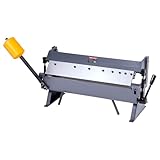
This model lists a 24-inch width, a 16-gauge mild steel capacity and an adjustable bend angle of 0 to 135 degrees, with a set of fingers (confirm the count on the listing). Sixteen gauge is about 0.06 inch, thick enough for brackets, mounting plates, light structural parts and sturdy enclosures. The 135 degree range also lets you overbend slightly to compensate for springback.
It suits a home fabricator who wants one brake to do most things: trays, boxes, cleats, flashing and brackets. It is also the middle width that most guides recommend as a starting point. Twenty-four inches covers many projects without the bench space of a 48-inch machine.
Heavier capacity also means the brake needs a better mounting. Bolt it to a bench that will not shift, keep the lower clamp bolts snug and lubricate pivot points lightly as the maker recommends. When you push toward the stated 16-gauge limit, bend in a single smooth motion and listen for creaks or movement in the frame. If the machine fights you, step back to a thinner gauge or shorter piece rather than adding a pipe to the handle.
- 24-inch working width
- 16-gauge mild steel capacity
- 0 to 135 degree adjustable bend angle
- Box and pan finger design
- Brand: VEVOR
Pros
- Heavier gauge listed than most in the group
- Generous bend angle for overbending
Cons
- Limited to 24-inch bends
- Machine weight and bench mounting should be confirmed on listing
Next to the KASTFORCE, you get four gauges more capacity and a wider bend range.
A worked example: to fold a 2-inch flange on 18-gauge mild steel, you would clamp the sheet with the bend line at the edge of the clamping bar, raise the apron to roughly 100 degrees to allow for springback and release. If the part ends up at 92 degrees, you adjust the stop slightly and repeat on a scrap piece.
5. 18-Inch Portable Sheet Metal Brake – Best for Compact, Simple Bends

This brake is described as a portable 18-inch sheet metal bender with an 18-gauge mild steel capacity and a 0 to 90 degree adjustable bending angle. The listing title mentions further construction details that are cut off, so confirm materials and any included extras on the product page. A 90 degree limit makes it a straight-flange brake, ideal for angles, channels and simple trays rather than hems and returns.
It suits someone who needs to move the tool between a garage and a job site, or who has little space and bends only moderate amounts of sheet. Eighteen gauge is a useful thickness for light fabrication, and 18 inches is wider than the small 12-inch combination machines.
A portable brake is easiest to use when it is clamped to a workbench or a sturdy sawhorse. Mark the bend line, align it with the edge of the clamp bar and make slow, even pulls on the handle. The 90 degree limit means you will usually bend to the target directly, but keep in mind that springback on harder materials can leave the finished angle slightly open. Practice on scrap before you commit expensive sheet.
- 18-inch working width
- 18-gauge mild steel capacity
- 0 to 90 degree adjustable bend angle
- Portable design
- Box and pan fingers: confirm on listing
Pros
- Portable and easy to store
- Wider than the 12-inch units
Cons
- 90 degree maximum limits overbending
- Brand and detailed specs are not clear from the title
It sits between the 12-inch combination machines and the 24-inch box and pan brakes in size and capability.
Because the title is generic, read the full description for the frame material, handle design and clamping method. Portable brakes can flex, so use gentler bends on harder material and bend in stages.
6. 12-Inch 3-in-1 Brake with Shear and Slip Roll – Best for Small-Scale Cutting, Bending and Rolling

This second 12-inch combination machine is listed as a 3-in-1 sheet metal brake with shear and slip roll for bending, rolling and cutting, rated for 20 gauge. It covers the same ground as the other 3-in-1 here: small boxes, short flanges, cut-to-size blanks and rolled cylinders for ducts, pipe covers or model parts.
It suits hobbyists who want to dip into sheet metal work without buying three machines. Because it is a combination tool, accuracy depends on careful setup, and each function has its own limits. Roll small diameters in several light passes, and do not force the shear on thicker material.
As with any combination tool, keep a clear workspace around it: the brake, shear and roll each need room for the sheet to pass through. Clamp or bolt the machine so it cannot move, and test every function on scrap of the same gauge before you start a project. If the title leaves out the maximum bend angle or whether fingers are included, find those details in the listing before deciding.
- 12-inch working width
- 20-gauge capacity per the listing
- Shear, brake and slip roll functions
- Bend angle: confirm on listing
- Brand: not clearly stated in the title
Pros
- Cut, bend and roll in one tool
- Compact enough for a small bench
Cons
- Narrow width and light-duty construction
- Limited detail in the listing title
Compared with the VEVOR 3-in-1, it is essentially the same class, so choose by the full specification list and included accessories.
Specs Compared
| Model | Width | Gauge capacity | Bend angle | Type |
|---|---|---|---|---|
| VEVOR 48-Inch | 48 in | Confirm on listing | 0 to 130 degrees | Box and pan |
| VEVOR 12-Inch 3-in-1 | 12 in | 20 gauge | Up to 90 degrees | Brake, shear, slip roll |
| KASTFORCE KF5006 | 24 in (610 mm) | 20 gauge (1.0 mm) | Confirm on listing | Box and pan |
| VEVOR 24-Inch | 24 in | 16-gauge mild steel | 0 to 135 degrees | Box and pan |
| 18-Inch Portable | 18 in | 18-gauge mild steel | 0 to 90 degrees | Portable brake |
| 12-Inch 3-in-1 Shear and Slip Roll | 12 in | 20 gauge | Confirm on listing | Brake, shear, slip roll |
How We Chose These
This list comes from reading the product listings and comparing them with general guidance on how sheet metal brakes are sized. We looked for stated width, gauge capacity and bend angle, because those three numbers describe what a brake can actually do. We then grouped the machines by type: wide box and pan brakes, mid-width box and pan brakes, a portable bender and combination machines. Listings that leave out gauge or angle are flagged so you can confirm them on the product page. We did not rank anything on the strength of marketing language alone, and we did not claim any performance we could not trace to a listing.
What to Look For
Width and gauge go together
Capacity and width trade off. A 24-inch brake may handle 16-gauge mild steel across its full width, while a 48-inch brake with similar construction is usually rated for lighter material. Pick the width that matches your longest bend, then check that the stated gauge covers your typical stock with a margin. A useful rule is to choose a brake rated at least one or two gauges heavier than your thickest regular material. Gauge numbers run backward: 16 gauge is about 0.06 inch, 18 gauge about 0.05 inch and 20 gauge about 0.036 inch for mild steel.
Material changes the numbers
Brake ratings are almost always for mild steel. Stainless steel is far tougher, so expect a rated capacity roughly half as thick. Aluminum is softer in many tempers but springs back and can crack on tight bends, especially in harder alloys. If you work mainly with stainless or hard aluminum, buy more capacity than the nominal chart suggests.
Box and pan fingers
Fingers are removable segments on the upper clamping bar that let you bend one side of a box while leaving room for the sides already formed. Typical sets include fingers in widths from about 1 to 6 inches. Match the set to the smallest box you plan to make: if you want 2-inch-tall flanges on a small tray, you need narrow fingers and enough clearance behind the bar. Straight-bar brakes, including most combination units, cannot make closed boxes.
Bend angle, springback and repeatability
Metal springs back after bending, so the apron has to travel past your target angle. A brake that reaches 135 degrees gives room to overbend and still land at 90. Look for a visible angle scale, an adjustable stop and a clamping bar that applies even pressure. For repeat parts, set the stop on a scrap and keep it there. Avoid forcing a bend that the brake resists; flex in the frame or a stripped bolt is a sign you are over capacity.
Always mount the brake to a stable bench or stand. Deburr sheet edges, wear gloves when handling raw sheet and keep fingers out of the clamp area during bends. Never exceed the stated thickness, and avoid bending hardened or springy materials on light-duty machines.
Last, think about where the brake will live. A 48-inch machine needs bench space plus clear floor area at both ends, while a 12-inch combination tool can sit on a corner of a workbench. Add a sturdy stand or bench to your plan, along with measuring tools, a hammer for tweaking bends, files for deburring and gloves for handling sharp edges. Good setup often matters more to bend quality than a small difference in listed capacity.
Questions
What size sheet metal brake do I need?
Choose a width a bit longer than your longest bend. A 24-inch brake is a good all-purpose size; a 48-inch brake suits long panels and trim; a 12-inch machine is best for small crafts.
Is a 3-in-1 machine worth it?
For small projects, yes, because it saves space. For larger or thicker work, dedicated tools are more rigid and accurate.
What does 16 gauge mean?
Gauge is a thickness standard where a larger number means thinner metal. For mild steel, 16 gauge is roughly 0.06 inch thick. Always check whether the brake’s stated gauge applies to mild steel.
Can a home brake bend stainless steel?
Thin stainless can be bent, but the capacity is much lower than for mild steel. Expect to use material about half as thick as the stated mild-steel rating, and bend in careful stages.
What is a box and pan brake?
It is a brake with removable fingers on the clamping bar. The fingers allow you to form boxes and pans with multiple sides without the already-bent flanges blocking the tool.
Do I need to bolt the brake down?
Yes, in most cases. Bending generates real force, and an unsecured brake can shift or tip. Bolt it to a sturdy bench or stand, and make sure the work height is comfortable.
Update History
- October 20, 2026 – Initial publication; product set drawn from current catalog listings.
- Check the product page for current specifications and availability before buying.
Sources
- Retailer listing titles and specification fields for each brake
- Manufacturer and retailer product pages for box and pan brakes from other makers, used to understand typical gauge, width and finger-set conventions
- Machinist community discussions on brake capacity and derating for stainless steel