4 Best DeWalt Table Saws for Shops (November 2026)
Compare the best dewalt table saw models, from compact jobsite saws to a cordless FlexVolt, and pick the right DeWalt for ripping sheet goods in your shop.
As an Amazon Associate I earn from qualifying purchases. This post may contain affiliate links at no extra cost to you.
A DeWalt table saw is the machine most small shops build around, because ripping sheet goods and hardwood accurately is the job everything else depends on. The brand’s rack and pinion fence moves smoothly and locks square, which matters more than raw power when a cut must stay true across eight feet of plywood. The differences between models come down to blade size, rip capacity, weight and whether the saw needs a cord or a battery. A fence that stays square matters just as much on a small saw as on a large one.
This guide is for woodworkers setting up a first shop, contractors who carry a saw to the job, and hobbyists who want straight rips without a full cabinet saw. Every saw below was chosen from the name and specifications shown on its Amazon product page, with attention to blade size, motor, rip capacity and fence design. We compare four DeWalt saws that cover job sites, small garages and cordless work.
Quick Picks
As an Amazon Associate we earn from qualifying purchases
Product
Best for
Key spec from title
DEWALT DWE7491RS
Full sheet goods on a rolling stand
32-1/2-inch rip capacity
DEWALT DWE7485
Compact jobsite ripping
8-1/4-inch blade
DEWALT DCS7485B
Cordless work away from outlets
60V MAX FlexVolt power
DEWALT DWE7485WS
Portable saw with a rolling stand
24-1/2-inch rip capacity
How to Choose
Blade Size and Cut Depth
Blade size sets the deepest cut the saw can make, and that depth decides whether a thick hardwood board passes through in one cut. A 10-inch blade cuts about 3-1/8 inches at 90 degrees, which handles most furniture stock and sheet goods with ease. An 8-1/4-inch blade cuts a little less deep but keeps the saw lighter and easier to carry, and it still rips plywood and standard dimensional lumber. Choose the blade size by the thickest stock you cut regularly, not by the thickest board you might cut once a year. Thick stock also needs a sharp blade, since a dull edge burns the cut.
Rip Capacity and Fence Accuracy
Rip capacity is the distance from the blade to the fence at its widest setting, and it decides whether you can rip a full sheet of plywood without a second setup. A 32-1/2-inch capacity handles sheet goods comfortably, while a 24-1/2-inch capacity covers most cabinet parts with a helper or a track saw for the widest cuts. The rack and pinion fence on these DeWalt models moves with a hand crank and stays parallel to the blade, which is the feature that separates a frustrating saw from one you trust for glue-line rips. Choose a capacity that covers the widest board you rip often without a second setup.
Power, Weight and Portability
A 15-amp corded motor delivers steady power for ripping hardwood all day, while a 60V battery saw trades some runtime for the freedom to work where no outlet exists. Weight matters when the saw moves between a truck and a job site every day: a 46-pound compact saw carries easily, while a rolling-stand model stays in the shop or rolls across a flat driveway. Match the power source to where you actually cut, and remember that a heavier saw vibrates less and holds its settings better. A saw that lives on a bench can be heavier, while one that rides in a truck every day should lift easily with one person.
Table Saw Safety and Guarding
The listings for these saws name the guarding system that keeps hands away from the blade: a modular blade guard, a non-thru-cut riving knife and anti-kickback pawls that sit behind the blade. Use the guard for through cuts, keep the riving knife in place for every rip, and use the included push stick whenever your fingers would pass within a hand span of the blade. Stand to the side of the blade rather than directly behind it, unplug the saw before changing blades, and never reach over a spinning blade to clear offcuts. Keep the floor clear, so offcuts fall free and nobody trips while feeding a board.
The 4 Best Options
DEWALT DWE7491RS
Top Pick
DEWALT DWE7491RS
Best for: Ripping full sheet goods on a job site or in a small shop.
The DWE7491RS is the full-size jobsite saw for woodworkers who rip sheet goods every day. Its 10-inch blade and 32-1/2-inch rip capacity handle full plywood sheets, and the rack and pinion fence adjusts smoothly and locks square for repeatable cuts. The rolling stand folds for transport and sets up in seconds, so the saw moves from truck to job site without a second trip. The 15-amp motor holds speed through hardwood, making this the default choice when one saw must do everything. The stand also locks firmly once open, so the table stays level while long boards pass across it in the shop.
Watch out for: The rolling stand adds size and weight, so it needs a clear path to roll through the shop.
DEWALT DWE7485
Runner-Up
DEWALT DWE7485
Best for: A light, portable saw for job sites and small garages.
The DWE7485 is the compact saw for woodworkers who carry their tools and work in tight spaces. Its 8-1/4-inch blade still rips plywood and standard lumber, and the 24-1/2-inch rip capacity covers most cabinet parts. The rack and pinion fence gives the same accurate adjustment as the larger models, and the saw weighs little enough to lift onto a bench or a folding stand alone. It is the right pick when portability matters more than maximum cut depth. Its small table also fits a folding stand, and the whole setup stores against a wall between jobs. That makes it easy to reclaim the garage for other work.
Watch out for: The smaller blade cuts less deep than a 10-inch saw, so very thick stock needs two passes or another tool.
DEWALT DCS7485B
DEWALT DCS7485B
Best for: Cordless cutting on job sites without power.
The DCS7485B brings the compact 8-1/4-inch saw to places without power, running on the 60V MAX FlexVolt battery system. Its brushless motor spins the blade to 5,800 RPM, and the rack and pinion fence keeps cuts accurate away from the shop. The tool-only package means you supply the battery and charger, which suits anyone already invested in FlexVolt tools. For framing, decking and punch-list work on a site with no outlets, it cuts without a generator or a long extension cord. A spare battery in the bag extends the working day, and the saw packs down small enough to carry with one hand on site.
Watch out for: Runtime depends on the battery you own, so carry a spare for a full day of cutting.
DEWALT DWE7485WS
DEWALT DWE7485WS
Best for: A portable saw that sets up at working height anywhere.
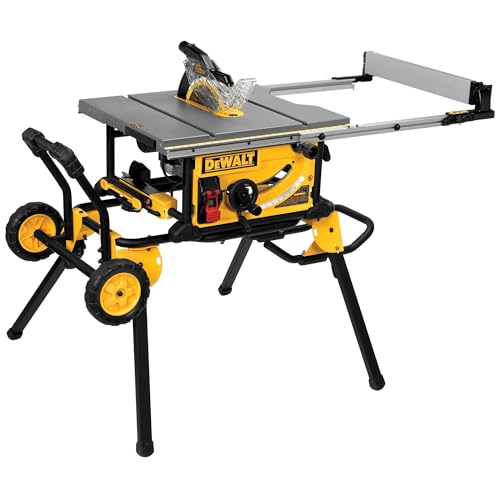
The DWE7485WS pairs the compact 8-1/4-inch saw with a rolling stand, giving a portable saw the stability of a floor-standing setup. The stand folds for transport and wheels across a driveway or garage floor, while the saw itself keeps the light weight and 24-1/2-inch rip capacity of the bare DWE7485. The rack and pinion fence and 15-amp motor handle plywood and hardwood rips, and the stand raises the table to a comfortable working height without a separate bench. The stand raises the table to a comfortable height, so long rips do not mean bending over the blade. Its wheels also help the saw move across a garage.
Watch out for: The stand adds bulk to transport, so measure your truck bed or storage space first.
Which One Fits Your Situation
Full Sheets and Daily Ripping
Pick the DWE7491RS when plywood and hardwood rips are your daily work. The 10-inch blade, 32-1/2-inch rip capacity and rolling stand make it the most capable saw here, and the fence stays accurate across long cuts. It is the best single saw for a small shop that cuts sheet goods several times a week. Its wide rip capacity also means fewer cuts need a second tool to finish.
Tight Spaces and Easy Carrying
Pick the DWE7485 when you carry the saw to the work and space is short. The compact frame and 46-pound weight make it easy to lift, while the rack and pinion fence keeps cuts square. It suits punch-list work, small garages and anyone who stores the saw on a shelf between jobs. Its light frame also frees the bench for assembly work once the saw is put away.
Work Without an Outlet
Pick the DCS7485B when the job site has no power and a generator is more trouble than it is worth. The FlexVolt battery drives the brushless motor through a full day of light cutting with a spare battery in the bag. It is the right choice for decks, fences and remote repairs where a cord would only get in the way. A spare battery keeps the saw ready for longer days.
A Stand Without the Bulk
Pick the DWE7485WS when you want a rolling stand but do not need the largest saw. The compact saw on its own stand sets up fast, rolls where you need it and stores in a corner. It is a good middle ground for a garage shop that cuts sheet goods occasionally and values floor space. It rolls into a corner when the job is done, freeing the garage.
Common Mistakes
Judging a saw by blade size alone while ignoring rip capacity, which decides whether a full sheet fits.
Removing the riving knife for convenience, then wondering why a board pinched and kicked back.
Buying the heaviest saw for a job site, then leaving it in the truck because it is too much trouble to unload.
Forgetting to check fence squareness after transport, so every rip comes out a fraction off.
Choosing a cordless saw without owning a spare battery, then stopping work halfway through a cut list.
Frequently Asked Questions
Is an 8-1/4-inch table saw enough for a home shop?
Yes, for most home work. It handles plywood, standard lumber and furniture stock up to about 2-1/2 inches thick, which covers sheet goods and cabinet parts. Only very thick hardwood needing one deep pass calls for a larger blade.
What does the rack and pinion fence do?
It moves the fence along a geared rail with a hand crank, so small adjustments stay smooth and the fence stays parallel to the blade. A fence that drifts causes binding, burn marks and kickback, so check it against the blade with a square after every move.
Can I use a dado stack on a DeWalt jobsite saw?
The compact 8-1/4-inch models are not built for a full dado stack, and their arbors suit single blades and thin-kerf work. The 10-inch DWE7491RS accepts a dado set within its arbor limits, so check the manual for the maximum stack width first.
How do I keep a jobsite saw accurate?
Keep the table clean and waxed so boards slide without catching, and check fence and blade alignment with a square after every move. Tighten the fence lock firmly and test it with a scrap cut before starting on good lumber.
J
JD's Woodworks Editorial Team
We compare specs, warranty terms, long-term owner feedback and street pricing before anything earns a spot. Rankings are never paid.
Affiliate disclosure. As an Amazon Associate we earn from qualifying purchases at no extra cost to you. Prices accurate as of the date shown.
Four hobby TIG welders compared for home shops: AC/DC picks for aluminum, a compact DC model for steel, listed specs, included gear and honest tradeoffs.
The best Creality Falcon engravers compared: Falcon A1 10W, CR-Laser Falcon 10W, Falcon2 Pro 22W and Falcon2 Pro S 40W, by power, work area and enclosure.
The best CNC machines for manufacturing compared: large-bed routers and closed-loop desktop mills with the work area, spindle and control for batch work.



 DEWALT DWE7485WS









