5 Best CNC Accessories for Wood Routers (November 2026)
Five CNC router accessories that solve real shop problems: a carbide bit set, spoilboard surfacing bit, ER11 collets, a dust shoe and hold-down clamps.
Five CNC router accessories that solve real shop problems: a carbide bit set, spoilboard surfacing bit, ER11 collets, a dust shoe and hold-down clamps.
As an Amazon Associate I earn from qualifying purchases. This post may contain affiliate links at no extra cost to you.
The real decision after unboxing a CNC router is not the machine itself. It is which accessories close the gaps the machine ships with: starter bits that cover only one kind of cut, a single collet that fits one shank size, no dust collection at all, and workholding improvised from tape and hope. Those gaps decide whether your cuts come out clean and repeatable, or whether every job starts with a workaround.
This roundup is for hobby and small-shop CNC router owners, especially desktop machines in the 3018 class and trim-router-based wood routers. Each pick below was chosen from its Amazon listing by name, fitment and stated specifications, and each covers a different job in the setup: cutting, flattening, toolholding, workholding and dust control.
Quick Picks
As an Amazon Associate we earn from qualifying purchases
Every accessory purchase runs through the spindle. Desktop machines with ER11 spindles accept ER11 collets and bit shanks up to 7mm, while trim-router machines such as Makita-based setups use their own collet style, most often 1/4 inch. Dust shoes are sized by spindle body diameter, commonly 42mm or 52mm, and a shoe built for one will not seal on the other. Before ordering anything, confirm three numbers on your own machine: spindle diameter, collet series, and the shank sizes you actually run. An accessory that misses any of them is dead weight in the drawer.
Build the bit library around the work you run
Signs and lettering lean on V-groove and tapered ball nose bits. Sheet goods and cutouts call for up-cut and down-cut spirals, and relief carving needs a ball nose that can follow contours. A mixed starter set covers more of that ground than five copies of one profile, and it shows you which cutters you reach for before you invest in duplicates. Solid carbide is the material to look for in the listing: it holds an edge in plywood and MDF far longer than coated steel, and the listing should name the profiles included rather than hiding them behind a piece count.
Plan workholding before the first cut
Workholding fails quietly: a board shifts a fraction mid-job and the part is scrap. Aluminum T-slot beds take T-track hold-down clamps, while MDF spoilboards rely on screws, tape, or low-profile edge clamps. Match the method to your bed first, then check clamp height against your gantry clearance and stock thickness. A clamp that stands too tall is a collision waiting for the one pass you did not simulate. Thin stock is the hardest to hold, so if you cut veneer, acrylic sheet or thin plywood, low-profile clamps that grip the edge deserve priority over taller general-purpose ones.
Treat dust control and surfacing as accuracy tools
A dust shoe is not just housekeeping. Chips packed into a cut get recut, edges suffer, and you cannot see the bit through a cloud of MDF dust. A shoe with a brush ring and a hose adapter matched to your vacuum, commonly 38mm on desktop machines, keeps the cut visible and the air cleaner. Surfacing matters the same way: a spoilboard carved with grooves makes cut depth vary across the bed, so parts come out uneven. A wide surfacing bit on a regular resurfacing schedule keeps depth consistent from corner to corner.
The 5 Best Options
SpeTool 8Pcs Carbide CNC Router Bits Set
Top Pick
SpeTool 8Pcs Carbide CNC Router Bits Set
Best for: New CNC owners building a first bit library for signs, carving and sheet-goods cutouts.
8 pieces in the set
Solid carbide construction
1/4 inch shank on all bits
Includes 2 V-groove end mills and 1 tapered end mill
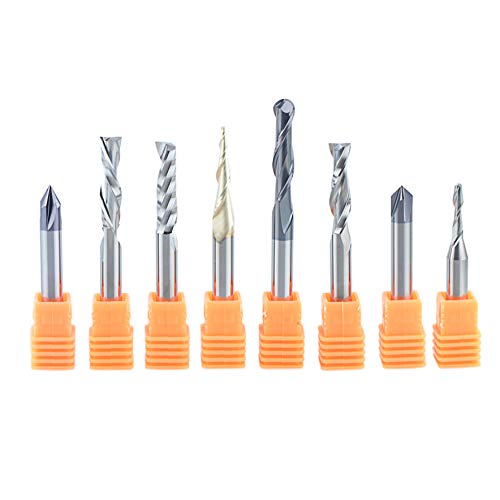
Most new owners own exactly one bit: whatever shipped in the box. This eight-piece set replaces that limitation with the profiles wood CNC work actually cycles through, including V-groove bits for lettering, a tapered bit and a ball end mill for carving, and spiral up-cut and down-cut bits for cutouts in plywood and MDF. Because every cutter shares a 1/4 inch shank, the whole set swaps through one collet on trim-router machines, and through the 1/4 inch collet on ER11 spindles. It suits sign makers and plaque carvers who need variety before they need depth in any single profile.
SpeTool 2+2 Flute Slab Flattening Router Bit
Runner-Up
SpeTool 2+2 Flute Slab Flattening Router Bit
Best for: Resurfacing a worn spoilboard or flattening slabs and wide boards on the CNC.
Resurfacing a worn spoilboard or flattening slabs and wide boards on the CNC.
Watch out for
Confirm your machine has the Z travel and rigidity for a bit this wide, and take shallow passes; the listing also sells a 1/2 inch shank version under a different ASIN, so check the shank before ordering.
A grooved spoilboard quietly ruins depth accuracy, and this bit is the fix. Its 1-1/4 inch cutting diameter clears a desktop bed in a handful of passes, and instead of a fixed edge it uses carbide insert knives that can be rotated or swapped when they dull, so the body of the tool keeps working. The ATS coating on the inserts is listed for softwood, hardwood, MDF, laminate and plywood, which covers both spoilboard resurfacing and slab flattening duty. It fits owners whose cut depths have started drifting, and anyone flattening rough slabs too wide for a planer.
Genmitsu 15PCS ER11 Precision Spring Collet Set
Genmitsu 15PCS ER11 Precision Spring Collet Set
Best for: ER11 spindle owners who switch between metric and inch-shank bits across jobs.
ER11 spindles ship with one or two collets, and that shortage shows up the first time a job needs a 1/8 inch bit after a 1/4 inch one. This fifteen-piece set spans 1.0mm to 7.0mm in metric sizes and adds the two inch sizes CNC bits actually come in, 1/8 and 1/4 inch, so nearly any small shank has a collet that grips it on size rather than stretched beyond its range. The listing states a clamping accuracy of 0.02mm and spring steel construction. It is the natural companion purchase for 3018-class machines and any ER11 spindle running mixed metric and inch tooling.
Genmitsu CNC Dust Shoe for 3018-PRO
Genmitsu CNC Dust Shoe for 3018-PRO
Best for: 3018-class owners who want dust extraction without losing sight of the bit.
Desktop CNC routers throw fine dust everywhere, and this shoe is built for the most common spindle size in that class. It clamps around a 42mm spindle motor, surrounds the bit with a 40mm nylon brush ring, and leaves the cover transparent so the cut stays visible while the vacuum pulls through a 38mm hose adapter. The split cover uses a magnetic design, which means bit changes happen without unbolting the shoe from the spindle. It is aimed squarely at 3018-PRO, 3018-PROVer V2 and Cubiko owners who run long carving jobs in a garage or spare room and are tired of breathing the results.
Genmitsu 2PCS T-Track Mini Hold Down Clamp Kit
Genmitsu 2PCS T-Track Mini Hold Down Clamp Kit
Best for: Holding thin stock flat on a 3018 T-slot bed without screws or tape.
2 clamps in the kit
T-track mini hold-down design
Dimensions 2.57 x 0.79 x 1.97 inches
Listed fitment: 3018-PRO, 3018-PROVer and 3018-MX3
Holding thin stock flat on a 3018 T-slot bed without screws or tape.
Watch out for
Two clamps secure small workpieces; larger boards need a second kit, and the clamps require a T-slot or T-track bed rather than a plain MDF spoilboard.
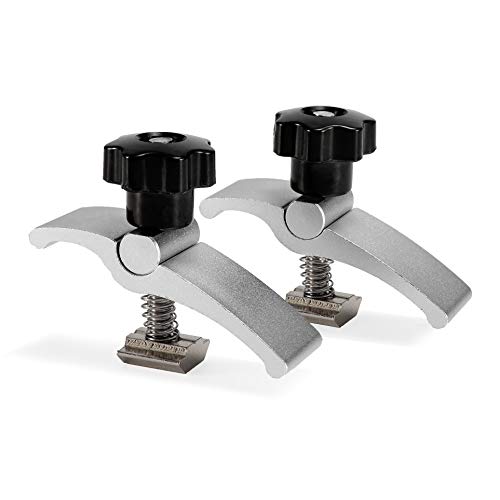
Tape and glue workholding works until a thin part lifts at the worst moment. These mini hold-down clamps anchor into the T-slots of a 3018 aluminum bed and press stock down at the edge, keeping the top face clear for the bit. At 2.57 inches long and just under 2 inches tall, they stay low enough for the shallow Z clearance on desktop gantries, and the two-piece kit covers a pair of corners or one long edge. They suit 3018-PRO, 3018-PROVer and 3018-MX3 owners cutting thin plywood, acrylic or circuit-board blanks that screws would split and tape cannot hold flat.
Which One Fits Your Situation
You just unboxed a 3018-class machine
Start with the Genmitsu ER11 collet set and the T-track clamp kit. The collets unlock the full range of small bits your spindle can run, including the 1/8 inch cutters most starter files assume, and the clamps replace the fiddly stock hardware before it costs you a workpiece. Add the dust shoe next, once you know the machine will stay in its current spot.
You carve signs and plaques on a trim-router CNC
The SpeTool eight-piece set is your purchase. Its V-groove and tapered bits handle lettering, the ball end mill follows carved detail, and the up-cut and down-cut spirals cover cutouts, all on the 1/4 inch collet your router already has. Pair it with the SpeTool surfacing bit when your spoilboard starts showing grooves, and depth across wide signs will stay even again.
Your cut depths have started drifting across the bed
That symptom points at the spoilboard, not the machine. The SpeTool 2+2 flute surfacing bit, run in shallow overlapping passes, brings the surface back to one plane so a bit set to one depth cuts that depth everywhere. Resurface, then re-check with a shallow test cut in each corner before trusting the bed with real stock again.
You run long jobs in a small garage shop
Dust is your limiting factor. The Genmitsu dust shoe keeps MDF and plywood dust out of the air and out of the cut on 42mm spindle machines, and its transparent cover means you still watch the bit work. Combine it with the clamp kit so long jobs run unattended by your hands, not held down by them.
Common Mistakes
Ordering bits by cutting diameter alone and ignoring shank size, then discovering the collet on the machine cannot grip them.
Buying a dust shoe by machine name instead of spindle diameter, when 42mm and 52mm versions look nearly identical in photos.
Stretching one collet across shank sizes it was not ground for, which grips off-center and wears both the collet and the bit.
Positioning tall clamps inside the toolpath, where the gantry or the bit finds them mid-job.
Never resurfacing the spoilboard, then blaming the machine for parts that come out deeper on one side than the other.
Frequently Asked Questions
What is the first accessory a new CNC router owner should buy?
Workholding and collets come first, because they decide whether the bits you already own can be used at all. A clamp kit that fits your bed and a collet set that covers your shank sizes turn a machine that ships with limitations into one that can start real jobs. Bits and dust control build on that base.
Will 1/4 inch shank bits fit an ER11 spindle?
Yes, with the correct collet. ER11 collets are made in a 1/4 inch size, and sets like the Genmitsu fifteen-piece include it alongside the metric range. The bit does not fit a metric collet that is merely close; use the collet ground for the exact shank so the bit runs true and the collet is not damaged.
How often should a spoilboard be resurfaced?
Whenever cut depth stops matching across the bed, or when grooves from earlier jobs become visible across the working area. A surfacing bit makes the job quick enough that there is little reason to wait for a fixed schedule. Shallow, overlapping passes are the approach the bit is built for, and they leave a flat reference for the next round of work.
Do dust shoes fit every CNC router?
No. A dust shoe is built around a specific spindle diameter, and the common desktop sizes are 42mm and 52mm, which are not interchangeable. Check the listing’s stated spindle size against your motor, and also confirm the hose adapter diameter matches your vacuum hose, or the shoe will collect poorly even when it mounts correctly.
J
JD's Woodworks Editorial Team
We compare specs, warranty terms, long-term owner feedback and street pricing before anything earns a spot. Rankings are never paid.
Affiliate disclosure. As an Amazon Associate we earn from qualifying purchases at no extra cost to you. Prices accurate as of the date shown.
Miter saw vs table saw: compare crosscuts, rip cuts, accuracy, space, and value to choose the right saw for your shop and your first woodworking projects.
Compare five solar portable generators for shops, campsites, and outages, covering battery size, output, solar charging, outlets, and what to check first.
The best portable CNC machines for small shops and shared spaces, compared by footprint, weight, work area, and setup. Compact benchtop picks for wood, acrylic, and soft metal.
Find the best Penn Industries dust collector on Amazon: the PSI Woodworking DC3XX blower and the DC725 tabletop unit, compared on airflow, pressure, and shop fit.
Compare five large stationary horizontal metal band saws for fabrication shops on cutting capacity, motor, power supply, blade speed, and mitering before buying.
Find the best mortising chisel bits for clean square mortises in this guide: hollow-chisel sets and singles compared by size, shank, steel, and machine fit.
Find the best drill press base for your shop. Compare rolling stands and mobile bases by capacity, footprint, casters, locking, and setup before you buy.
Find the best dewalt planer dw734 blades for your 12-1/2-inch thickness planer. Compare OEM and aftermarket 3-knife sets, steel types, and fit before you buy.



 Genmitsu CNC Dust Shoe for 3018-PRO
 Genmitsu 2PCS T-Track Mini Hold Down Clamp Kit









