Find the best 110 volt plasma cutter for home shops: dual-voltage 50-amp and 55-amp picks compared on cut capacity, pilot arc and air needs before you buy.
Find the best 110 volt plasma cutter for home shops: dual-voltage 50-amp and 55-amp picks compared on cut capacity, pilot arc and air needs before you buy.
As an Amazon Associate I earn from qualifying purchases. This post may contain affiliate links at no extra cost to you.
A 110 volt plasma cutter lets a home shop cut steel from a standard household outlet, and the strongest options are dual-voltage machines that run on 110 volts now and 220 volts later. The LOTOS LTP5000D leads this group with a non-touch pilot arc and a 1/2-inch clean cut, while the bestarc BTC500DP adds a large LED display and an air sensor at the same 50-amp class. Every pick below runs on 110 volts, so match the machine to the thickest metal you cut most often and the air supply you already own.
A plasma cutter earns its place in a home shop the moment a project calls for cutting plate, sheet, angle iron or tubing faster than a grinder or a saw can manage. The catch is power: many capable machines demand a 220-volt circuit that a garage may not have. That is why the 110-volt class matters. These machines plug into the outlet already on the wall, cut sheet metal and light plate cleanly, and still leave room to grow, because all four picks in this guide are dual-voltage units that deliver their full output once a 220-volt circuit is available.
Our top pick: the LOTOS LTP5000D. Runner-up: the bestarc BTC500DP 10GEN. This guide compares published specifications only: input voltage, output amperage on 110 volts, clean-cut capacity, start type, air requirements, duty cycle, weight and included accessories, as listed by each manufacturer. Nothing here is based on a claim that cannot be traced to a published specification.
At a Glance
Product
Best for
Key specification
LOTOS LTP5000D — ASIN B0052OX876
Overall 110-volt cutting
50-amp dual-voltage, 1/2-inch clean cut, non-touch pilot arc
bestarc BTC500DP 10GEN — ASIN B0D7CR3YLC
Display and air monitoring
50-amp dual-voltage, 1/2-inch clean cut, large LED display with air sensor
ARCCAPTAIN CUT50 — ASIN B0B5N7K2DJ
Portability
50-amp dual-voltage, 1/2-inch clean cut, 13-pound body
YESWELDER CUT-55DS PRO — ASIN B0CWMY354P
Maximum output on 110 volts
55-amp dual-voltage, non-high-frequency blow-back pilot arc, IPT40 torch
How to Choose
1. Confirm True 110-Volt Operation
A listing that says “dual voltage” should also state the input range plainly, such as 110 to 220 volts, and give separate output figures for each input. Every machine in this guide lists 110-volt operation in its published specifications, with a lower maximum amperage on 110 volts than on 220 volts. If a listing only gives a single amperage number with no input voltage attached, treat that number as the 220-volt figure and look elsewhere for the 110-volt rating.
2. Read the 110-Volt Amperage, Not the Headline Number
The headline amperage on most dual-voltage cutters is the 220-volt maximum. On 110 volts the same machine typically delivers 35 amps or less. The LOTOS LTP5000D, for example, lists 10 to 35 amps on 110 volts against 10 to 50 amps on 220 volts, and the ARCCAPTAIN CUT50 lists 20 to 35 amps on 110 volts against 20 to 50 amps on 220 volts. Since amperage drives cutting thickness, the 110-volt amperage is the number that decides what the machine can actually cut in your shop today.
3. Match Clean-Cut Capacity to Your Thickest Common Metal
Manufacturers publish two thickness figures: a clean cut, which leaves an edge that needs little cleanup, and a maximum or severance cut, which gets through thicker stock with a rougher edge. On 110 volts, expect a clean cut around 1/3 inch and a maximum cut around 1/2 inch from a 50-amp machine. Buy for the thickest metal you cut regularly, not for the thickest piece you might cut once, and remember that rust, paint and scale all reduce the effective cut.
4. Choose the Start Type
A non-touch pilot arc starts the arc without the torch tip touching the metal, which makes it easier to cut rusty, painted or expanded metal and extends consumable life. High-frequency start machines can interfere with nearby electronics, which is why the YESWELDER CUT-55DS PRO uses a non-high-frequency blow-back start instead. For a home shop with a mix of clean and dirty stock, a pilot arc or blow-back start is the more forgiving choice.
5. Size Your Air Supply
Every plasma cutter in this guide needs clean, dry compressed air, and the compressor is sold separately. The LOTOS LTP5000D lists 3.6 cubic feet per minute at 60 to 70 PSI, while the ARCCAPTAIN CUT50 lists an air range of 30 to 75 PSI. A small pancake compressor that cannot hold the required flow will starve the arc and wear consumables quickly, so check the air figure against the compressor you own before choosing a cutter.
6. Check Duty Cycle and Breaker Needs
Duty cycle states how many minutes in a 10-minute window the machine can cut at a given amperage before it must cool down, and the published figure is usually measured at full output. On 110 volts the breaker matters too: the bestarc BTC500DP lists a 40-amp breaker requirement on 110 volts, which is larger than the 20-amp breaker on a typical household circuit. Read both figures before ordering, and plan the circuit the machine will actually run on.
7. Weigh Portability and Included Accessories
A plasma cutter moves around the shop more than a stationary tool does, so weight and cable length matter. The ARCCAPTAIN CUT50 weighs 13 pounds and the YESWELDER CUT-55DS PRO weighs 19.41 pounds, a difference you will feel carrying the machine to a project. Check what ships in the box as well: torch, ground clamp, air regulator and adapter cables vary by model, and the LOTOS LTP5000D needs a separate pigtail adapter for 110-volt use.
Our Picks
LOTOS LTP5000D 50Amp Non-Touch Pilot Arc Plasma Cutter, Dual Voltage 110V/220V — ASIN B0052OX876
Top Pick
LOTOS LTP5000D 50Amp Non-Touch Pilot Arc Plasma Cutter, Dual Voltage 110V/220V — ASIN B0052OX876
Best for: Home shops that want a proven 110-volt cutter with a non-touch pilot arc for rusty or painted stock.
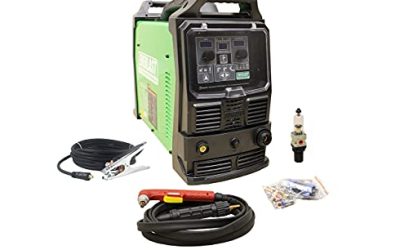
The LOTOS LTP5000D is the longest-established machine in this group, a 50-amp dual-voltage cutter with a non-touch pilot arc and a 1/2-inch clean cut. On 110 volts it delivers 10 to 35 amps, and on 220 volts it reaches the full 10 to 50 amps, with the unit switching between inputs automatically. It ships with a 13-foot cutting torch, a 6-foot ground clamp and a pre-installed air-filter regulator, and it lists an air requirement of 3.6 cubic feet per minute at 60 to 70 PSI.
Consideration: The 110-volt pigtail adapter is sold separately, so confirm it is in your order if you plan to run the machine on a household outlet.
bestarc BTC500DP 10GEN 50A Pilot Arc Plasma Cutter, Dual Voltage 110/220V — ASIN B0D7CR3YLC
Runner-Up
bestarc BTC500DP 10GEN 50A Pilot Arc Plasma Cutter, Dual Voltage 110/220V — ASIN B0D7CR3YLC
Best for: Beginners who want a clear digital display and air monitoring while cutting on 110 volts.
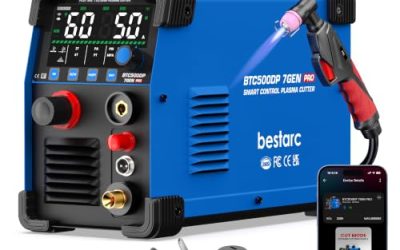
The bestarc BTC500DP 10GEN pairs a 50-amp dual-voltage inverter with a large LED display and an air sensor that monitors the air supply in real time. Its published figures list a 1/2-inch clean cut and a 4/5-inch maximum cut, with a maximum cutting thickness of 20 millimeters at 220 volts and 65 PSI. A built-in regulator, 2T/4T trigger modes and adjustable post flow round out a control set aimed at beginners who still want to see what the machine is doing.
Consideration: The listing calls for a 40-amp breaker on 110 volts, so verify your household circuit can support it before ordering.
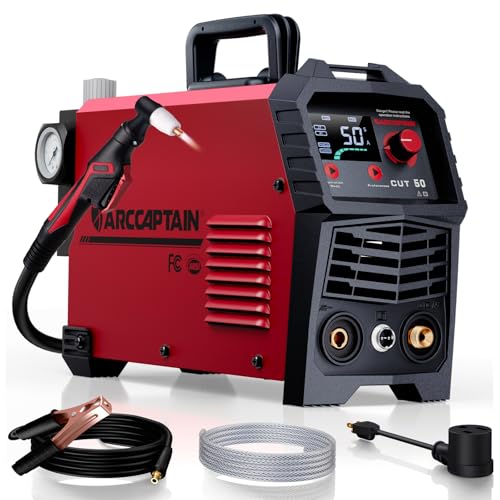
The ARCCAPTAIN CUT50 is the lightest machine in this guide at 13 pounds, built around a 50-amp DC inverter with a large LED display, 2T/4T trigger modes and post flow. On 110 volts it delivers 20 to 35 amps with a recommended maximum cut of 12 millimeters, and on 220 volts it reaches 20 to 50 amps with an 18-millimeter maximum. Its published figures list a 1/2-inch clean cut, a 2/3-inch maximum cut, a 60 percent duty cycle and a 2-year warranty, with an air requirement of 30 to 75 PSI.
Consideration: Cut capacity drops sharply on 110 volts compared with 220 volts, so plan on the thinner end of its range when running from a standard outlet.
YESWELDER CUT-55DS PRO 55A Plasma Cutter, Non-High-Frequency, Dual Voltage 110/220V — ASIN B0CWMY354P
YESWELDER CUT-55DS PRO 55A Plasma Cutter, Non-High-Frequency, Dual Voltage 110/220V — ASIN B0CWMY354P
Best for: Shops that cut near sensitive electronics or want the highest amperage in this group.
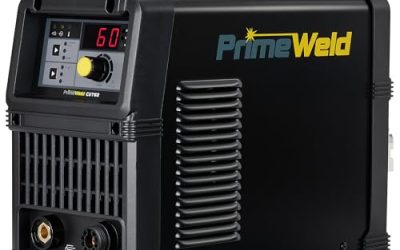
The YESWELDER CUT-55DS PRO is the only 55-amp machine in this guide, using a non-high-frequency blow-back start that avoids electromagnetic interference with nearby electronics. It carries an IPT40 torch, a large LED digital display, a built-in rear air filter and adjustable post flow from 5 to 20 seconds. Its published figures list a 1/3-inch clean cut at 110 volts and a 1/2-inch clean cut at 220 volts, with maximum cuts of 1/2 inch on 110 volts and 4/5 inch on 220 volts, and the unit weighs 19.41 pounds.
Consideration: At 19.41 pounds it is the heaviest machine here, and its 110-volt clean cut is thinner than the 50-amp picks, so it suits thicker work best once a 220-volt circuit is available.
Which One Is Right for You?
If you want the most established 110-volt cutter with a non-touch pilot arc, the LOTOS LTP5000D is the natural first choice, with the longest track record of the four and a torch and clamp set suited to daily home-shop use. If you want to watch your settings and air supply on a large display, the bestarc BTC500DP 10GEN gives you that feedback at the same 50-amp class, provided your 110-volt circuit meets its breaker requirement. If the machine will move between the bench, the driveway and a project site, the 13-pound ARCCAPTAIN CUT50 is the easiest to carry, though its 110-volt cutting range is the most limited. If you work near a CNC controller, a computer or other sensitive electronics, the YESWELDER CUT-55DS PRO and its non-high-frequency start are the safer pick, and its 55-amp output leaves the most headroom for a future 220-volt circuit.
For most home shops, the choice comes down to the thickest metal cut every week. Sheet metal up to 1/4 inch is comfortable for any of these four on 110 volts. Plate around 1/2 inch is where the differences show: the LOTOS and bestarc hold a 1/2-inch clean cut on their published figures, while the ARCCAPTAIN and YESWELDER list thinner clean cuts on 110 volts. Match the machine to that weekly thickness, confirm the air supply and breaker, and the rest of the decision is about display, weight and start type.
Frequently Asked Questions
Can a plasma cutter really run on a standard 110-volt household outlet?
Yes, all four machines in this guide list 110-volt operation in their published specifications, and they plug into a standard household outlet with the correct adapter where one is required. Output drops on 110 volts, typically to 35 amps or less, so the clean-cut thickness is thinner than on 220 volts. Check the breaker requirement in the listing, because some machines call for more than a standard 20-amp household circuit.
How thick can a 110-volt plasma cutter cut?
A 50-amp dual-voltage machine typically lists a clean cut around 1/3 inch and a maximum cut around 1/2 inch on 110 volts. The exact figures vary by model: the YESWELDER CUT-55DS PRO lists a 1/3-inch clean cut at 110 volts, while the LOTOS LTP5000D and bestarc BTC500DP list a 1/2-inch clean cut. Rust, paint, scale and a weak air supply all reduce the thickness a machine can cut cleanly.
Do I need an air compressor to use a plasma cutter?
Yes. A plasma cutter needs a steady supply of clean, dry compressed air to form the plasma arc and blow molten metal out of the cut, and none of the four machines in this guide includes a compressor. The LOTOS LTP5000D lists 3.6 cubic feet per minute at 60 to 70 PSI, and the ARCCAPTAIN CUT50 lists 30 to 75 PSI. A compressor that cannot hold the required flow will starve the arc and wear torch consumables quickly.
What is a pilot arc, and why does it matter?
A pilot arc starts the cutting arc before the torch touches the metal, so the torch can begin a cut on rusty, painted or expanded metal without contact. Machines with a non-touch pilot arc, such as the LOTOS LTP5000D and the bestarc BTC500DP, start more easily on dirty stock and put less wear on consumables. The YESWELDER CUT-55DS PRO uses a non-high-frequency blow-back start, which gives the same contact-free starting without the electromagnetic interference of a high-frequency start.
Should I buy a dual-voltage machine if I only have 110 volts today?
Yes, for most home shops a dual-voltage machine is the better long-term choice. It runs on the 110-volt outlet you have now, and it delivers its full amperage and clean-cut thickness later if a 220-volt circuit is added. All four picks in this guide are dual-voltage, so the decision is about which 110-volt figures, display, weight and start type fit your shop, not about whether to buy dual voltage at all.
Bottom Line
The best 110 volt plasma cutter for a home shop is a dual-voltage machine with honest 110-volt figures, a pilot arc start and an air requirement your compressor can meet. The LOTOS LTP5000D leads this guide on track record and cutting figures, the bestarc BTC500DP 10GEN is the pick for clear display feedback, the ARCCAPTAIN CUT50 is the lightest option for mobile work, and the YESWELDER CUT-55DS PRO brings the highest amperage and an interference-free start. Whichever you choose, confirm the 110-volt amperage, the breaker requirement and the air supply before ordering, and the machine will cut from the outlet you already have.
Disclosure: As an Amazon Associate, this site earns from qualifying purchases.
J
JD's Woodworks Editorial Team
We compare specs, warranty terms, long-term owner feedback and street pricing before anything earns a spot. Rankings are never paid.
Affiliate disclosure. As an Amazon Associate we earn from qualifying purchases at no extra cost to you. Prices accurate as of the date shown.
Find the best steel plasma cutter for your shop. Compare four proven machines for clean cuts in mild steel, from a portable 12-amp unit to a 60-amp workhorse.
Best high frequency TIG welder guide: four HF-start AC/DC welders compared on output, duty cycle, dual voltage, torch, foot pedal and warranty for home shops.
Find the best gas shielded MIG welder for your shop. Compare four gas MIG machines by output range, duty cycle, voltage, weight, and included gas hardware.
Compare deep cut portable band saws in the Milwaukee 6230 class: the 6232-21 kit, DEWALT DWM120K and two cordless rivals, by capacity, speed and weight.
Compare the best small plasma cutter options for garages and small shops with dual-voltage 50-amp models, pilot arc starts, and clean-cut limits explained.


 YESWELDER CUT-55DS PRO 55A Plasma Cutter, Non-High-Frequency, Dual Voltage 110/220V — ASIN B0CWMY354P