As an Amazon Associate I earn from qualifying purchases. This post may contain affiliate links at no extra cost to you.
An affordable TIG welder is not simply the cheapest machine on the shelf. It is the machine that gives clean arc starts, steady low amperage control, and the right current type for the metals on your bench without forcing you to buy a second welder a year later. For a home workshop that handles brackets, furniture frames, exhaust parts, and small fabrication repairs, that balance matters more than a long feature list.
This guide compares four verified TIG welders that sit in the affordable end of the market: two AC and DC models for aluminum as well as steel, one long-running square wave AC and DC machine with a foot pedal in the box, and one very light DC pulse machine for steel and stainless work. Each pick is a true TIG welder of the same type, and the differences come down to current type, control depth, weight, and what arrives in the package.
As an Amazon Associate, we earn from qualifying purchases.
How to Choose an Affordable TIG Welder
Start with current type, because it decides which metals you can weld properly. DC TIG handles mild steel, stainless steel, and most other common workshop metals well, and DC-only machines are usually lighter and simpler. AC TIG is needed for aluminum, because the alternating current helps break up the oxide layer on the surface while the arc runs. If aluminum is even an occasional part of your plans, choose an AC and DC machine now rather than working around a DC-only limit later.
Next, look at the low end of the amperage range as carefully as the top end. Thin sheet, small tubing, and delicate stainless parts need a stable arc at low amps, so a machine that starts cleanly at 10 amps or lower gives you more control where affordable welders often struggle. The top end, usually around 200 amps in this class, covers thicker steel and aluminum sections found in brackets, frames, and general repair work. A wide, usable range is more valuable than a headline number alone.
High frequency start is worth prioritizing. It lets the arc begin without touching the tungsten to the work, which helps keep the tungsten clean and reduces contamination at the start of a bead. Lift start can work, but for beginners learning puddle control, high frequency starting removes one source of frustration. Check that the listing states the start method clearly before you buy.
Duty cycle tells you how long the machine can weld at a given amperage before it needs to cool, expressed as a share of a ten minute period. A rating written as 60 percent at 200 amps means six minutes of welding at that output in ten minutes. For short beads and project work, a modest duty cycle is rarely a problem, but for longer runs on thicker material it becomes the limit you feel first. Compare duty cycle at the amperage you will actually use, not only at maximum output.
Input power shapes where you can work. Dual voltage machines that run on both standard household circuits and higher voltage shop circuits are easier to place in a garage, a small workshop, or a borrowed space. Output falls on the lower voltage input on most models in this guide, so plan thicker work for the higher voltage circuit when you have one. Also confirm the plug and adapter arrangement in the listing, because adapters differ between brands.
Controls and accessories complete the picture. A foot pedal gives live amperage control while both hands stay on the torch and filler, which is especially helpful on aluminum and on thin material where heat needs to taper at the end of a bead. Pulse control helps manage heat on thin stock by cycling between peak and background current. AC balance and AC frequency controls, where fitted, let you adjust cleaning action and arc focus on aluminum. Finally, add up what is included: a torch, ground clamp, gas hose, regulator, and pedal included in the box can matter as much as the power source itself when the budget is tight.
Shielding gas and consumables are ongoing needs, not part of the machine choice, but they belong in your plan. TIG welding uses argon, and you will need tungsten electrodes, collets, cups, and filler rod matched to your metals. None of the machines below include a gas cylinder, so allow for that separately when you set up.
The YESWELDER TIG-200P AC/DC is the natural starting point for a buyer who wants one affordable machine for steel, stainless, and aluminum. Its AC output covers aluminum work that a DC-only machine cannot do, while DC output handles the steel and stainless jobs that fill most workshop time. Dual voltage input adds flexibility for shops where the available circuit changes from one location to another.
This model suits a general fabricator who does not want to decide in advance that aluminum is off the table. The 200 amp class output is enough for common bracket, frame, and repair thicknesses, and the AC and DC pairing means the same torch setup approach carries across projects. As with any AC and DC machine in this price class, take time to learn what each control does rather than turning every dial at once; the capability is there, but aluminum TIG rewards a methodical setup.
Who It Suits
Choose this machine if aluminum is part of your project list and you want it covered by your first TIG purchase. Skip it if you know your work is steel and stainless only and you would rather have the lightest possible DC machine, because the DC pulse pick below is far easier to carry and store.
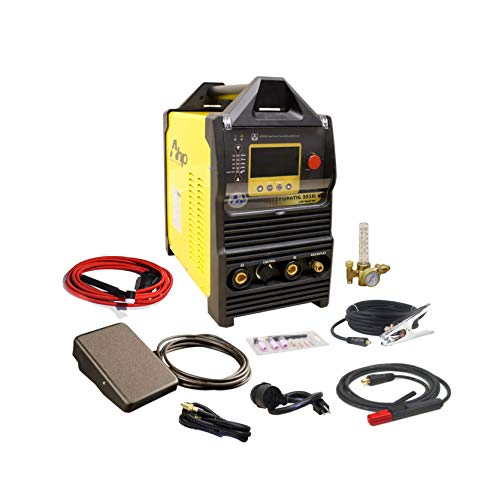
The AHP AlphaTIG 200X is a long-running AC and DC design built around IGBT inverter technology with pulse width modulation control. The listing for this ASIN describes the newer 203Xi version shipped under the same listing, with a fully controlled LCD screen, pulse and AC frequency up to 200 hertz, and a three year warranty. Buyers should read the current listing carefully to confirm exactly which version and accessories are described at the time of ordering, since this model line has been updated over several years.
On specification, the machine covers TIG from 10 to 200 amps, runs on 110 volt and 220 volt single phase input, and is rated at 200 amps at a 60 percent duty cycle. It welds steel, stainless, and aluminum, includes a foot pedal and an argon regulator in the listed components, and uses high frequency arc ignition. It is a heavy package at 69 pounds as listed, so it fits best on a cart or a fixed bench rather than as a carry-around tool.
Who It Suits
This is a good fit for a buyer who wants AC and DC capability, pulse control, a foot pedal in the box, and a longer warranty, and who has a permanent place for a heavier machine. Skip it if portability is your top priority, or if you prefer the simplest possible control layout while learning.
The LOTOS TIG200ACDC is a square wave inverter machine that pairs AC and DC TIG with stick welding in one dual voltage package. Square wave output is a traditional and effective approach for aluminum, giving a focused arc and cleaning action that suits sheet, tubing, and cast parts commonly found in repair work. The package is notably complete, with a foot pedal and an argon regulator included rather than sold as later add-ons.
Manufacturer documentation lists TIG output from 10 to 200 amps and stick output from 15 to 200 amps, automatic dual voltage and dual frequency input, and high frequency start with foot pedal heat control. Listed welding capacity is three eighths of an inch, and the documented package includes the TIG torch, stick electrode holder, ground clamp and cable, pigtail adapter, argon hose, argon regulator, and foot pedal. For a buyer comparing total setup effort, that included regulator and pedal simplify the first day in the shop.
Who It Suits
Choose the LOTOS if you want AC and DC range with a pedal and regulator already in the box and a straightforward square wave character on aluminum. Skip it if you want digital pulse programs and a lighter carry weight, because this is a fuller, more traditional package aimed at a settled workshop corner.
The YESWELDER TIG-205P takes the opposite approach to the AC and DC machines above: it leaves aluminum out and focuses on doing steel and stainless work in a very small, light package. At about 10.7 pounds, it is by far the easiest machine in this guide to move, store on a shelf, or carry to a repair in another part of the building. For a wood and metal workshop where space is already committed to benches and dust collection, that size is a real advantage.
Specification from the manufacturer manual and listing gives DC TIG from 10 to 200 amps on 220 volt input and 10 to 160 amps on 110 volt input, with stick output up to 160 amps on the higher voltage. Pulse runs from 0.5 to 200 hertz with adjustable pulse duty, and the TIG duty cycle is rated at 60 percent at 200 amps on 220 volt input, with a continuous rating at lower amperage. High frequency start, 2T and 4T trigger modes, spot timing, and pre and post flow controls are all part of the package. The listed package includes a WP-17 TIG torch, electrode holder, earth clamp, and argon hose. The limit must be stated plainly: this is a DC-only machine, so it does not weld aluminum with TIG.
Who It Suits
This machine suits steel and stainless work on thin to medium stock, especially where portability, pulse heat control, and easy storage matter most. It is also a sensible first TIG machine for learning puddle control on steel without paying for AC capability you will not use. Skip it entirely if aluminum welding is on your list, because no setting changes a DC-only output into AC.
Frequently Asked Questions
Do I need AC output in an affordable TIG welder?
You need AC output only if you plan to TIG weld aluminum. AC helps clean the oxide layer from aluminum while welding, and DC-only machines in this guide, such as the TIG-205P, should not be chosen for aluminum TIG work. If your projects are mild steel and stainless steel, a DC machine can be lighter, simpler, and entirely sufficient.
Is 200 amps enough for general workshop work?
For most home and small shop fabrication, yes. A 200 amp class machine covers thin sheet at its low settings and common bracket, frame, and repair thicknesses at higher settings, especially on a higher voltage circuit. Very thick sections, long continuous runs, and production work are where larger industrial machines separate themselves, mainly through duty cycle rather than peak amperage alone.
What else do I need besides the welder itself?
You need an argon cylinder and regulator, tungsten electrodes, torch consumables such as collets and cups, filler rod matched to your metal, and proper protective gear including a welding helmet and gloves. Some machines in this guide include a regulator and foot pedal, and some do not include every item, so read the included components list for the exact model before ordering. No machine here includes the gas cylinder.
Is a foot pedal necessary for TIG welding?
A foot pedal is not strictly necessary, because torch switch control with 2T and 4T modes can start and stop the arc and follow preset slopes. A pedal does make heat control easier, especially on aluminum and thin material, because you can raise and lower amperage during the bead and taper out at the end. If your chosen machine does not include one, check whether a compatible pedal is available for that model before you buy.
Final Verdict
For most buyers searching for the best affordable TIG welder, an AC and DC machine is the safest single purchase, because it keeps aluminum open as a future project material. The YESWELDER TIG-200P AC/DC is the straightforward all-rounder in that group, the AHP AlphaTIG 200X adds a long-running control layout, a pedal and regulator package, and a three year warranty for a settled bench, and the LOTOS TIG200ACDC offers square wave aluminum character with a notably complete included package.
If your work is steel and stainless only, the YESWELDER TIG-205P is the standout value in a different way: pulse control, high frequency start, and full 200 amp class DC output in a machine light enough to put away after every job. Match the current type to your metals first, confirm the included accessories on the current listing, and any of these four machines can be a sound, affordable entry into TIG welding.
Product and ASIN Reference
Product
ASIN
YESWELDER TIG-200P AC/DC Aluminum TIG Welder
B0C8J6Z4BF
AHP AlphaTIG 200X AC/DC TIG and Stick Welder
B076BSD6PG
LOTOS TIG200ACDC AC/DC Aluminum TIG Welder
B00AFM33R0
YESWELDER TIG-205P Pulse DC TIG Welder
B0BVYHBQZ6
J
JD's Woodworks Editorial Team
We compare specs, warranty terms, long-term owner feedback and street pricing before anything earns a spot. Rankings are never paid.
Affiliate disclosure. As an Amazon Associate we earn from qualifying purchases at no extra cost to you. Prices accurate as of the date shown.
Find the best steel plasma cutter for your shop. Compare four proven machines for clean cuts in mild steel, from a portable 12-amp unit to a 60-amp workhorse.
Best high frequency TIG welder guide: four HF-start AC/DC welders compared on output, duty cycle, dual voltage, torch, foot pedal and warranty for home shops.
Find the best gas shielded MIG welder for your shop. Compare four gas MIG machines by output range, duty cycle, voltage, weight, and included gas hardware.
Find the best 110 volt plasma cutter for home shops: dual-voltage 50-amp and 55-amp picks compared on cut capacity, pilot arc and air needs before you buy.
Compare deep cut portable band saws in the Milwaukee 6230 class: the 6232-21 kit, DEWALT DWM120K and two cordless rivals, by capacity, speed and weight.
Compare the best small plasma cutter options for garages and small shops with dual-voltage 50-amp models, pilot arc starts, and clean-cut limits explained.

 YESWELDER TIG-200P AC/DC Aluminum TIG Welder
 AHP AlphaTIG 200X AC/DC TIG and Stick Welder
 LOTOS TIG200ACDC AC/DC Aluminum TIG Welder
 YESWELDER TIG-205P Pulse DC TIG Welder