Find the best woodwork table saw for your shop: four current models compared by rip capacity, motor power, fence design, and stand, with a buying guide.
As an Amazon Associate I earn from qualifying purchases. This post may contain affiliate links at no extra cost to you.
The best woodwork table saw for most home workshops is the DEWALT DWE7491RS, because its 32-1/2-inch rip capacity, rack-and-pinion fence, and folding rolling stand cover sheet goods and furniture work without demanding a permanent footprint. Woodworkers who want worm drive torque in a portable frame should look at the SKILSAW SPT99T-01, while the Bosch 4100XC-10 suits anyone who values a gravity-rise stand and a soft-start motor. For a small shop or a bench that doubles as a work surface, the compact DEWALT DWE7485 is the practical pick.
A table saw is the center of most woodworking shops, and it is the one machine where a weak fence or a short rip capacity shows up in every project. Ripping a full sheet of plywood, cutting repeatable widths for cabinet parts, and trimming hardwood to final size all depend on the same few specifications: rip capacity, fence accuracy, depth of cut, and motor power. The four saws below cover the main ways woodworkers actually set up a shop, from a folding jobsite saw that rolls out of a garage to a compact benchtop model that lives on a workbench.
Our top pick: DEWALT DWE7491RS. Runner-up: Bosch 4100XC-10. This guide compares published specifications only: every figure below comes from the manufacturer listing or the Amazon product page for that saw, and no claim here rests on personal use. The goal is to match the saw to the work, so the guide weighs rip capacity and fence design more heavily than raw motor figures, because a saw that cuts straight and repeats a setting is worth more in a wood shop than a saw that simply spins faster.
At a Glance
Product
Best for
Key specification
DEWALT DWE7491RS
Most home workshops
10-inch blade, 32-1/2-inch rip capacity, rolling stand included
Bosch 4100XC-10
Smooth setup and portability
10-inch blade, 30-inch rip capacity, Gravity-Rise wheeled stand
Rip capacity is the distance from the blade to the fence at its widest setting, and it decides whether a saw can cut a full sheet of plywood down the middle or only handle narrower stock. A capacity of 32-1/2 inches, like the DWE7491RS provides, lets a woodworker rip a 48-inch sheet in half in one pass. A capacity near 24 or 25 inches still handles most furniture parts, drawer sides, and shelving, but sheet goods need a second setup or a circular saw for the first cut. Table size matters alongside capacity, because a wider cast or aluminum table supports long boards better and reduces the need for outfeed help.
2. Motor Power and Blade Speed
Most portable table saws use a 15-amp universal motor, and the difference between models comes from gearing and blade speed rather than amperage alone. The DWE7491RS spins its 10-inch blade at 4,800 revolutions per minute, while the compact DWE7485 reaches 5,800 revolutions per minute with its smaller 8-1/4-inch blade. A worm drive motor, as in the SKILSAW SPT99T-01, trades some speed for torque, which helps when ripping thick hardwood. For general woodworking, any of these motors handles softwood and hardwood up to the saw’s depth of cut, provided the blade is sharp and the feed rate stays steady.
3. Fence Accuracy
The fence is the feature that separates a pleasant saw from a frustrating one. A rack-and-pinion fence, found on both DEWALT models and the SKILSAW, moves when the operator turns a wheel, and both ends of the fence travel together so it stays parallel to the blade. Cheaper cam-lock fences need a nudge and a check with a tape measure at both ends. When comparing saws, look for a fence that locks firmly without flex, slides smoothly along its rails, and repeats a setting after being moved away and returned.
4. Depth of Cut and Bevel Range
Depth of cut at 90 degrees decides whether a saw can cut through standard two-by lumber and thick hardwood in a single pass. The 10-inch saws here cut 3-1/8 inches deep at 90 degrees, which clears a two-by board laid flat, while the 8-1/4-inch models cut around 2-9/16 inches. Bevel range matters for angled cuts on trim, boxes, and picture frames. The DWE7485 bevels from minus 2 degrees to 48 degrees, which covers the common angles for mitered corners and chamfers without a separate setup.
5. Stand and Portability
A table saw that never moves can sit on a fixed base, but most home woodworkers share a garage with a car, a bench, and storage. A rolling stand changes how often the saw actually gets used, because setup takes a minute instead of a lift and a carry. The DWE7491RS includes a folding rolling stand, and the Bosch 4100XC-10 uses a gravity-rise wheeled stand that folds with a single motion. The compact DWE7485 weighs 46 pounds and fits on a workbench, which suits a shop where the saw is stored on a shelf between sessions.
6. Dust Collection
Table saws throw a large volume of sawdust, and a dust port that connects to a shop vacuum keeps the cut line visible and the shop cleaner. The DWE7491RS has a 2-1/2-inch dust port at the rear, and the Bosch and SKILSAW models include dust collection ports sized for a standard vacuum hose. A port alone does not collect everything, so the blade guard and the area under the table still need occasional cleaning, but a connected vacuum makes a clear difference during long ripping sessions.
7. Safety Features
Every saw in this guide ships with a blade guard assembly, a riving knife, and anti-kickback pawls, and those three parts work together to reduce the most common table saw injuries. The riving knife sits directly behind the blade and keeps the kerf open so the workpiece cannot pinch the blade and kick back toward the operator. The guard covers the blade above the table, and the pawls grip the wood if it starts to move backward. A push stick is included with each saw, and it should be used for any cut where fingers would pass within a hand’s width of the blade.
Our Picks
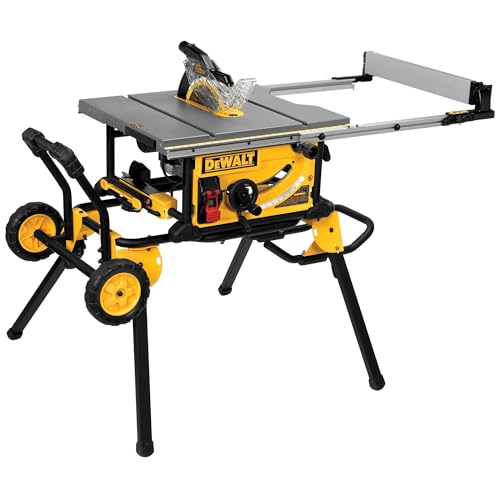
DEWALT DWE7491RS 10-Inch Jobsite Table Saw with Rolling Stand — ASIN B00F2CGXGG
Top Pick
DEWALT DWE7491RS 10-Inch Jobsite Table Saw with Rolling Stand — ASIN B00F2CGXGG
Best for: Home workshops that rip sheet goods and build cabinets, and need a saw that rolls out of the way when the work is done.
The DWE7491RS pairs a 15-amp motor and a 10-inch blade with a 32-1/2-inch rip capacity, the widest in this group, so it handles full sheets of plywood and long cabinet parts without a second setup. Its rack-and-pinion telescoping fence moves with a turn of the front wheel and locks parallel to the blade, which makes repeat cuts faster and more consistent. The folding rolling stand is included, and the saw ships with a 24-tooth carbide blade, a miter gauge, a push stick, and a blade guard assembly. Depth of cut reaches 3-1/8 inches at 90 degrees and 2-1/4 inches at 45 degrees, and a 2-1/2-inch dust port connects to a shop vacuum.
Consideration: At 110 pounds with the stand, it moves on its wheels rather than by hand, so carrying it up stairs is a two-person job.
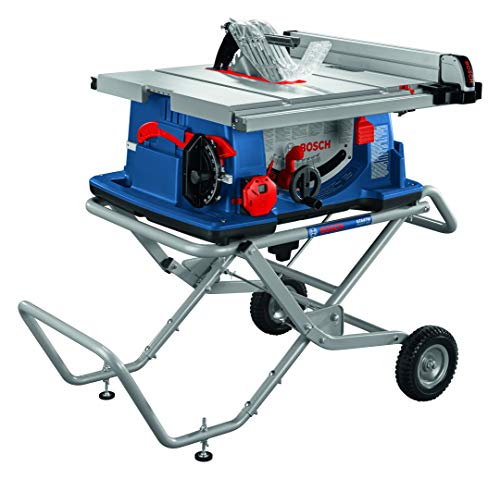
Bosch 4100XC-10 10-Inch Worksite Table Saw with Gravity-Rise Wheeled Stand — ASIN B0851KL858
Runner-Up
Bosch 4100XC-10 10-Inch Worksite Table Saw with Gravity-Rise Wheeled Stand — ASIN B0851KL858
Best for: Woodworkers who move the saw often and want the smoothest setup, with a stand that does the lifting.
The Bosch 4100XC-10 runs a 15-amp motor rated up to 4.0 max horsepower behind a 10-inch blade, with a 30-inch rip capacity that cuts a four-foot sheet in half. Its Gravity-Rise wheeled stand folds and unfolds with one motion, which makes setup quick for a saw that weighs enough to need wheels. A soft-start motor eases the saw up to speed instead of jerking at startup, and constant-response circuitry holds speed under load when the blade meets dense hardwood. The Smart Guard system includes a riving knife, a blade guard, and anti-kickback pawls, and the table measures 30 by 22-1/2 inches.
Consideration: The 30-inch rip capacity is narrower than the DEWALT DWE7491RS, so the widest sheet cuts need the fence at its full extension.
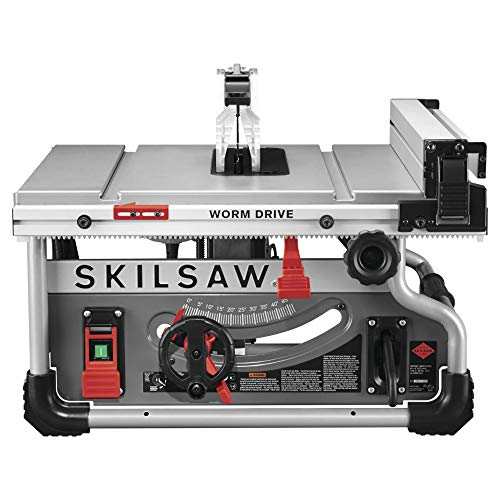
The SPT99T-01 is the lightest saw in this group at 51 pounds, and its 15-amp Dual-Field worm drive motor delivers the torque that worm drive saws are known for when ripping thick stock. The 8-1/4-inch blade and 25-inch rip capacity suit furniture parts, trim, and smaller panels, and the rack-and-pinion fence adjusts with the same wheel-driven motion as the larger jobsite saws. A compact frame and a folding design make it easy to carry to a job or store on a shelf, and the saw includes a blade guard, a riving knife, and anti-kickback pawls. Its worm drive gearing keeps blade speed steady under load, which helps when the cut runs through knots or dense hardwood.
Consideration: The 8-1/4-inch blade cuts less deep than a 10-inch blade, so thick stock may need a flip-and-cut approach or a second pass.
The DWE7485 is a compact benchtop saw built around a 15-amp motor that spins its 8-1/4-inch blade at 5,800 revolutions per minute, the fastest blade speed in this group. Its 24-1/2-inch rip capacity handles most furniture and trim work, and the rack-and-pinion fence keeps settings square across repeat cuts. At 46 pounds it is light enough to lift onto a workbench and store on a shelf, and it bevels from minus 2 degrees to 48 degrees for angled cuts. Depth of cut is 2-9/16 inches at 90 degrees, and the saw ships with a blade guard assembly, a riving knife, anti-kickback pawls, and a push stick.
Consideration: The 24-1/2-inch rip capacity and 8-1/4-inch blade limit sheet work, so full plywood sheets need a first cut with another saw.
Which One Is Right for You?
Choose the DEWALT DWE7491RS if the shop handles sheet goods and cabinet work, because its 32-1/2-inch rip capacity and rolling stand cover the widest range of jobs in this group. Choose the Bosch 4100XC-10 if the saw moves between a garage and a job site, since the gravity-rise stand makes setup the easiest here and the soft-start motor is gentler at startup. Choose the SKILSAW SPT99T-01 if worm drive torque and light weight matter more than maximum rip capacity, for trim and furniture parts carried to the work. Choose the DEWALT DWE7485 if space is the limiting factor, because it is the smallest and lightest saw here and still carries a rack-and-pinion fence and a fast-spinning blade. Any of the four cuts straight and repeats a fence setting, so the deciding factor is how much sheet work the shop does and how far the saw has to travel.
Frequently Asked Questions
What size table saw blade is best for woodworking?
A 10-inch blade is the standard for general woodworking because it cuts 3-1/8 inches deep at 90 degrees, which clears two-by lumber and most hardwood boards in one pass. An 8-1/4-inch blade cuts around 2-9/16 inches deep, which is enough for trim, panels, and furniture parts, and it comes in a lighter and more compact saw. The blade size matters less than fence accuracy for most work, so a smaller saw with a good fence often serves a home shop better than a large saw with a weak one.
Can a jobsite table saw handle cabinet work?
Yes, a jobsite saw with a rack-and-pinion fence and at least 30 inches of rip capacity handles cabinet parts well, because cabinet work is mostly repeatable rip cuts and crosscuts on sheet goods and hardwood. The DEWALT DWE7491RS and the Bosch 4100XC-10 both clear that bar, and their fences hold a setting across a full run of parts. A cabinet saw still wins on mass, vibration, and dust collection, but for a home shop building a kitchen or a set of built-ins, a good jobsite saw is enough.
What is a riving knife and why does it matter?
A riving knife is a flat steel plate mounted directly behind the blade that rides in the kerf as the wood passes through, keeping the cut open so the two halves cannot pinch the blade. Pinching is the main cause of kickback, where the workpiece is thrown back toward the operator, so the riving knife is the single most important safety part on a table saw. It should stay installed for every through cut, and it rises and lowers with the blade so it is always at the right height.
Do I need a dado throat plate?
A dado throat plate is needed only when cutting dados or grooves with a stacked dado blade set, because the standard throat plate has a narrow slot that a wide dado stack cannot pass through. The saws in this guide ship with a standard plate, so a dado set requires a separate zero-clearance insert or a dado plate made for that model. If the work never calls for grooves or rabbets cut on the table saw, the standard plate is all that is needed.
How much rip capacity do I need for sheet goods?
Ripping a full 48-inch sheet of plywood in half needs at least 24 inches of rip capacity, and 30 inches or more makes the cut comfortable with room to guide the sheet. The DEWALT DWE7491RS at 32-1/2 inches and the Bosch 4100XC-10 at 30 inches both clear a half sheet in one pass, while the 24-1/2-inch and 25-inch saws handle a half sheet only with the fence at full extension. For furniture parts and shelving, 24 inches is usually enough, since most parts are narrower than the sheet they came from.
Bottom Line
The DEWALT DWE7491RS is the best woodwork table saw for most home workshops, because it combines the widest rip capacity in this group with a rack-and-pinion fence and a rolling stand that makes a 110-pound saw easy to live with. The Bosch 4100XC-10 is the runner-up for anyone who moves the saw often, the SKILSAW SPT99T-01 brings worm drive torque to a light frame, and the DEWALT DWE7485 is the right call when bench space is tight. Pick by rip capacity first, fence second, and size third, and any of these four will cut straight for years.
Disclosure: As an Amazon Associate, this site earns from qualifying purchases.
J
JD's Woodworks Editorial Team
We compare specs, warranty terms, long-term owner feedback and street pricing before anything earns a spot. Rankings are never paid.
Affiliate disclosure. As an Amazon Associate we earn from qualifying purchases at no extra cost to you. Prices accurate as of the date shown.
Compare the best two stage dust collectors for weekend woodworking projects, with cyclone separation, canister filters, drum sizes and inlet specs compared.
Compare the best cyclone dust collectors for experienced DIY woodworkers, with airflow, canister filtration, remote control and drum capacity compared.
Compare the best wall mounted dust collectors for weekend woodworking projects, with CFM, bag size and filtration from each listing to size one machine right.
Stationary thickness planers that ship with a dust hood, compared for home shops: 15, 20 and 22 inch helical floor models with listing specs and ASINs.
True open-sided thickness planers are rare on Amazon. See the verified open-end pick with a dust connection, its listing specs, safety notes and buying checks.
Floor standing band saws for garage workshops compared on resaw height, throat, motor power and dust ports, with setup and safety checks before buying.

 DEWALT DWE7485 15-Amp 8-1/4-Inch Compact Portable Jobsite Table Saw — ASIN B0842QDW95