
What's inside
- Best Folding Table Saw Outfeed Tables: Which Setup Fits Your Saw?
- Folding Outfeed Table Saw Solutions Compared
- Best Choices by Situation
- Flat Folding Tables: The Most Versatile Option
- Folding Sawhorses and a Replaceable Top
- Roller Stands and Conveyors: Fast but Less Forgiving
- How to Check Compatibility With a Portable Table Saw
- Stability Matters More Than Maximum Capacity
- Ownership Realities and Common Failures
- Final Buying Recommendation
- Related Guides
As an Amazon Associate I earn from qualifying purchases. This post may contain affiliate links at no extra cost to you.
Best Folding Table Saw Outfeed Tables: Which Setup Fits Your Saw?
The best folding table saw outfeed solution for most portable saws is a rigid folding worktable with a 24- to 32-inch-deep top, adjustable feet, and at least a 300-pound working capacity; choose a roller or ball-bearing support instead when storage space matters more than continuous support.
A good outfeed table does more than catch a board. It keeps long stock level with the saw, reduces lifting force at the blade, and gives the operator a predictable place to control the cut. The right choice depends on support area, folded size, setup speed, stability, and whether the table can match the height of a portable table saw.
As an Amazon Associate we earn from qualifying purchases at no extra cost to you.


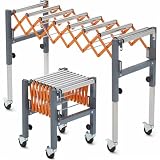
Folding Outfeed Table Saw Solutions Compared
| Solution | Typical support area | Folded or stored size | Typical capacity | Setup time | Best use |
|---|---|---|---|---|---|
| Folding worktable with a flat top | 24–32 in. deep by 24–48 in. wide | About 4–8 in. thick when folded | 300–1,000 lb, depending on design | 1–3 minutes | Sheet goods, cabinet parts, and controlled solo work |
| Folding sawhorses with a plywood panel | 24–36 in. deep by any practical width | Horses fold to roughly 4–7 in. thick each | 500–1,300 lb per pair | 3–8 minutes | Large panels and inexpensive custom setups |
| Folding roller stand | 3–12 in. contact width | About 4–6 in. thick by 24–36 in. long | 100–150 lb at the support | 30–60 seconds | Narrow boards and fast occasional setup |
| Folding conveyor or ball-bearing support | 12–24 in. wide by 24–60 in. long | Usually 6–12 in. thick | 200–700 lb, depending on the frame | 1–3 minutes | Repeated cutting of long boards or sheet stock |
These are useful comparison ranges rather than universal ratings. Capacity is only meaningful when the load is centered, the legs are fully opened, and the floor is reasonably level. A table rated for 500 pounds can still feel unstable if its top is too narrow or its legs are not braced.
Best Choices by Situation
| Your situation | Best choice | Why |
|---|---|---|
| Small shop or apartment garage | Compact folding worktable | Large enough for ordinary boards but stores against a wall |
| Frequent sheet-goods cutting | Two folding sawhorses and a 3/4-inch plywood top | Provides a broad, replaceable surface at low cost |
| Occasional outdoor or jobsite use | Folding roller stand | Lightest and fastest option to transport |
| One-person cutting of long boards | Wide flat table or conveyor support | Prevents the trailing end from dropping or twisting |
| Beginner building a first setup | Adjustable flat-top table | Less alignment work than a homemade frame |
| Heavy hardwood and daily use | Braced folding table with leveling feet | Stability matters more than the smallest folded footprint |
Flat Folding Tables: The Most Versatile Option
A flat folding worktable is usually the best all-round folding outfeed table saw solution. Models such as the WORX Pegasus WX051 illustrate the format: a portable folding work surface with a roughly 31.5-by-25-inch top, a working height near 32 inches, and a 300-pound rated load. That size is suitable for many portable table saws, but it may be too low or too narrow for a particular saw and large sheet goods.
The main advantage is continuous support. A board can slide across the entire surface without falling into the gaps between rollers. A flat table also supports narrow offcuts and irregular stock better than a single roller.
Look for a top that accepts clamps, legs that lock positively, and feet that do not skate across concrete. A table with a 24-inch depth supports a typical 24-inch-wide shelf panel reasonably well. For a full 4-by-8-foot sheet, however, the folding table should supplement side support or a second table rather than carry the entire sheet alone.
Folding Sawhorses and a Replaceable Top
Folding sawhorses provide the largest support area for the least money, especially when paired with a plywood, MDF, or melamine top. The surface can be cut to match the saw and replaced after it becomes damaged. This is particularly useful when using a portable table saw whose legs or stand do not provide a convenient outfeed attachment point.
The trade-off is setup and alignment. Two horses must be positioned parallel, the panel must be secured, and the top must be brought exactly level with the saw table. A 3/4-inch plywood panel measuring 24 by 48 inches weighs approximately 24 pounds; adding a 30-pound folding worktable or a pair of heavy-duty horses can create a setup that is stable but inconvenient to move repeatedly.
Use a sacrificial top if the saw blade may contact the surface. Leave enough clearance around the blade guard and riving knife, and do not attach the panel in a way that restricts the saw’s folding legs or wheel movement.
Roller Stands and Conveyors: Fast but Less Forgiving
A folding roller stand is the quickest answer when the work consists mainly of long, narrow boards. It can be unfolded beside the saw in under a minute and stored in a very small space. Roller stands are also useful as an auxiliary support in front of or behind a broad table.
They are less suitable as the only support for sheet goods. A board can drift sideways, catch on a roller, or tip when its center of gravity moves off the stand. Ball-bearing or multi-roller conveyors offer better continuous contact, but they are usually heavier and have a larger folded footprint.
Choose a roller height with plenty of adjustment range. If the support is even 1/8 inch high, it can push stock into the fence; if it is low, the board may dip as it leaves the saw. Both conditions can affect cut accuracy and increase the effort needed to control the workpiece.
How to Check Compatibility With a Portable Table Saw
- Measure the saw table height. Measure from the floor to the flat cast or stamped surface, not to the top of a removable fence rail.
- Check the folded stand. Make sure the outfeed table will not interfere with folding legs, wheels, power cords, or the saw’s on/off switch.
- Match the surfaces. Set the outfeed surface level with the saw or up to 1/32 inch lower. Never set it higher than the saw table.
- Confirm blade and fence clearance. The support must not touch the riving knife, blade guard, fence, or dust-collection hose.
- Test with the longest stock. Push a scrap board through with the saw unplugged. Check for snagging, side movement, and table flex before making a powered cut.
Portable saws vary considerably in height. Many jobsite saws fall near the 30- to 34-inch range, but the exact dimension depends on the stand. An adjustable table is safer to buy than a fixed-height table unless you have already measured the saw.
Stability Matters More Than Maximum Capacity
Outfeed stability is determined by footprint, bracing, surface friction, and how far the load extends beyond the table. A 40-pound board can produce a strong tipping force if several feet of it hang beyond the support. For that reason, a wide, lower-rated table can be safer than a narrow table with a higher headline capacity.
Lock every hinge and leg brace before use. Place the table so the saw and outfeed surface cannot separate under pressure. On smooth concrete, rubber feet or a thin non-slip mat can prevent creeping, but do not use a soft mat thick enough to make the table rock.
Ownership Realities and Common Failures
- Hinges and leg locks wear first. Keep them free of sawdust and tighten only hardware intended for adjustment. Do not force a jammed locking mechanism.
- Rollers collect resin and dust. Clean them periodically so boards do not drag or skew. Avoid oily residue on surfaces that contact finished wood.
- Thin tops sag. A large folding top needs an underside rail or center support. A sagging top changes the effective height as stock moves across it.
- Capacity ratings are not alignment ratings. A table may hold a heavy object while still flexing enough to spoil a cut.
- Improvised clamps can create hazards. Keep clamps, screws, and edge stops away from the blade path and the underside of the workpiece.
Final Buying Recommendation
Choose a flat folding worktable if you want one portable support for boards, panels, and narrow stock. Choose folding sawhorses with a plywood top when maximum coverage and replaceability matter most. Choose a roller stand when speed, low weight, and compact storage outweigh all-purpose support. For frequent professional use, a braced conveyor or heavy adjustable table is worth the extra folded size because it offers more consistent support.
Before buying, prioritize a levelable height, positive leg locks, a surface at least 24 inches deep, and a capacity comfortably above the heaviest stock you expect to cut. Those characteristics matter more than a large advertised load rating or the smallest possible folded dimensions.