
What's inside
As an Amazon Associate I earn from qualifying purchases. This post may contain affiliate links at no extra cost to you.
A good table saw taper jig holds your workpiece at a repeatable angle, locks down securely near the blade, and sets up in under a minute — and for most woodworkers, an adjustable aluminum jig in the $40–$90 range does all three better than shop-made plywood versions. Below, we compare the tapering jigs worth buying in 2026, mapped to the kind of work you actually do.
As an Amazon Associate we earn from qualifying purchases at no extra cost to you.


What a Table Saw Taper Jig Actually Needs to Do
A taper jig for table saw work is deceptively simple: a base that rides the miter slot (or the rip fence), an adjustable fence that sets the taper angle, and clamps or stops that keep the stock from drifting mid-cut. Where jigs differ — and where cheap ones fail — is in three places:
- Fence adjustment precision. The best jigs let you dial the taper by degrees or by rise-over-run (e.g., “remove 1/4″ over 24″”), so you don’t have to convert furniture plans into angles with a calculator.
- Hold-down security. A taper cut concentrates lateral pressure at the heel of the board. Toggle clamps beat friction stops; star knobs that loosen mid-cut are a common complaint on budget jigs.
- Repeatability. If you’re tapering four table legs, the jig must return to the exact same setting four times. Positive stops and indexed scales matter more than the maximum angle range.
Comparison: Taper Jigs Worth Buying in 2026
| Jig | Max stock length | Taper capacity | Fence adjustment | Hold-down style | Weight | Typical price range |
|---|---|---|---|---|---|---|
| Microjig Microdial Tapering Jig | ~32″ (expandable to 48″+ with second fence) | Up to ~1″ per foot; memory-based setting system | Color-coded dial (0–8 memory slots), no math needed | Grr-Ripper-style gravity heel + optional clamps | ~7 lbs | $130–$160 |
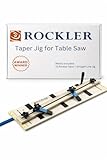
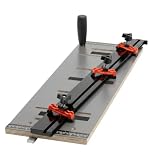
| Rockler Taper/Straight Line Jig | ~36″ | Up to 15° taper or straight-line ripping | Indexed degree scale + tape scale | Two toggle clamps | ~6 lbs | $80–$100 |
| Powertec 71035 Taper Jig | ~24″ | Up to ~3″ of taper over jig length | Sliding fence, wing-nut lock, printed scale | Adjustable stop blocks (no clamps) | ~3 lbs | $35–$50 |
| Kreg-style / generic aluminum miter-bar jig | ~24–30″ | Varies; typically up to 15° | Protractor-style hinge, single lock knob | Friction stop or single clamp | 3–5 lbs | $40–$70 |
| Shop-made plywood jig (plans) | Whatever you build it to | Whatever you build it to | Pivot bolt + lock knob | Toggle clamps added by you (~$15) | 4–8 lbs | $15–$30 in materials |
Two things stand out in the numbers. First, the Microjig Microdial is the only jig here that solves repeatability as a system — its memory dial lets you cut a taper, change setups for another operation, and return to the identical taper days later. Second, the Rockler jig’s dual role as a straight-line rip jig gives it real value for anyone milling rough lumber, not just tapering legs.
Pick by Situation
Occasional tapers, small shop, tight budget
A budget aluminum table saw tapering jig like the Powertec handles legs and narrow stock fine if you add one upgrade: replace or supplement the stop blocks with a toggle clamp ($8–$15). The printed scales drift, so mark your setting with a pencil line on the base rather than trusting the scale to return.
Furniture work — tapered legs, angled parts, batch production
The Microjig Microdial earns its price the moment you cut a second identical leg. Tapering four legs by “set once, cut four” vs. “set four times by eye” is the difference between matching legs and a wobbly table. It also doubles as a jointer substitute for edge-jointing boards.
Mixed work — tapers plus straight-line ripping rough lumber
The Rockler jig is the pragmatic middle ground. Its toggle clamps are genuinely secure on narrow stock, the degree scale is readable, and the straight-line mode saves you from building a separate sled for edge-trimming bowed boards.
Long workpieces or unusual angles
Most commercial tapering jigs top out around 32–36″ of stock. For tapers longer than that — bed posts, long aprons, architectural trim — a shop-made jig at 48–60″ is the practical answer, or a tapering sled that rides the fence rather than a pivoting jig.
Tenons instead of tapers
A related search worth untangling: a table saw tenon jig is a different tool entirely. Tenon jigs (like the Shop Fox W1768 or Delta-style cast-iron jigs) hold stock vertically and ride the rip fence to cut cheeks and shoulders. If your project list is mortise-and-tenon furniture rather than tapered legs, buy the tenon jig; it cannot substitute for a taper jig, and vice versa. Some woodworkers end up needing both.
Setup and Repeatability: A Quick Reference
Whichever taper jig for table saw use you choose, this sequence prevents the two most common failures — tapered cuts that vary leg-to-leg, and stock drifting off the fence:
- Zero the blade. Confirm your blade is at 90° to the table with a square. Taper jigs assume a vertical blade; any tilt compounds the error.
- Set the taper by measurement, not angle. Mark the finished taper on your workpiece, lay it on the jig, and adjust the fence until the blade path follows your line. Degree scales are starting points, not guarantees.
- Clamp at the trailing end. Drift almost always happens at the heel. Position your clamp or stop where the blade exits.
- Test on scrap at final thickness. A 2×2 offcut tells you everything.
- Cut all matching pieces in one session. Wood moves; a jig set today and “reset” tomorrow produces a 1–2% variance that’s visible on four legs standing side by side.
Ownership Realities Nobody Mentions in Listings
- Wear points: the pivot bolt and lock knob loosen first on budget jigs. A drop of threadlocker and a yearly check keeps the fence from creeping. Toggle clamp pads compress over time — replacements cost a few dollars.
- Miter-bar slop: most jigs ship with adjustable miter bars that arrive loose in the slot. Spend five minutes snugging the set screws; bar slop translates directly to taper inconsistency.
- Sawdust packing: chips jam the pivot point and lift the fence a degree or two. Blow out the hinge before each session.
- Common mistake: pushing the jig by the workpiece instead of by the jig base. Push the jig; the stock is only along for the ride.
Bottom Line
For a first table saw tapering jig under $50, the Powertec plus one aftermarket toggle clamp covers occasional work honestly. For anyone tapering legs more than a few times a year, the Microjig Microdial’s memory dial and expandability justify the roughly $100 premium — the cost math is simple: if it saves you one ruined $40 hardwood leg, it’s halfway paid for. And if your real need is joinery, redirect that budget to a dedicated table saw tenon jig instead — it’s the right tool for a different cut.