Compare the best bandsaw fence options for straight rips and steady resaw work, from rail-mounted and magnetic fences to clamp-on guides for benchtop saws.
Compare the best bandsaw fence options for straight rips and steady resaw work, from rail-mounted and magnetic fences to clamp-on guides for benchtop saws.
As an Amazon Associate I earn from qualifying purchases. This post may contain affiliate links at no extra cost to you.
A bandsaw fence turns a freehand saw into a straight-cutting machine. Without one, every rip depends on your hands holding a steady line against a moving blade, and the cut wanders. With one, the board rides a fixed guide from the first inch to the last, so rips come out parallel and resaw cuts stay even. This guide covers aftermarket fences only: add-on fences that replace or upgrade the fence your saw shipped with. No complete saws appear here, and every pick is a fence that bolts, clamps, or sticks onto a bandsaw table you already own.
OUR TOP PICK
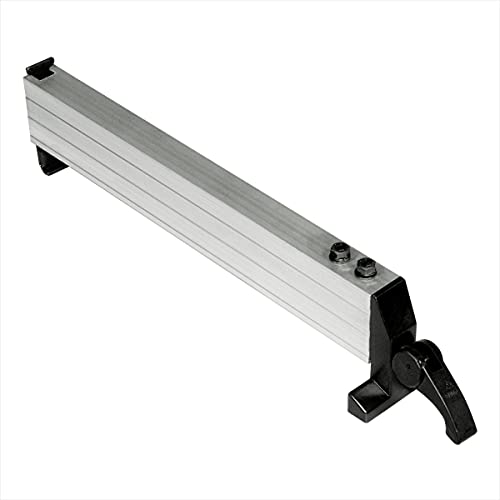
POWERTEC BS900RF Rip Fence for POWERTEC BS900 Wood Band Saw
The five fences below cover the main ways a fence mounts to a saw. One clamps straight onto a small benchtop table with a cam lever. One pairs a long straight edge clamp with a fence face for drift control. One holds itself in place with magnets and moves anywhere on a cast iron table. One rides a fixed rail with a measuring scale for repeatable settings. One clamps onto almost any table up to eighteen inches deep and doubles as a drill press fence. Match the mount to your table first, then weigh fence height, locking strength, and how often you move the fence between cuts.
What to look for
Fit comes first. A fence that cannot mount to your table is useless no matter how rigid it is. Measure the table front to back and side to side before you buy, and check what the table is made of. Magnetic fences grip cast iron and steel tables only; they do not hold on aluminum tables. Rail-mounted fences need a rail screwed to the table edge, and some tables need new holes drilled and tapped before the rail goes on. Clamp-on fences need a table edge they can grip, so check the table thickness and whether the edge is clear of obstructions.
Fence face height matters for tall work. A low face guides thin boards well but gives a tall board little support, and a tall board can lean away from the blade near the top of the cut. If you resaw wide boards often, look for a tall face or a fence that accepts an auxiliary tall face bolted to it. Face length matters too: a short face gives the board less guidance at the beginning of the cut, while a long face keeps a long board tracking straight.
Locking strength decides whether the fence stays square under load. A fence that shifts a fraction of an inch mid-cut ruins the board. Cam levers lock fast and hold well on clamp-on fences. Rail fences lock to the rail with a lever or a knob and stay put once set. Magnetic fences rely on magnet grip, so they need a clean, flat table surface and a firm twist of the locking knobs. Whatever the lock, check square against the blade with a square before each session, and again after moving the fence.
Drift adjustment is the feature that separates a good fence from a poor one. Bandsaw blades drift: the blade cuts at a slight angle to the fence line, and a fence fixed square to the table fights that angle. A fence that angles slightly, or a fence face you can shim, lets you align the fence to the blade drift instead of forcing the board against a square fence. If your saw drifts, a fence with angle adjustment saves wood.
Weight and material tell you how rigid the fence is. Extruded aluminum fences are light and stay straight; a warped fence cannot guide a straight cut. Steel fences are heavier and stiffer but add weight to a small saw. A fence that feels flimsy in the hand will flex under side load from a thick board, so rigidity matters more than weight alone.
POWERTEC BS900RF Rip Fence for POWERTEC BS900 Wood Band Saw
Top Pick
POWERTEC BS900RF Rip Fence for POWERTEC BS900 Wood Band Saw
The POWERTEC BS900RF is a cam-lever rip fence built for small benchtop band saws, and it is the simplest fence in this guide. It clamps directly to the table with a cam lever, so there are no rails to install and no holes to drill. The fence is extruded aluminum, which keeps it light and straight, and it arrives fully assembled. You set it on the table, flip the cam lever, and cut.
Its clamp adjusts from eleven and three-eighths inches to twelve inches, which covers the tables on most nine-inch saws from POWERTEC, WEN, Ryobi, Delta, Craftsman, and Harbor Freight. That narrow fit range is the fence’s main limit: it suits small benchtop saws and nothing bigger. If your table measures outside that range, the cam cannot grip, and the fence will not hold. Measure the table before you buy.
The fence gives small-saw owners what they usually lack most: a straight, square guide for ripping. Benchtop saws often ship with no fence at all, or with a thin guide that flexes. The BS900RF solves the single biggest frustration on a nine-inch saw, which is cutting a straight line, and it does so without permanent modification to the saw. Some owners note needing to file a small amount from the guide for an exact fit on older Delta models, so check the fit on your table and be ready for a minor adjustment.
O’SKOOL 24 Inch Straight Edge Guide Clamp with Band Saw Fence
Runner-Up
O’SKOOL 24 Inch Straight Edge Guide Clamp with Band Saw Fence
The O’SKOOL PTA18 combines two tools in one box: a twenty-four-inch straight edge guide clamp and a band saw fence. The clamp grips the workpiece or the table edge with a quick-release mechanism, and the fence face gives the board a guide to ride against. Together they hold the board steady and keep hands away from the blade, which matters on cuts where the board wants to wander.
The fence allows slight angle adjustment during clamping, which is the feature that makes it useful for drift. When a blade drifts, you angle the fence a touch so the fence line matches the blade path instead of fighting it. That small adjustment keeps the cut straight without forcing the board. The quick-release clamp makes setup fast: attach, adjust, lock, and cut, then release and move on.
At four and eighty-eight hundredths pounds, the O’SKOOL is light enough to move between machines, and the twenty-four-inch clamp length suits tables on Delta and Rikon saws as well as other mid-size machines. The package measures about thirty-four and a half inches long, so it stores easily on a shelf or a wall hook. Note that the listing gives no assembly or usage instructions, so a first-time user should study the parts and set the fence square against the blade with a square before the first cut. The fence is a guide and a clamp, not a rail system, so it will not hold a setting across a long run of identical cuts the way a rail-mounted fence does; you set it fresh for each cut.
The Carter Magfence II is a magnetic fence that anchors to a cast iron or steel bandsaw table with no clamps and no drilling. A twist of two knobs engages powerful magnets that hold the fence in place, and another twist releases it, so you can reposition the fence anywhere on the table in seconds. That freedom is its main strength: you can set the fence at any angle, which helps when you need to cut along a line that is not parallel to the table edge, and you can move it between cuts without tools.
The fence face measures fifteen inches long by three inches high, in an aluminum body that weighs about three and a quarter pounds. The fifteen-inch face gives a board solid guidance through the cut, and the three-inch height suits most ripping and resaw work on boards up to that height. Carter lists the part number as MFII, and the maker states the fence is not discontinued, so replacement parts and support remain available.
The magnetic mount sets one hard limit: it works only on ferrous tables. Cast iron and steel tables grip well; aluminum tables do not grip at all. Check your table with a magnet before you buy. The magnet also needs a clean, flat surface, so wipe sawdust and pitch from the table before setting the fence. A dirty table weakens the hold, and a fence that slips mid-cut is worse than no fence. Used on the right table, the Magfence II is the fastest fence to set and move in this guide, and it suits shops where the fence comes on and off the saw between jobs.
The Kreg KMS7200 is a rail-mounted precision fence built for most fourteen-inch band saws, including Jet, Delta, Grizzly, and General models. It mounts on an aluminum rail fixed to the table edge, with a measuring scale on the rail and a micro-adjust control on the fence head, so you can return to the same setting cut after cut. That repeatability is what a rail system gives you that a clamp-on fence cannot: set the fence once, lock it, and every board comes out the same width.
The fence head rides the rail and locks with a lever, holding square under load from thick boards. The aluminum rail and fence body stay straight and resist warping, and the scale on the rail reads clearly enough to set a width without a tape measure. For shops that rip the same widths often, the KMS7200 turns the bandsaw into a reliable ripping station rather than a freehand tool.
Installation is the fence’s main demand. The rail screws to the table edge, and some tables need new holes drilled and tapped into the cast iron before the rail goes on. Owners who have fitted the fence to a Craftsman fourteen-inch saw describe tapping threads into the table as part of the job. That is a one-time job, and once the rail is on, the fence works like a fixed part of the saw. If you are not comfortable drilling and tapping cast iron, factor that into your choice, or have the work done by someone who is. The fence suits fourteen-inch saws; it is not made for small benchtop saws or for saws whose tables cannot take a rail.
The Peachtree ProGrip is a universal clamp-on fence that fits any band saw table up to eighteen inches front to back, which makes it the widest-fitting fence in this guide. It is machined from warp-resistant aluminum and weighs four and thirty-nine hundredths pounds, so it is light to move but stiff enough to hold a straight line under load. A built-in straight edge helps you set the fence square, and a triple cam locking mechanism gives three levels of clamping force, so the fence locks down with no wobble.
The ProGrip doubles as a drill press fence, which makes it a useful second tool in a small shop: the same fence guides boards on the band saw and guides repetitive drilling on the drill press, with an included stop block for repeat cuts. The stop block also serves on the band saw for repetitive ripping, letting you cut the same width again and again without measuring each board.
The universal fit is the fence’s main strength and its main thing to verify. Eighteen inches front to back covers most fourteen-inch and larger saws, but measure your table before you buy, and check that the table edge is clear for the clamps. The fence is a clamp-on design, so it does not hold a setting across a session the way a rail-mounted fence does; you set it for each cut. For shops that want one fence for several machines, or a fence that moves between the band saw and the drill press, the ProGrip is the most versatile pick here.
Comparison
Fence
Mount style
Fits
Fence face
Locking
Weight
POWERTEC BS900RF
Cam-lever clamp-on
9-inch benchtop saws, tables 11-1/8 to 11-13/16 in
Extruded aluminum
Cam lever
Light
O’SKOOL PTA18
Straight edge clamp + fence
Delta, Rikon and similar mid-size saws
24-inch clamp + fence face
Quick-release clamp
4.88 lb
Carter Magfence II
Magnetic
Ferrous tables, cast iron or steel
15 in long x 3 in high
Magnet, two knobs
3.27 lb
Kreg KMS7200
Rail-mounted
Most 14-inch saws, Jet, Delta, Grizzly, General
Aluminum rail with scale
Lever lock on rail
Rail system
Peachtree ProGrip
Triple cam clamp-on
Tables up to 18 in front to back
Aluminum, straight edge built in
Triple cam lock
4.39 lb
Frequently asked questions
Will a universal fence fit my saw?
Measure the table front to back and side to side first, then compare those numbers with the fence maker’s fit range. A clamp-on fence needs a table edge it can grip and a table depth inside its range. A magnetic fence needs a ferrous table, so check yours with a magnet: cast iron and steel grip, aluminum does not. A rail-mounted fence needs a table edge that accepts a rail, and some tables need holes drilled and tapped. If the table size or material falls outside the fence’s range, the fence will not hold no matter how well it is made.
Do I need a tall fence face for resaw work?
A tall board needs a tall guide. A three-inch face guides boards up to about three inches high well, but a taller board can lean away from the blade near the top of the cut. If you resaw wide boards often, look for a fence that accepts an auxiliary tall face bolted to it, or build a tall wooden face that clamps to the fence. None of the fences in this guide ships with a tall resaw face, so plan on adding one if your resaw work runs taller than the fence face.
Which holds better, magnetic or rail-mounted?
A rail-mounted fence holds a setting best. Once the rail is fixed and the fence is locked to it, the fence stays square and returns to the same width cut after cut. A magnetic fence holds well on a clean, flat cast iron table, but it relies on magnet grip, so a dirty table or a heavy side load can shift it. Magnetic fences win on speed: they set and move in seconds with no tools, while a rail fence takes a one-time installation and then holds its setting. Choose the rail fence for repeatable ripping and the magnetic fence for fast moves between varied cuts.
How to choose
Begin with the table. Measure front to back and side to side, note whether the table is cast iron, steel, or aluminum, and check whether the edge is clear for clamps or a rail. That single check rules out fences that cannot mount to your saw, and it narrows five options to two or three in most shops.
Next, weigh how you cut. If you rip the same widths often, a rail-mounted fence like the Kreg KMS7200 pays for its installation with repeatable settings. If you move the fence between varied cuts all day, a magnetic fence like the Carter Magfence II saves time on every move. If you own a small benchtop saw, the POWERTEC BS900RF is the only fence here made for that table size. If your saw drifts, favor a fence with angle adjustment, like the O’SKOOL PTA18, or plan on shimming the fence face.
Finally, check the fence face against the boards you cut most. A low face suits thin stock; tall resaw boards need a tall face or an auxiliary face bolted on. Buy the fence that fits your table, matches your cutting pattern, and holds square under the thickest board you cut, and check square against the blade before each session.
Disclosure: As an Amazon Associate, we may earn a commission from qualifying purchases made through links in this article, at no additional cost to you.
J
JD's Woodworks Editorial Team
We compare specs, warranty terms, long-term owner feedback and street pricing before anything earns a spot. Rankings are never paid.
Affiliate disclosure. As an Amazon Associate we earn from qualifying purchases at no extra cost to you. Prices accurate as of the date shown.
Table saws under the 1500 mark compared: the Grizzly G0771Z and Shop Fox W1837 hybrid saws with cast iron tables, 2 HP motors and T-square fences, specs from their listings.
Table saws for fine woodworking compared: the SawStop Professional Cabinet Saw and Powermatic PM1000, judged on fence precision, table flatness and vibration from listing specs.
Table saw combos explained: saws sold with a stand and accessories in one listing, what to check in the box, and which bundle fits your shop or jobsite.
Compare the best planer digital thickness gauges and digital readout kits for portable planers, with fit, resolution and mounting checks before you buy.
Model table saws for scale modelling and hobby work compared: the precision Proxxon FET 37070 and the compact Saker mini table saw, with specs taken from their Amazon listings.
Three CoreXY 3D printers for product development, each with the architecture stated on its listing: an enclosed multicolor machine, a large-format enclosed model and a heated-chamber model.

 POWERTEC BS900RF Rip Fence for POWERTEC BS900 Wood Band Saw
 O’SKOOL 24 Inch Straight Edge Guide Clamp with Band Saw Fence
 Carter Magfence II Universal Magnetic Fence
 Kreg Precision Band Saw Fence KMS7200
 Peachtree ProGrip Universal Bandsaw Fence









