4 Best Clamp Meters for Home Electrical Use (November 2026)
Compare four clamp meters for home electrical checks, from simple AC checks to full AC/DC testing, with jaw size, CAT categories and included leads explained.
Compare four clamp meters for home electrical checks, from simple AC checks to full AC/DC testing, with jaw size, CAT categories and included leads explained.
As an Amazon Associate I earn from qualifying purchases. This post may contain affiliate links at no extra cost to you.
A clamp meter earns its place in a toolbox when you need to know how much current a circuit carries without breaking the circuit. The real decision is which meter matches the work you do at home: checking a breaker that keeps tripping, tracing a load on a workshop circuit, or confirming that a dead outlet is truly dead before you touch a wire. A meter with more modes than you will ever use only slows you down, while one that cannot measure your panel current leaves you guessing.
This guide is for homeowners, workshop owners, and renters who handle basic electrical checks and want a meter they can trust for those jobs. It covers four clamp meters chosen from their Amazon listings, from a simple auto-ranging model for occasional checks to a full-featured meter for deeper troubleshooting. Each pick is described from the name and specifications shown on its Amazon listing, so you can see what it measures, what comes in the box, and where its limits sit.
Quick Picks
As an Amazon Associate we earn from qualifying purchases.
Product
Best for
Key spec from title
Klein Tools CL120
Occasional AC checks around the house
Auto-Ranging 400 Amp AC
Fluke 323
Straightforward AC troubleshooting with a trusted build
Measures AC Current to 400 A
KAIWEETS HT206D
Broad AC/DC testing with temperature checks
T-RMS 6000 Counts
Klein Tools CL800
Full-featured troubleshooting with LoZ and temperature
Auto-Ranging 600 Amp AC/DC
How to Choose
AC Current, DC Current, or Both
The first question is what kind of current you need to measure through the clamp. Most household circuits run on alternating current, so a meter that reads AC current through its jaw covers breaker checks, appliance loads, and workshop circuits. Direct current matters for battery systems, solar components, or vehicle wiring, and only a meter that lists DC current through the clamp can read it that way. The Fluke 323 and Klein CL120 read AC current through the jaw and use test leads for voltage, resistance, and continuity. The KAIWEETS HT206D and Klein CL800 read both AC and DC current through the jaw, so they fit homes where battery or inverter work sits alongside ordinary mains circuits.
Jaw Size and the Spaces You Work In
A clamp meter is only useful if its jaw fits around the conductor you need to measure. Household panels, junction boxes, and crowded workshop wiring often leave little room, and a jaw that cannot close around a single wire gives no reading at all. The Fluke 323 opens to 30 mm, which handles the individual conductors found in most residential panels without forcing the meter into place. The Klein CL800 has a jaw of 1-3/8 inches, a similar working size that fits home panel wiring while staying compact enough to carry. Before you choose, look at how the wires are bundled in your panel, because a meter that fits a tidy panel may struggle where wires are packed tight.
True RMS and the Loads in a Modern Home
Modern homes are full of loads that do not draw current in a smooth wave: LED drivers, variable-speed motors, computers, and chargers all distort the waveform a meter sees. A True RMS meter measures the real heating value of that distorted current, while a simpler averaging meter can read noticeably low on the same circuit. That difference matters when you are deciding whether a circuit is overloaded, because an under-reading meter can tell you a circuit is fine when it is not. The Fluke 323, KAIWEETS HT206D, and Klein CL800 all list True RMS measurement. The Klein CL120 does not list True RMS, so it fits best for simple resistive loads and basic checks.
Safety Categories, Leads, and What Comes in the Box
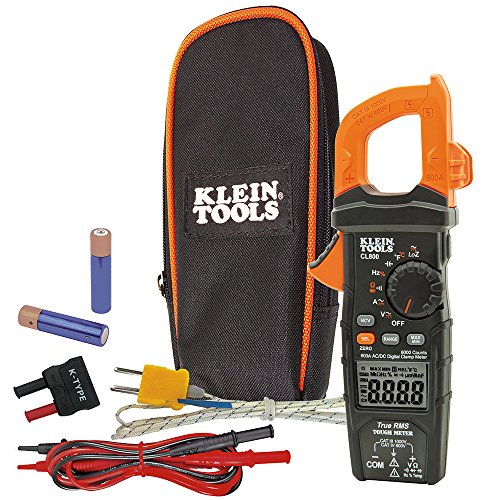
A clamp meter is a safety tool as much as a measuring tool, so its overvoltage category deserves a look. It describes the electrical environment the meter is built for, and one built for a lower category than your panel should not be used there. The Fluke 323 lists CAT IV 300V and CAT III 600V, while the Klein CL800 lists CAT IV 600V and CAT III 1000V, so check the listing for the exact model you buy. Also look at what ships in the box: the Klein CL800 includes a case, leads, a thermocouple with adapter, and batteries, while the Fluke 323 includes a soft case. A meter without leads cannot check voltage or continuity until you buy them.
The 4 Best Options
Klein Tools CL120 Digital Clamp Meter
Top Pick
Klein Tools CL120 Digital Clamp Meter
Best for: Homeowners who want a simple auto-ranging meter for occasional AC checks.
Auto-ranging digital clamp meter
AC current through the clamp up to 400 A
AC/DC voltage, resistance, and continuity via test leads
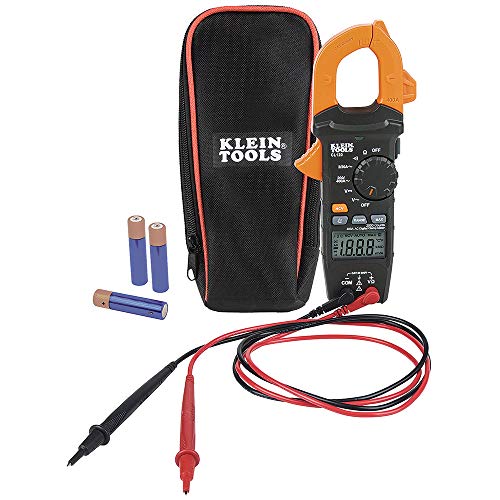
The Klein CL120 is the simplest meter in this guide, and that simplicity is its main strength for a homeowner who checks a circuit a few times a year. It auto-ranges, so you turn the dial to the function you need and the meter picks the range, removing the most common beginner mistake. Its jaw reads AC current, while the included test leads handle voltage, resistance, and continuity, covering the checks that come up most often in a house. A non-contact voltage tester built into the jaw tip lets you check whether a wire is live before you clamp around it.
Watch out for: It reads AC current through the jaw only, so it cannot measure DC current without another tool, and its listing does not mention True RMS.
Fluke 323 True-RMS Clamp Meter
Runner-Up
Fluke 323 True-RMS Clamp Meter
Best for: Homeowners who want a straightforward True RMS meter for AC troubleshooting in residential panels.
The Fluke 323 is the meter to choose when you want a focused tool with a strong safety category and no extra modes to get in the way. It measures AC current to 400 A through the jaw, AC and DC voltage to 600 V, and resistance to 4 kΩ, with an audible continuity check that lets you keep your eyes on the probes. True RMS sensing keeps its readings honest on distorted waveforms from LED drivers and variable-speed motors. Its slim body and 30 mm jaw fit crowded panels, and the included soft case keeps meter and leads together in a drawer.
Watch out for: It does not measure DC current through the clamp, so battery and solar DC work needs a different meter.
KAIWEETS HT206D Digital Clamp Meter
KAIWEETS HT206D Digital Clamp Meter
Best for: Workshop owners who need AC/DC current, temperature, and a broad set of functions in one meter.
The KAIWEETS HT206D is the versatile pick in this guide, covering AC and DC current through the jaw plus a wide set of functions through its test leads. Its 6000-count True RMS display gives finer resolution than the simpler meters here, which helps when comparing small differences between circuits or tracking a load that changes as equipment cycles. Temperature measurement through the included K-type thermocouple adds a useful check for warm breakers, motor housings, and heating elements. Capacitance, diode, continuity, and duty-cycle functions round out a meter that suits a home workshop where electrical work mixes with appliance repair and automotive checks.
Watch out for: Its wide function set means more dial positions to learn, so read the manual and confirm each function before relying on a reading.
Klein Tools CL800 Digital Clamp Meter
Klein Tools CL800 Digital Clamp Meter
Best for: Frequent troubleshooters who want AC/DC current, LoZ mode, and temperature in a rugged meter.
Auto-ranging True RMS digital clamp meter
AC/DC current up to 600 A through the clamp
Maximum operating voltage of 1000 V
Low-impedance mode and non-contact voltage detection
The Klein CL800 is the most capable meter in this guide, built for homeowners who troubleshoot often and want extra functions ready when a job turns complicated. It measures AC and DC current to 600 A through the jaw and AC and DC voltage to 1000 V, with True RMS sensing, a low-impedance mode that helps clear ghost voltages, and non-contact voltage detection. Temperature measurement through the included thermocouple, plus frequency, capacitance, diode, and continuity functions, covers most of what a home workshop meets. Its CAT IV 600V and CAT III 1000V listing, 6.6-foot drop protection, and included case, leads, thermocouple with adapter, and batteries make it a complete kit.
Watch out for: Its full feature set and higher voltage range are more than an occasional user needs, so simpler meters suit lighter use.
Which One Fits Your Situation
You Check a Circuit a Few Times a Year
Choose the Klein CL120 when your electrical work is occasional and mostly involves mains circuits. Its auto-ranging operation and built-in non-contact voltage check keep the routine simple, and its 400 A AC jaw covers the loads in a typical home. You give up DC current measurement and True RMS, but for a breaker check or a dead-outlet check, that trade keeps the tool easy to pick up after months in a drawer.
You Want a Simple Meter You Can Trust in a Panel
Choose the Fluke 323 when you want True RMS readings and a clear safety category in a meter with few modes to confuse the job. Its 400 A AC range, 600 V voltage range, and 30 mm jaw fit residential panels well, and the audible continuity check speeds up basic fault-finding. The missing DC current measurement is the only real limit, and it only matters if you work on battery or solar circuits.
Your Workshop Mixes Electrical, Appliance, and Automotive Work
Choose the KAIWEETS HT206D when your work crosses between mains wiring, battery systems, and appliance repair. Its AC/DC clamp current, temperature function, and 6000-count display cover more situations than either simple meter, and its auto-ranging operation keeps the extra functions manageable. Spend an evening learning its dial positions before the first real job, and it will cover most of what a home workshop asks of it.
You Troubleshoot Often and Want Every Function Ready
Choose the Klein CL800 when electrical troubleshooting is a regular part of your week rather than an occasional chore. Its 600 A AC/DC clamp, LoZ mode for ghost voltages, temperature probe, and strong safety category handle the awkward jobs that simpler meters cannot, and the included case and accessories mean it is ready to use from the box. It is the most capable pick here, so it suits the buyer who will actually use that capability.
Safety Notes
Treat every circuit as live until your meter shows otherwise, and confirm the meter works by checking a known live source before and after a dead-circuit check. Keep your fingers behind the finger guard on the meter and the leads, never clamp around more than one conductor at a time when measuring current, and do not use a meter with cracked housing or damaged leads. Match the meter’s category to the panel you are working on, and call a licensed electrician for anything inside a main service panel that you are not confident handling. A clamp meter helps you see what a circuit is doing; it does not make an unsafe job safe.
Common Mistakes
Clamping around a whole cable instead of a single conductor, which cancels the reading and looks like zero current.
Using a meter on a panel its category was not built for, especially at a main service entrance.
Forgetting that an AC-only clamp cannot read DC current, then trusting a zero reading on a battery circuit.
Measuring voltage with the leads on the wrong function or range and misreading the result.
Ignoring a low-battery warning, which can make readings unreliable at the moment you need them most.
Frequently Asked Questions
Can a clamp meter measure current without disconnecting a wire?
Yes, that is the main advantage of a clamp meter. You open the jaw, close it around a single conductor, and the meter reads the current flowing through that wire without breaking the circuit. Clamp around one conductor only, because clamping around a whole cable with both conductors inside cancels the magnetic field and gives a misleading reading.
Do I need a meter that measures DC current for home use?
Most household mains work needs AC current only, so an AC-only clamp meter covers breaker checks, appliance loads, and workshop circuits. You need DC current through the clamp if you work on battery banks, solar components, or vehicle wiring. The KAIWEETS HT206D and the Klein CL800 in this guide measure DC current through the jaw, while the Fluke 323 and Klein CL120 do not.
What does True RMS mean on a clamp meter?
True RMS means the meter measures the real heating value of the current, including distortion from LED drivers, chargers, and variable-speed motors. A simpler averaging meter can read low on those loads, which may hide an overloaded circuit. Three meters in this guide list True RMS, so they suit modern homes where electronic loads are common.
How do I check whether an outlet is really dead before working on it?
Turn off the breaker, then use the non-contact voltage function or the test leads to check the outlet, and confirm the meter itself is working by checking a known live outlet first. A zero reading only counts if the meter proves it can still detect voltage on a live source. If you are unsure at any step, leave the breaker off and call a licensed electrician.
J
JD's Woodworks Editorial Team
We compare specs, warranty terms, long-term owner feedback and street pricing before anything earns a spot. Rankings are never paid.
Affiliate disclosure. As an Amazon Associate we earn from qualifying purchases at no extra cost to you. Prices accurate as of the date shown.
Find the best wpa 3 routers for safer home Wi-Fi, with Wi-Fi 6 and Wi-Fi 6E models that protect every device on the network for families and small offices.
Compare 4 wireless routers that pair well with Excede satellite internet, from Wi-Fi 7 standalones to a mesh kit for wide rural homes and busy families.
Looking for the best wifi routers 1gb? Compare four gigabit routers for home internet, with Wi-Fi speed, ports, and coverage for each model and every home.
Looking for the best twc modems routers? Compare three modem-router combos approved for Spectrum cable, with DOCSIS, Wi-Fi, and ports explained for every home.
Looking for the best routers with verizon fios? Compare three routers that work with a FiOS connection, with Wi-Fi speed, ports, and coverage for every home.
Compare the best routers for wireless internet at home by band, coverage, device handling and mesh options, using only the specs stated on each Amazon listing.
Compare the best routers for security by VPN support, named protection services, guest networks and update handling, taken from the wording of each Amazon listing.
Compare the best routers for schools and classrooms by device capacity, mesh expansion, central app management and content controls named on each Amazon listing.
Compare the best routers for a homelab by VLAN support, multi-gig wired ports, VPN throughput and expansion options, with specs taken from each Amazon listing.



 Klein Tools CL800 Digital Clamp Meter