
What's inside
As an Amazon Associate I earn from qualifying purchases. This post may contain affiliate links at no extra cost to you.
Best Drill Presses for Home Use
The best drill press for home use is usually a 10- to 12-inch benchtop model with variable speed, a table that tilts, and a motor compatible with your workshop’s outlet; choose a compact 8-inch press for occasional small parts, or a floor model if you regularly drill wide stock and have room to dedicate to it.
For home workshops, the deciding factors aren’t just capacity and power. A press has to fit through the door, sit securely on a bench, run on the available circuit, and be manageable to assemble. The picks below are established models; confirm current specifications and electrical requirements with the manufacturer before buying, since product versions can change.
As an Amazon Associate we earn from qualifying purchases at no extra cost to you.


Quick picks by workshop situation
| Home-shop situation | Best fit | Why it fits | Trade-off |
|---|---|---|---|
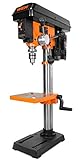
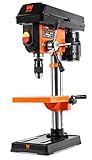
| Very limited bench space; small projects | WEN 4208T, 8-inch benchtop | Compact, 5-speed layout; suited to small parts and routine drilling | Less reach and capacity than a 10- or 12-inch press |
| General DIY and furniture repair | WEN 4212T, 10-inch benchtop | Variable-speed control avoids frequent belt changes | Still needs a stable bench and clearance for tall work |
| Frequent woodworking with a little more reach | WEN 4214T, 12-inch benchtop | More capacity than a compact press, with electronic variable speed | Heavier and more demanding to lift onto a bench |
| Large workpieces or a permanent drilling station | JET JDP-17, 17-inch floor model | Floor-standing format and greater reach for larger stock | Higher cost, larger footprint, and greater setup effort |
These are different classes of machine, not interchangeable substitutes. A 17-inch floor press is overkill for hanging shelves, while a compact press may be frustrating if the work regularly exceeds its throat capacity. “Swing” is twice the distance from the spindle center to the column, so a 12-inch-swing press can drill to the center of a board about 12 inches wide when positioned appropriately.
What matters in a home workshop
Noise and vibration
All these presses make motor and cutting noise; the bit and material often contribute more than the machine itself. A sharp bit, a secure workpiece, and the right speed help reduce squealing and chatter. Benchtop presses can transmit vibration into a hollow or lightweight bench. Bolt the base down or secure it to a heavy, stable surface, and check that the belt cover and table hardware are snug. If noise is a concern in a shared home, plan work for reasonable hours rather than assuming a “quiet” model will be silent.
Electrical requirements
Many small benchtop presses are designed for ordinary household supply, but plug type, voltage, amperage, and motor rating vary by model and region. Check the nameplate and manual, and avoid sharing an overloaded circuit with high-draw tools. Floor models may have more demanding electrical requirements. Do not use an adapter to bypass grounding, and consult a qualified electrician if the circuit or outlet is uncertain.
Footprint, reach, and storage
A press needs more space than its base occupies. Leave room to raise the head or open the belt cover, lower and raise the table, and fit long stock in front of and behind the column. Measure the tallest piece you expect to drill, including the bit and chuck, before choosing a location. A benchtop press saves floor space but occupies valuable bench area; a floor model preserves the bench yet permanently claims floor space.
Setup effort
Benchtop machines are easier to place, but they are not necessarily easy to lift safely: the head and column can be awkward, and some presses are heavy enough to call for a second person. Floor models involve more lifting and alignment. In either case, assemble on a level surface, tighten the column and table supports, check that the table is square to the spindle, and secure the base before drilling. A press that shifts under load is a safety problem, not just an accuracy issue.
Choosing by task and frequency
| Typical use | Useful capacity | Practical choice | What to check |
|---|---|---|---|
| Occasional pilot holes, small brackets, craft parts | About 8-inch swing | Compact benchtop press | Workpiece can reach the spindle; table supports the part |
| Cabinet hardware, dowels, general repairs | About 10–12-inch swing | Variable-speed benchtop press | Speed range suits both small bits and larger bits |
| Repeated drilling in wide panels or thick stock | 12-inch swing or more | Larger benchtop or floor press | Throat depth, spindle travel, and table size |
| Frequent use with large workpieces | Floor-press class | Floor model, if space and electrical supply allow | Machine weight, delivery route, and installation help |
For wood, speed choice depends on bit diameter and material: larger bits generally call for slower speeds, while small bits can run faster. Variable speed is convenient, but it does not eliminate the need to consult the bit maker’s guidance or use a conservative speed in unfamiliar material. A belt-drive model with stepped pulleys can be perfectly adequate if you change speeds infrequently and don’t mind moving the belt.
Model notes and ownership realities
WEN 4208T: compact and occasional-use friendly
The 8-inch WEN 4208T is a sensible fit when the work is small and bench space is tight. Its fixed speed settings require belt changes, so it is less convenient when switching often between bit sizes. Before buying, check the distance from spindle to column against your widest routine workpiece; nominal capacity does not guarantee that every awkwardly shaped part will fit.
WEN 4212T and 4214T: flexible benchtop choices
The WEN 4212T and 4214T offer variable-speed operation in 10- and 12-inch classes, respectively. That makes them easier to adapt to mixed DIY tasks without repeatedly opening the belt cover. Their larger size also means more weight and a greater need for a sturdy bench. Compare the listed spindle travel and table dimensions—not just swing—if you plan to use Forstner bits, drill thick stock, or support panels.
JET JDP-17: for a dedicated station
The JET JDP-17 is a floor-standing option for people who have room for a permanent drilling station and regularly handle larger work. Its size can be an advantage with bulky pieces, but delivery, assembly, and placement deserve planning. Measure the route into the shop, ceiling clearance, and the space needed to maneuver stock before committing. Verify the exact electrical specification for the version sold in your area.
Set it up for accurate, safer drilling
- Anchor the press: Bolt it to a solid bench or floor as appropriate. This reduces movement and helps keep holes consistent.
- Square the table: Check table alignment to the spindle with a square, then lock the table before drilling. Recheck after changing its angle.
- Support the work: Clamp the piece and use a sacrificial backing board to reduce tear-out. Never hold small stock by hand near a rotating bit.
- Set speed before switching on: Unplug the machine before changing belts. Follow the manual’s procedure and close the cover before use.
- Maintain the moving parts: Remove dust from the table, column, and vents; inspect the belt for wear and tension; and keep the chuck clean. Replace worn belts or damaged bits rather than compensating with more pressure.
Common problems are often setup problems: a loose table, dull bit, unsupported work, or excessive feed pressure. For wood, clear chips from deep holes periodically to prevent packing and heat. Keep hands clear of the rotating spindle, tie back long hair, and avoid loose clothing or gloves around rotating machinery.
Bottom line
For most home woodworkers, a 10- or 12-inch variable-speed benchtop press is the best balance of reach, convenience, and space. Choose the WEN 4208T when compact size matters more than flexibility, the WEN 4212T or 4214T for varied household and woodworking tasks, and a floor model such as the JET JDP-17 only when larger stock and frequent use justify its footprint and setup. Before ordering, measure your work area, check the machine’s actual dimensions and electrical plate, and make sure the bench or floor can support it securely.