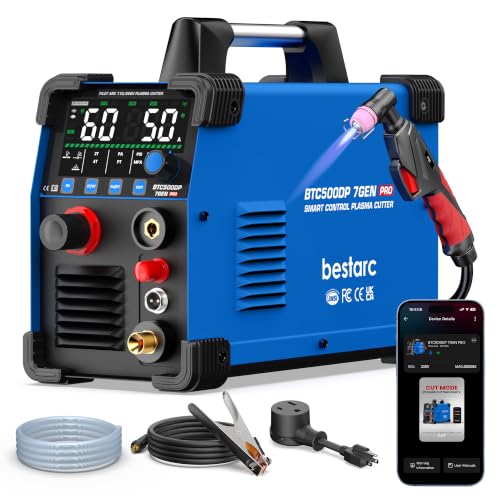
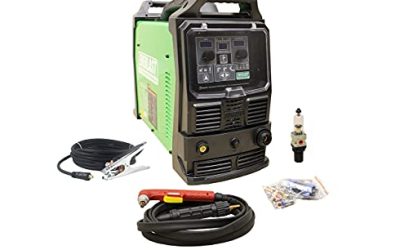
bestarc BTC500DP 7GEN Plasma Cutter (50A APP Pilot Arc)
Best for: buyers who want app control, a live air-pressure readout and help with rusted metal.
50 A IGBT inverter with non-touch pilot arc; dual voltage 110 V / 220 V
Recommended capacity: 1/2 in at 35 A on 110 V (50 PSI); 2/3 in at 50 A on 220 V (65 PSI); maximum thickness 2/3 in
Bluetooth app remote control up to 98 ft (30 m): current, modes, status and error codes
Built-in air pressure sensor with real-time PSI on the LED display; recommended air 50–80 PSI; built-in metal air filter; 1/4 in NPT quick-connect fitting included
As an Amazon Associate I earn from qualifying purchases. This post may contain affiliate links at no extra cost to you.
A handheld plasma cutter earns its place in a home workshop when it turns jobs that used to mean an angle grinder and a shower of sparks into one guided pass. The real decision is not headline amperage, which sits at 50 amps on nearly every machine in this class, but how much thickness each cutter honestly handles on the voltage your shop actually has, and whether your air supply can feed it.
The three machines below suit three kinds of buyer: the LOTOS LT5000D (2024 Upgraded) as the proven entry point, the bestarc BTC500DP 7GEN for app control and a live air-pressure readout, and the ARCCAPTAIN CUT50 for shoppers who want the current category best-seller. Each was chosen from its Amazon listing name and stated specifications, with capacity figures taken from the listings’ own feature details rather than their titles alone.
Quick Picks
As an Amazon Associate we earn from qualifying purchases.
Product
Best for
Key spec
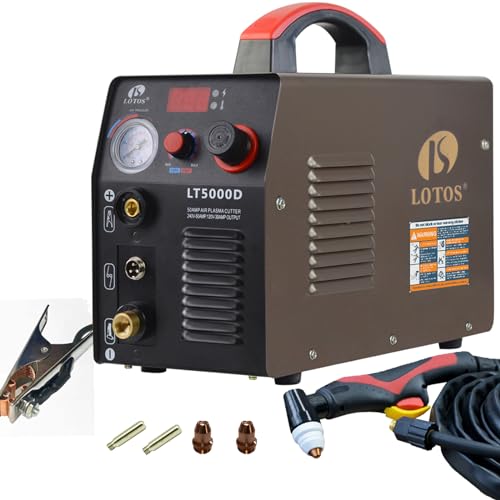
LOTOS LT5000D Plasma Cutter, 2024 Upgraded
A proven first handheld cutter
50 A pilot arc, dual voltage 110/220 V
bestarc BTC500DP 7GEN Plasma Cutter (50A APP Pilot Arc)
App control and rusty-metal work
Bluetooth app control up to 98 ft
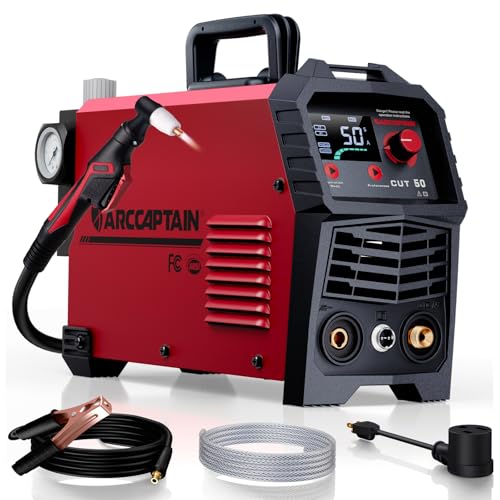
ARCCAPTAIN CUT50 Plasma Cutter
Beginners who want the category best-seller
50 A with 1/2 in clean cut rating
How to Choose
Match capacity to the voltage you will actually use
All three cutters here are dual-voltage machines, but output drops sharply on a household circuit. The LOTOS delivers 10–50 A on 220/240 V yet only 10–35 A on 110/120 V, and the bestarc rates its capacity at 1/2 inch on 110 V against 2/3 inch on 220 V. Judge every machine by the figures for the outlet you own today, not the one you plan to wire someday. If thick plate on 110 V is the goal, expect slower travel speeds and rougher edges.
Plan the air supply before the cutter
None of the three machines in this roundup has a built-in compressor, so an external air compressor is a mandatory part of the purchase, not an accessory. The LOTOS arrives with its air filter regulator and NPT 1/4 inch type D plug pre-installed, while the bestarc adds a built-in metal air filter, a quick-connect fitting and a pressure sensor that shows real-time PSI on its display. Budget for dry, regulated air in the range each listing recommends, because wet air eats consumables.
Weigh pilot arc starting and torch control
A pilot arc starts the cutting arc without the torch tip touching the workpiece, which matters most on rusted, painted or coated stock where a contact start struggles. The bestarc builds the most control around it: non-touch pilot arc, an adjustable pilot arc time up to 15 seconds, a dedicated Rust Removal mode, and 2T/4T trigger modes with post-flow cooling adjustable from 3 to 15 seconds. Simpler machines still cut clean metal perfectly well, so pay for control features only when your material demands them.
Read thickness claims the way the listing writes them
Headline numbers and detailed figures often disagree inside the same listing. The LOTOS title rates the machine at 5/8 inch clean cut, while its own feature bullets describe 1/2 inch as the ideal clean cut under 220/240 V. Clean cut and severance cut are also different promises: a severance cut separates metal with a rough edge, while a clean cut is the thickness you can slice neatly at reasonable speed. Buy against the conservative clean-cut figure at your voltage and treat anything above it as occasional-use territory.
The 3 Best Options
LOTOS LT5000D Plasma Cutter, 2024 Upgraded
Top Pick
LOTOS LT5000D Plasma Cutter, 2024 Upgraded
Best for: first-time buyers who want the proven budget handheld in this class.
50 A plasma cutter with pilot arc; 10–50 A DC output on 220/240 V, 10–35 A DC output on 110/120 V
Feature bullets rate 1/2 in ideal clean cut and 3/4 in maximum severance cut under 220/240 V (listing title rates 5/8 in clean cut)
Automatic dual voltage and dual frequency: 110/120 V and 220/240 V, 50/60 Hz
Pre-installed NPT 1/4 in industry type D plug and air filter regulator
first-time buyers who want the proven budget handheld in this class.
Watch out for
the listing title claims a 5/8 in clean cut while its own feature bullets call 1/2 in the ideal clean cut, so plan your work around the smaller figure; like every pick here, it has no built-in compressor.
The LT5000D has been the entry-level benchmark in this class for years, and the 2024 upgraded version keeps the formula simple: a 50-amp pilot arc machine that runs on either household or shop voltage and arrives with its air regulator already fitted. It suits the home fabricator who cuts sheet, angle and the occasional piece of plate, and who would rather trust a long-running model than chase features. Its published capacity needs careful reading, as the Watch out for note explains, but judged on its detailed figures it covers most home workshop work.
bestarc BTC500DP 7GEN Plasma Cutter (50A APP Pilot Arc)
Runner-Up
bestarc BTC500DP 7GEN Plasma Cutter (50A APP Pilot Arc)
Best for: buyers who want app control, a live air-pressure readout and help with rusted metal.
50 A IGBT inverter with non-touch pilot arc; dual voltage 110 V / 220 V
Recommended capacity: 1/2 in at 35 A on 110 V (50 PSI); 2/3 in at 50 A on 220 V (65 PSI); maximum thickness 2/3 in
Bluetooth app remote control up to 98 ft (30 m): current, modes, status and error codes
Built-in air pressure sensor with real-time PSI on the LED display; recommended air 50–80 PSI; built-in metal air filter; 1/4 in NPT quick-connect fitting included
buyers who want app control, a live air-pressure readout and help with rusted metal.
Watch out for
confirm the listing is the “50A APP Pilot Arc” variant of the BTC500DP, because other variants and generations of this model are separate listings with different features; it also needs an external compressor.
The BTC500DP 7GEN is the control-focused option in this 50-amp class. A Bluetooth app connects from up to 98 feet away to adjust current, switch modes and read error codes, while a built-in air pressure sensor puts live PSI on the LED display so the air setup stops being guesswork. Its non-touch pilot arc and dedicated Rust Removal mode speak directly to anyone cutting weathered steel, and the adjustable post-flow cooling and pilot arc timing let experienced users tune behaviour that fixed machines leave alone.
ARCCAPTAIN CUT50 Plasma Cutter
ARCCAPTAIN CUT50 Plasma Cutter
Best for: beginners who want the current best-selling handheld in the class.
50 A cutter machine, DC inverter IGBT; dual voltage 110 V / 220 V
1/2 in clean cut; post flow; 2T/4T modes; large LED display
Recommended maximum cutting thickness: 12 mm at 35 A, 110 V, 50 PSI; 18 mm at 50 A, 220 V, 60 PSI
beginners who want the current best-selling handheld in the class.
Watch out for
recent US checks found this listing live and in stock on Amazon US, but a Canadian storefront reproduction of the same listing showed “No featured offers available”, so confirm a live featured offer for ASIN B0B5N7K2DJ on the US product page before ordering.
The CUT50 is the current category best-seller on Amazon US, pitched squarely at beginners and DIY users who want a straightforward 50-amp machine. Its listing keeps the specification honest and simple: a 1/2 inch clean cut rating, a large LED display, post-flow cooling and 2T/4T trigger modes, with recommended maximum thickness stated separately for each voltage rather than one blended headline number. For a home workshop cutting sheet, tube and moderate plate, that plain-spoken spec sheet covers the work without asking you to decode marketing claims.
Which One Fits Your Situation
Your shop runs on household 110 V outlets only
Choose the bestarc BTC500DP 7GEN. It is the only pick whose listing rates capacity explicitly at household voltage, a full 1/2 inch at 35 A on 110 V, and its live air-pressure readout helps you squeeze the most from a smaller compressor. The LOTOS also runs on 110 V, but its output ceiling there is 35 A with no published per-voltage thickness figure.
You cut rusty, painted or farm-worn metal
Choose the bestarc BTC500DP 7GEN again. Its non-touch pilot arc starts through surface contamination that defeats contact-start torches, and the dedicated Rust Removal mode is built for exactly this material. Adjustable pilot arc time up to 15 seconds gives you control on heavily coated stock, and the machine still handles clean steel, stainless, aluminum and copper when the job changes.
You want the simplest proven first cutter
Choose the LOTOS LT5000D (2024 Upgraded). It has been the entry-level reference point for years, arrives with its air filter regulator and plug pre-installed, and covers stainless, alloy and mild steel, copper and aluminum on either voltage. Accept the conservative 1/2 inch ideal clean-cut figure from its feature bullets rather than the title number, and it will handle typical home workshop cutting without fuss.
You have 220 V power and cut plate regularly
Choose the ARCCAPTAIN CUT50. Its listing states recommended maximum thickness per voltage, reaching 18 mm at 50 A on 220 V, and the 1/2 inch clean cut rating matches the plate work most home shops actually do. Post-flow cooling and 2T/4T modes support longer cutting sessions, and the large LED display keeps settings readable through a welding helmet.
Common Mistakes
Buying on the title’s thickness number instead of the detailed capacity figures in the same listing, which are often more conservative.
Forgetting the air compressor: none of these three cutters has one built in, so the machine alone cannot cut anything.
Expecting 220 V cutting capacity while plugged into a 110 V outlet, where every dual-voltage machine here loses output.
Shopping for a handheld cutter when the real job is repeatable CNC table work, a different machine type entirely.
Ordering a different variant or generation of the same model name, such as another BTC500DP version, without checking that the listing matches the features you wanted.
Frequently Asked Questions
Do I need an air compressor to use these plasma cutters?
Yes. None of the three machines in this roundup has a built-in compressor, so each one needs an external compressor supplying dry, regulated air. The LOTOS includes a pre-installed filter regulator and plug, and the bestarc includes a quick-connect fitting, a metal air filter and a pressure sensor, but the compressor itself is always a separate purchase.
Can a 50-amp plasma cutter run on a normal household outlet?
Each of these machines is dual voltage and will run on 110/120 V, but output falls: the LOTOS tops out at 35 A instead of 50 A, and the bestarc’s rated capacity drops to 1/2 inch. For occasional sheet and light plate that is plenty, while regular thick cutting justifies wiring a 220/240 V circuit.
What does pilot arc actually do for the cut?
A pilot arc lets the torch start its arc without touching the workpiece, then transfers to the metal once cutting begins. That matters on rusted, painted or coated surfaces where a contact start can fail to establish an arc. The bestarc leans hardest into the idea, adding a non-touch pilot arc, adjustable arc time and a Rust Removal mode for contaminated stock.
What is the difference between a clean cut and a severance cut?
A clean cut is the thickness a machine slices neatly at a reasonable travel speed, leaving an edge that needs little cleanup. A severance cut is the maximum it can push through at slow speed, separating the metal but leaving a rough edge. Listings quote both, so compare machines on clean-cut figures at your voltage, not severance headlines.
J
JD's Woodworks Editorial Team
We compare specs, warranty terms, long-term owner feedback and street pricing before anything earns a spot. Rankings are never paid.
Affiliate disclosure. As an Amazon Associate we earn from qualifying purchases at no extra cost to you. Prices accurate as of the date shown.
Find the best steel plasma cutter for your shop. Compare four proven machines for clean cuts in mild steel, from a portable 12-amp unit to a 60-amp workhorse.
Best high frequency TIG welder guide: four HF-start AC/DC welders compared on output, duty cycle, dual voltage, torch, foot pedal and warranty for home shops.
Find the best gas shielded MIG welder for your shop. Compare four gas MIG machines by output range, duty cycle, voltage, weight, and included gas hardware.
Find the best 110 volt plasma cutter for home shops: dual-voltage 50-amp and 55-amp picks compared on cut capacity, pilot arc and air needs before you buy.
Compare deep cut portable band saws in the Milwaukee 6230 class: the 6232-21 kit, DEWALT DWM120K and two cordless rivals, by capacity, speed and weight.