
What's inside
As an Amazon Associate I earn from qualifying purchases. This post may contain affiliate links at no extra cost to you.
The Best Variable Speed Drill Press Depends on Your Work
For most woodworkers, the best variable speed drill press is a 12- to 13-inch floor or benchtop model with a belt-driven motor, a useful low-speed setting near 250–300 RPM, and a verified runout specification—not simply the widest advertised speed range. Choose a pulley-based press for value and straightforward maintenance, or a mechanically variable model when you change speeds often and want to avoid moving belts.
There is no single winner for every shop. Small benchtop presses suit occasional woodworking and tight spaces; heavier floor presses are better for large workpieces, frequent use, or drilling metal as well as wood. Compare the actual speed steps, quill travel, swing, and runout before paying extra for variable speed.
As an Amazon Associate we earn from qualifying purchases at no extra cost to you.


What to Compare Before You Buy
- Speed range and steps: Low speed helps with large-diameter bits and many metal-drilling tasks; high speed suits small bits in wood. A broad range is useful only if the press can deliver adequate torque at its lowest setting.
- Adjustment method: Belt-and-pulley presses require opening the cover and repositioning belts. Mechanical variable-speed presses change speed with a dial or lever while running, but are typically more expensive and their internal drive components can wear.
- Spindle runout: Runout is the amount the spindle and bit deviate from a true rotation. Lower runout matters for clean, accurately sized holes, especially with small bits. Check whether the manufacturer states a measurement and how it was measured; do not assume a low price or large capacity predicts accuracy.
- Capacity and travel: Swing describes the largest workpiece area the press can reach from the column to the spindle center. Quill travel limits how far the bit can descend in one stroke. Deep holes may require retracting and repositioning the work.
- Table and support: A tilting table is useful, but a large, rigid table with secure height adjustment is often more important. For long stock, plan on auxiliary support regardless of the press size.
Representative Models and Specifications
The figures below are useful comparison points from established product lines. Specifications can vary by model year and configuration, so confirm the exact version before purchase. Published speed steps are not directly comparable to a continuously adjustable speed range.
| Press | Type and capacity | Published speed range | Adjustment approach | Best suited to |
|---|---|---|---|---|
| JET JDP-15B | 15-inch floor press | 200–3,630 RPM | Six belt positions | Woodworkers wanting a substantial table and broad speed choice |
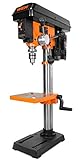
| WEN 4214T | 12-inch benchtop press | 580–3,200 RPM | Mechanical variable-speed dial | Small shops and frequent speed changes |
| Shop Fox W1667 | 8-inch benchtop press | 250–3,050 RPM | Belt positions | Light-duty work where compact size and low speed matter |
| Grizzly G0758 | 8-inch benchtop press | 530–3,100 RPM | Mechanical variable speed | Compact shops seeking dial adjustment |
These models illustrate different tradeoffs, not a universal ranking. Check current manuals for motor power, quill travel, weight, and runout: those details can differ across revisions and are not captured by a speed range alone. Prices also change; expect broad market tiers, with compact presses generally costing less than larger floor models and mechanically variable designs often carrying a premium.
Choose by Project and Shop
| Your situation | What to prioritize | Practical choice |
|---|---|---|
| Occasional small holes; limited budget and bench space | Stable base, usable table, standard chuck | Compact belt-driven benchtop press |
| Mixed woodworking; frequent bit changes | Easy adjustment, low-speed torque, at least 12-inch swing | Variable-speed benchtop press with dial control |
| Large panels, jigs, or long stock | Floor height, rigid column, table support, quill travel | Floor model; add roller or auxiliary work support |
| Regular metal drilling as well as wood | Low minimum speed, secure vise, suitable bit and coolant practices | Press with a genuinely low speed and a rigid table |
| Small, precise holes and repeatable fixtures | Documented low runout, good chuck, minimal spindle play | Choose by measured accuracy, not capacity or speed range |
How Speed Affects Wood, Metal, and Bit Choice
In wood, small bits can generally run faster than large bits, but excessive speed can burn the work, dull the cutting edge, or make a bit grab. Forstner bits and hole saws usually need slower settings than ordinary twist bits. Hardwood, end grain, and deep holes may also call for slower drilling and periodic chip clearing.
Metal generally needs slower speeds than wood, particularly with larger bits. A press whose minimum speed is around 500 RPM may be limiting for some larger metal-drilling jobs. Use sharp bits, clamp the work securely, and follow the bit maker’s speed guidance; never hold a small metal part by hand under the bit.
A speed dial does not guarantee equal performance across the range. Motor design, belt or drive condition, and load affect how well the spindle maintains speed. If a press slows noticeably with a moderate bit, the advertised maximum RPM will not compensate for insufficient power or a poor setup.
Accuracy, Setup, and Ownership Costs
Runout can come from several places: spindle bearings, the arbor, chuck, or the bit itself. A practical check is to mount a straight test rod in the chuck and measure its movement with a dial indicator while turning the spindle by hand. Repeat with the rod seated differently. If the reading changes substantially, the chuck or seating may be contributing; if it remains high, the spindle or arbor may be involved. This check helps diagnose a machine but is not a substitute for a manufacturer’s stated tolerance.
Before drilling, bolt or clamp the press securely, square the table to the spindle for ordinary vertical holes, and clamp the workpiece. A drill press can spin loose stock with enough force to cause injury or damage. For angled holes, verify the table angle with a square or gauge rather than trusting the scale alone.
Belts are ordinary wear items on pulley models; inspect for cracking, glazing, and poor tension, and replace them when they slip or vibrate. On mechanical variable-speed presses, keep dust out of the drive enclosure and follow the manual’s lubrication and inspection schedule. Periodically check table-lock hardware, spindle play, and chuck condition. Dust packed into the table mechanism and loose workholding are common causes of frustrating results that a more expensive press will not fix.
Final Buying Advice
For a budget-conscious hobby shop, start with a stable belt-driven benchtop model and accept the inconvenience of changing pulley positions. If you move between bit sizes often, a dial-adjustable press can save time, provided its minimum speed and accuracy suit your work. Choose a floor press for reach, support, and heavier projects—not just because it looks more capable.
Before ordering, confirm the exact model’s speed range, swing, quill travel, motor rating, weight, table dimensions, and runout specification in its current manual. If the maker does not publish runout, ask the seller or manufacturer how accuracy is specified, and factor a quality chuck and solid workholding into the budget. Those details are more useful than a headline speed number when selecting the best variable speed drill press for your projects.