
What's inside
As an Amazon Associate I earn from qualifying purchases. This post may contain affiliate links at no extra cost to you.
Best Aftermarket Table Saw Fence Systems in 2026
The best aftermarket table saw fence system for most woodworkers is the Delta T3 fence system: it offers a rigid steel fence, a long front rail, dependable locking, and a useful 30-inch rip capacity without the cost or installation demands of a premium precision system. The best choice changes, however, if you need cabinet-saw accuracy, a compact installation, or more than 50 inches of ripping capacity.
| Fence system | Typical rip capacity | Rail length | Fence material | Best for | Typical market range |
|---|---|---|---|---|---|
| Delta T3 | 30 in. | Approx. 43 in. front rail | Steel fence and rails | General-purpose upgrades | $250–$350 |
| Vega U26 | 26 in. | Approx. 36 in. front rail | Aluminum fence and steel rail components | Compact saws and smaller shops | $300–$400 |
| Vega U50 | 50 in. | Approx. 56 in. front rail | Aluminum fence and steel rail components | Wide sheet-goods work | $450–$600 |
| Shop Fox W2005 | 25 in. | Approx. 42 in. rail assembly | Steel fence and rails | Value-conscious cabinet-saw owners | $250–$350 |
| INCRA TS-LS | Typically 32–52 in., depending on version | Version-dependent | Precision-machined steel and aluminum components | Repeatable, measurement-critical work | $800–$1,300 |
Dimensions and capacities vary by package and saw configuration, so confirm the current manufacturer specification before ordering. A listed rip capacity is not always the distance from the blade to the fence: some manufacturers measure from the blade to the end of the table or use a particular rail position.
As an Amazon Associate we earn from qualifying purchases at no extra cost to you.


Quick recommendations by situation
- Best overall: Delta T3 for a typical contractor or cabinet saw that needs a substantial improvement over a flexible factory fence.
- Best for a compact table: Vega U26 when 26 inches of capacity is enough and you want a relatively compact front rail.
- Best for large panels: Vega U50, provided the saw stand and surrounding floor space can support its long rail.
- Best value alternative: Shop Fox W2005 for a conventional T-square-style fence at a moderate price.
- Best for precision workflow: INCRA TS-LS, especially when repeatable indexed settings matter more than a simple, fast installation.
Head-to-head comparison
Delta T3: the sensible all-round upgrade
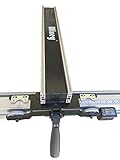
The Delta T3 uses a T-square-style fence that references the front rail and locks at the front. That design is preferable to a fence that clamps at only one point because it resists twisting as the fence is moved across the table. Its roughly 30-inch capacity covers most cabinet doors, shelving, flooring, and furniture parts without requiring an unusually long shop layout.
Its main attraction is balance. The steel rail is stiff enough for routine use, the fence is easier to understand than a fully indexed system, and replacement or adjustment parts are relatively conventional. Installation still requires accurate drilling or careful use of existing mounting holes. The common mistake is to mount the rail before checking that the blade, miter slot, and fence are all parallel.
Vega U26 and U50: compact precision with two useful sizes
Vega’s U26 is a good fit for a saw that has limited outfeed or side clearance. Its 26-inch capacity is enough for many solid-wood and cabinetmaking tasks while avoiding the long rail overhang of a 50-inch system. The U50 is the opposite choice: it is intended for frequent sheet-goods work and gives considerably more room to the right of the blade.
Vega fences use a relatively light aluminum fence body, which makes adjustment easier than lifting a heavy steel assembly. That can be an advantage on a contractor saw with a lighter stand. The trade-off is that the supporting rail and mounting structure must be installed accurately; a long rail does not compensate for a weak or uneven saw top.
Shop Fox W2005: conventional and cost-conscious
The Shop Fox W2005 is aimed at owners who want the familiar T-square layout without moving into a high-priced digital or indexed fence. Its approximately 25-inch capacity is adequate for many furniture projects, and its steel construction favors rigidity over minimum weight.
Measure the table width, front-to-back depth, and distance from the mounting edge to the blade before buying. Compatibility is less about the brand name on the saw than about whether the supplied rails can be mounted without interfering with the motor, handwheels, extension wings, or mobile base.
INCRA TS-LS: the specialist choice for repeatability
The INCRA TS-LS is different from a basic replacement fence. Its positioning system is designed around repeatable settings and indexed movement, making it attractive for production-style work, repeated dados, furniture parts, and projects where returning to a previous fence position matters.
It costs substantially more and normally demands more planning during installation. The system also occupies more visual and physical space than a simple T-square fence. Choose it because you will use its positioning features, not merely because it looks more precise. For occasional ripping, a Delta, Vega, or Shop Fox system usually provides better value.
What to check before ordering
1. Measure the saw, not just the advertised capacity
Record the table width, table depth, blade-to-front-edge distance, existing rail-hole spacing, and the available distance to the right of the saw. A 50-inch fence can provide 50 inches of ripping capacity only when the saw top, rail, and extension table allow the fence to travel that far.
As a practical fit check, measure from the blade’s intended cutting line to the farthest point where the fence can safely sit. If that distance is 28 inches, a nominal 50-inch fence system will not create 50 inches of usable capacity without an extension table.
2. Check rail and table compatibility
Aftermarket systems commonly fit contractor saws, hybrid saws, and cabinet saws, but “universal” does not mean drill-free. Some installations use the saw’s existing holes; others require new holes through the front and rear edges of the table or extension wings. Tubular rails may also conflict with a mobile base or dust-collection hose.
For a cast-iron cabinet saw, confirm that the extension wing is flush with the main table before aligning the rail. For a stamped-steel contractor saw, inspect whether the front edge can resist the clamping force without bending. A fence can be accurately adjusted yet still move if its mounting surface flexes.
3. Prioritize lock repeatability over a single alignment number
A useful fence should lock in the same position every time, not merely align correctly after careful adjustment. Look for a front-locking T-square design, an adjustable rear glide or pad, and a fence body that does not bow when the handle is engaged. Check the lock at several positions along the rail rather than only near the blade.
Installation and alignment procedure
- Flatten the saw first. Bring the table, extension wings, and insert plate to the same plane. Alignment cannot compensate for a raised wing.
- Mount the front rail loosely. Leave enough movement to level it and set its height relative to the table.
- Set the rail parallel to the miter slot. Use a combination square or a reliable rule at the front and rear of the slot. The rail itself does not need to be perfectly parallel if the fence can be adjusted, but a consistent reference makes setup easier.
- Install the rear rail or support. Tighten gradually from the center outward so the rail does not pull into a curve.
- Adjust the fence body. Set the fence parallel to the miter slot, then check that its bottom edge clears the table without excessive lift.
- Test the lock repeatedly. Unlock and relock the fence at 6, 18, and 30 inches, or at the maximum positions your saw supports. Confirm that the reading does not change when the handle is operated.
Allow roughly two to four hours for a first installation, including measuring and drilling. An experienced installer with compatible holes may finish sooner; a retrofit requiring new holes, extension-wing changes, or a mobile-base adjustment can take most of a day.
Ownership realities: what wears first
The first parts to show wear are usually the locking pad, plastic or polymer glide blocks, fence faces, and adjustment hardware—not the main rail. Keep the rail free of pitch and sawdust, especially around the locking path. A dry cloth and occasional manufacturer-approved lubricant on metal adjustment points are safer than spraying oil onto the fence face, where it can contaminate workpieces.
Do not use the fence as a guide for crosscutting long pieces; use a miter gauge or crosscut sled instead. Also avoid pushing a warped board tightly against the fence without a suitable jointed reference edge. That can produce inconsistent cuts regardless of how accurate the fence is.
Final buying advice
Choose the Delta T3 if you want the strongest all-purpose balance of capacity, rigidity, and cost. Choose the Vega U26 when shop space is limited, or the U50 when wide ripping is a regular requirement. Choose the Shop Fox W2005 when conventional operation and moderate cost are the priorities. Choose the INCRA TS-LS only when indexed repeatability and a more involved setup will save time in your specific workflow.
The best aftermarket table saw fence system is ultimately the one that matches the saw’s mounting surfaces and your real cutting range. Measure those first; a shorter, accurately installed fence is safer and more useful than a larger system that overloads the table or cannot be aligned consistently.