
What's inside
As an Amazon Associate I earn from qualifying purchases. This post may contain affiliate links at no extra cost to you.
Best 10-Inch Band Saws: Top Picks for Small Shops
The best 10 band saw for a small woodworking shop is usually the one that matches your stock thickness and available floor space: choose a benchtop model for curves and thin material, or a compact floor-standing saw if you need more resaw height and a steadier base. For many hobbyists, the WEN BA3962 is a practical all-rounder; for very tight budgets or occasional light work, consider the WEN 3939T.
Top picks by shop and project
- Best all-rounder: WEN BA3962. A 9¾-inch benchtop saw with a 3.5-amp motor, two speeds, and a 6-inch cutting height. Its stand and work light take up more room than a basic benchtop unit, but it offers a useful balance of capacity and shop-friendly size.
- Best for the smallest footprint: WEN 3939T. A compact 9-inch saw with a 2.8-amp motor and 3½-inch cutting height. It suits small parts, curves, and thin stock better than thick resawing.
- Best compact floor-standing option: Rikon 10-305. This 10-inch saw provides a 4⅝-inch cutting height and a sturdy floor stand. It is a good fit when a benchtop machine feels too limited, but its capacity still falls short of a larger resaw saw.
- Best for a more complete benchtop setup: WEN BA3959. A 9-inch, 2.8-amp model with a 3⅝-inch cutting height. It is aimed at light-duty work and small projects, with less resaw headroom than the BA3962.
These are different compromises, not interchangeable machines. A 9-inch saw can be the best 9 inch band saw for a shop that needs a compact curve-cutting tool; it is not automatically a substitute for a 10-inch saw when cutting height matters.
As an Amazon Associate we earn from qualifying purchases at no extra cost to you.

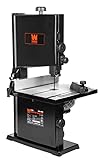


Compare capacity, power, and footprint
Band-saw listings often use nominal wheel size—9 or 10 inches—to distinguish models. That number alone does not tell you how thick a board the saw can cut. Check the stated cutting height, throat capacity (distance from blade to frame), motor rating, and the space needed around the table to handle your workpiece.
| Model | Wheel size | Motor | Max. cutting height | Type / footprint consideration |
|---|---|---|---|---|
| WEN BA3962 | 9¾ in. | 3.5 A | 6 in. | Benchtop saw with stand; reserve floor space for the stand and stock support |
| WEN 3939T | 9 in. | 2.8 A | 3½ in. | Compact benchtop unit; needs a stable bench and clear infeed area |
| Rikon 10-305 | 10 in. | ⅓ hp | 4⅝ in. | Floor-standing design; occupies more permanent space than a bench-mounted saw |
| WEN BA3959 | 9 in. | 2.8 A | 3⅝ in. | Benchtop unit; practical for small work, but plan for a secure mounting surface |
Specifications can vary by model revision and market, so confirm the manufacturer’s current manual before purchase. Amp ratings and horsepower are not directly comparable across different motor designs; treat them as context, not a promise that one saw will cut faster in every material.
Choose by the work you actually do
| Your situation | What matters most | Best fit among these picks |
|---|---|---|
| Apartment garage or crowded bench; occasional curves in thin stock | Small machine, easy storage, modest purchase cost | WEN 3939T |
| Hobby projects with mixed stock up to about 6 in. thick | More cutting height and a useful speed choice | WEN BA3962 |
| Regular use and preference for a dedicated floor machine | Stable base and a 10-in. frame | Rikon 10-305 |
| Mostly small parts, toys, and curved cuts; limited need for thick stock | Simple benchtop setup and low space demand | WEN BA3959 |
For the best 10 inch band saws for woodworking, separate curve cutting from resawing in your decision. A 10-inch frame is still a small saw: the Rikon’s 4⅝-inch capacity is enough for many furniture components and small blanks, but not for resawing a typical 6- or 8-inch-wide board in one pass. The BA3962’s 6-inch height is more flexible, though the saw’s stability, blade, and feed rate still limit how well it handles demanding cuts.
Blade changes and setup: the hidden ownership cost
Small band saws commonly use narrow blades for tight curves, while wider blades track better for straighter cuts. Before buying, check the blade-length range and available widths in the manual, then look for replacements from established blade makers. A machine that accepts only a narrow range of hard-to-find blades can become frustrating even if its headline price is low.
Expect blade changes to involve opening the wheel covers, releasing tension, guiding the blade off the wheels, and then resetting tracking and guides. The first change may take longer than later ones. After installing a blade, follow the manual’s tension and tracking procedure, rotate the wheels by hand with the saw unplugged, and verify that the blade stays centered before powering on. Don’t rely on tension alone to correct a poor cut; a dull or unsuitable blade, misaligned guides, or feeding too quickly can all cause drift.
What wears first—and how to keep the saw cutting well
- Blades are consumables. Dull teeth, pitch buildup, and damaged teeth are common reasons for burning or wandering cuts. Match tooth spacing to the material thickness: the blade should keep several teeth engaged in the work.
- Guides and tires need attention. Keep blade guides aligned with the blade and clear of packed dust. Inspect wheel tires for damage or buildup when tracking becomes inconsistent.
- Dust affects accuracy. Fine sawdust can collect around the wheels and guides. Unplug the machine before cleaning, and use extraction where practical.
- Small saws dislike forced feed. Let the blade do the cutting. Pushing thick hardwood too quickly can flex the blade, spoil the cut, and strain the motor.
Budget for blades and basic setup time, not just the machine. General market prices vary by retailer and region; entry-level 9-inch models are often in the lower-cost tier, while better-equipped benchtop and floor-standing 10-inch models typically cost more. Compare the complete setup—including a stand or bench, dust collection, and replacement blades—rather than the sticker price alone.
Bottom line
Choose the WEN 3939T or BA3959 if your work is light and your bench space is precious. Step up to the BA3962 if you want more cutting height and a versatile general-purpose saw. Pick the Rikon 10-305 when you prefer a dedicated floor-standing machine and its 4⅝-inch capacity suits your projects. If your regular work involves thicker resawing, a larger band saw is a better purchase than trying to make a compact 10-inch model do that job.