
What's inside
As an Amazon Associate I earn from qualifying purchases. This post may contain affiliate links at no extra cost to you.
Best 12-Inch Drill Presses for Workshop Versatility
The best 12-inch drill press for most small workshops is a variable-speed benchtop model with a tilting, height-adjustable table and enough quill travel for the holes you actually make. A 12-inch swing gives about 6 inches from the spindle center to the column—not 12 inches of reach from the bit to the edge of your work. Choose by comparing usable throat depth, table movement, motor, and the room needed to install and operate the machine.
What “12-inch” means—and what to measure
Drill-press swing is twice the distance between the spindle center and the column. A 12-inch machine therefore has a nominal 6-inch throat, enough to drill near the center of a board up to roughly 12 inches wide when it is positioned appropriately. The column, table supports, and workpiece shape can limit practical access, so allow clearance for clamps and awkward parts.
As an Amazon Associate we earn from qualifying purchases at no extra cost to you.
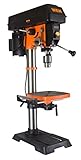


Before buying, measure the bench height and the distance from the bench to the lowest ceiling obstruction. Add the machine’s listed height, then leave space above the chuck to change bits and raise the table. Also check the base footprint and room to place long stock on the table. A drill press can fit on a bench yet still be frustrating if a shelf blocks its head or a wall prevents feeding a long board through.
Representative 12-inch-class choices
Specifications vary by model and market; confirm the exact manual before purchasing. The table compares established machines in or near the 12-inch class. Manufacturers sometimes describe swing, capacity, speed, and motor ratings differently, so treat these figures as a screening guide rather than proof of identical performance.
| Model | Swing / throat | Motor | Speed range | Approx. height | Best fit |
|---|---|---|---|---|---|
| WEN 4214T | 12 in / 6 in | 2/3 HP | 580–3,200 RPM | About 37 in | Versatile benchtop use and frequent speed changes |
| JET JDP-12 | 12 in / 6 in | 1/2 HP | Up to about 3,100 RPM | About 35 in | General-purpose shop work from a known toolmaker |
| Shop Fox W1667 | 12 in / 6 in | 1/2 HP | Up to about 3,050 RPM | About 34 in | Shops that value a sanding attachment as well as drilling |
| Delta 12-inch benchtop drill press | 12 in / 6 in | Varies by model | Varies by model | Check model manual | Buyers comparing current Delta specifications and local service |
Dimensions and configurations can change between versions. In particular, verify the exact Delta model number: “12-inch Delta drill press” is not enough to establish its motor, speed range, or height.
Pick by workload and available space
| Your situation | What to prioritize | Practical direction |
|---|---|---|
| Occasional holes, tight budget | Stable base, sound table lock, accessible belt-speed changes | A basic 1/2-HP benchtop press can be sufficient; compare overall setup and warranty, not just advertised horsepower. |
| Mixed woodworking, regular use | Broad speed range, easy table adjustment, useful depth stop | Consider a variable-speed model such as the WEN 4214T if its height and footprint suit the bench. |
| Large panels or deep workpieces | Throat, quill travel, table support, and clamping room | A 12-inch swing may be the limiting factor; compare a larger-swing press or plan a safe repositioning method. |
| Low ceiling or crowded bench | Measured head height, bit-changing clearance, and base footprint | Choose from actual assembled dimensions. A shorter machine is not useful if the table cannot clear your work. |
| Frequent large-diameter holes | Low-speed torque and rigidity | Look beyond peak horsepower: belt ratios, spindle bearings, and a secure table matter under load. |
The trade-offs that matter in use
Throat depth and table movement
Throat depth determines how far a hole can be from an edge without rotating or repositioning the work. Table height and tilt determine whether the machine can accommodate a tall part or angled drilling. Check how the table moves: a rack-and-pinion crank is convenient for frequent changes, while a simpler collar may require supporting the table by hand as you loosen it. Either way, lock the table firmly before drilling. For angled holes, tilt the table only when the work can still be secured safely; a clamped angle block or drill guide may be more repeatable.
Motor power and speed
For wood, small bits generally need higher speed than large bits. Large Forstner bits and hole saws need slower speeds, controlled feeding, and a machine that does not bog down. A motor’s horsepower rating alone does not reveal how well the press maintains speed under load. Check the available low-speed range, belt or electronic speed system, and whether speed changes are practical for your workflow. Do not force a dull bit to compensate for a light motor.
Height and installation footprint
A benchtop press needs a rigid, level bench, and its base should be bolted down or otherwise secured according to the manual. The machine’s weight affects whether the bench can support it without flexing; plan to lift it with help rather than balancing it during installation. Include space for the column and handles, access to the switch, and the arc needed to swing the table. If you regularly drill long stock, leave a clear path on both sides or the front and back of the press.
Setup checks that prevent avoidable problems
- Secure the press: Bolt the base to a stable bench. Vibration can loosen work, reduce accuracy, and make a tall machine less predictable.
- Check alignment: Install a straight bit and confirm it runs true. If holes wander, inspect the bit, chuck seating, and spindle runout before blaming the table.
- Support and clamp the work: Never rely on hand pressure alone. A spinning board can catch a bit and turn suddenly, particularly with large bits or breakthrough cuts.
- Use a backing board: Place scrap beneath the work to reduce tear-out and protect the table. Adjust the depth stop or feed carefully so the bit does not strike the table.
- Maintain the moving parts: Keep the table and column clean, remove chips from the base, and follow the manual for lubrication. Check belt condition and tension periodically; belts wear, and dust buildup can impair smooth operation.
Common ownership annoyances are often setup-related: a table that slips because its lock was not tightened, a press that walks because the bench is flexible, or inaccurate holes caused by a dull bit. These are usually more fixable than a short throat or insufficient clearance, which is why measuring before purchase pays off.
Bottom line
For varied woodworking in a compact shop, prioritize a 12-inch swing, an adjustable table that locks solidly, a useful low-speed option, and dimensions that fit the bench and ceiling. The WEN 4214T stands out on paper for speed flexibility; the JET JDP-12 is a straightforward general-purpose alternative; and the Shop Fox W1667 may suit a shop that wants its sanding feature. If your work routinely needs holes more than about 6 inches from an edge, the best 12 drill press for you may be a larger-swing machine rather than any 12-inch model.