
What's inside
As an Amazon Associate I earn from qualifying purchases. This post may contain affiliate links at no extra cost to you.
Best Tabletop Drill Presses for Small Workshops
The best tabletop drill press for a small workshop is the WEN 4214T if you want a compact, variable-speed machine with useful quill travel; choose the WEN 4208T for occasional drilling on a tighter budget, or the JET J-2530 for a heavier-duty press when stability matters more than easy storage.
Those picks reflect the trade-offs that matter at a crowded bench: the machine’s actual footprint, how far the quill can travel, how easily you can set speed, and whether the press is light enough to move off the bench. The figures below are published specifications; verify the current manual before purchase, since specifications can vary by model revision.
As an Amazon Associate we earn from qualifying purchases at no extra cost to you.
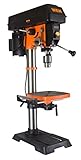
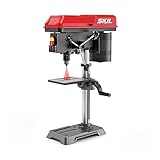


Compact drill presses compared
| Model | Footprint, approx. | Quill travel | Speed adjustment | Published weight | Best fit |
|---|---|---|---|---|---|
| WEN 4208T | 7 × 11 in. base | 2 in. | 5 belt steps, 740–3140 RPM | 34 lb | Occasional work and low cost |
| WEN 4214T | 9.5 × 11.5 in. base | 3⅛ in. | Variable, 580–3200 RPM | 89 lb | Frequent changes in material and bit size |
| JET J-2530 | 11 × 17 in. base | 3⅜ in. | 16 belt steps, 200–3630 RPM | 157 lb | Stability and heavier work |
Footprints are the manufacturer-listed base dimensions, not the full space needed to operate the machine. Allow extra room for the table, handle sweep, belt-cover access and long stock. A press with a small base can still be awkward if its head or motor crowds a wall.
Choose by your workshop situation
- Very limited bench space or occasional use: The WEN 4208T is the practical budget pick. Its 2-inch travel suits many shallow holes, but the five belt positions mean speed changes take more time than with a variable-speed model.
- Mixed woodworking and regular speed changes: The WEN 4214T offers a useful balance. Its variable speed is easier to adjust for different bits and materials, and its longer travel reduces the need to reposition a workpiece for deeper holes.
- Frequent use, larger work or maximum steadiness: The JET J-2530 is substantially heavier and has the longest travel here. That mass can help resist movement, but it is not a press most owners will want to lift on and off a bench.
- Shared or fold-away workspace: Prioritize the machine’s total weight and where it can be safely stored, not just its base size. Even a 34-pound press needs a stable, level surface during use; plan a dedicated cart or a secure lifting arrangement rather than carrying it by the table or handle.
What the numbers mean in practice
Footprint is not the whole space requirement
Measure the bench area, then check clearance above the press for tall workpieces and access behind it for belt adjustment. Also consider the longest board you expect to drill: a compact base does not make a long panel easy to support. If the press will sit near a wall, leave enough room to open the belt cover without moving the machine.
Quill travel determines how often you reposition work
Quill travel is the maximum spindle movement in one plunge. It is not the drilling depth guaranteed in every setup: the chuck, bit length, table position and workpiece thickness all affect usable clearance. For example, if a hole needs 2½ inches of depth, a press with 2 inches of travel cannot make it in one plunge. You would need to reposition the work or use a longer bit, which can reduce control. The 3⅛-inch travel of the 4214T is more forgiving for deeper operations, while the JET’s 3⅜ inches adds a little more room.
Speed changes affect convenience and finish
Stepped belt systems are simple and durable, but each change requires opening the cover and moving the belt. Variable-speed control is faster for repeated changes, though it does not replace choosing an appropriate speed for the bit diameter and material. Larger bits generally call for slower speeds; follow the bit manufacturer’s guidance and secure the work before drilling.
Published speed ranges are not a promise that every setting is equally useful for every bit. A broad range helps, but pulley steps or electronic control, motor behavior and the load can affect how practical a setting is. For occasional work mostly using similar bits, belt changes may be no bother. For varied projects, convenient adjustment can save more time than a small difference in maximum speed.
Stability, vibration and setup
Weight can help, but it does not by itself guarantee low vibration. A press mounted to a flexible or undersized bench may shake even if the machine is heavy. Bolt the base to a solid surface when possible; otherwise, use a properly rated, stable stand and make sure it cannot rock. Check that the chuck and bit are seated correctly, the work is clamped, and the table is square to the spindle. These basics can reduce chatter and improve hole accuracy more than chasing a particular weight figure.
For small parts, use a vise or clamps rather than holding the work by hand. A spinning bit can catch a loose piece and throw it. Keep the table clear of tools, remove the chuck key before starting, and disconnect power before changing belts or making adjustments.
Ownership: what needs attention first
On a belt-driven press, belts are wear items: inspect them for cracking, glazing or slack, and replace them when damaged or slipping. Keep the quill and table-column surfaces clean of dust and resin; accumulated debris can make adjustments rough and interfere with alignment. Follow the manual for lubrication, belt tension and maintenance intervals rather than applying oil indiscriminately, especially around belts or surfaces intended to stay dry.
Common sources of disappointing results are a dull or unsuitable bit, a loose table, an uncentered or poorly seated chuck, and feed pressure that is too aggressive. Before blaming the machine, check bit sharpness, workholding and alignment. For repeated precision work, use a square to check the table and confirm that the bit runs true; a tabletop press is a capable shop tool, but it is not automatically a precision instrument straight out of the box.
Bottom line
For most small workshops, the WEN 4214T is the strongest all-around choice because it combines a manageable base, 3⅛ inches of travel and convenient variable speed. Choose the WEN 4208T if low cost and light duty matter more than adjustment speed or deep travel. Step up to the JET J-2530 when steadiness and heavier construction outweigh its larger footprint and difficult storage. Before buying, measure not only the bench but also the space needed to operate, maintain and safely support the press.