
What's inside
As an Amazon Associate I earn from qualifying purchases. This post may contain affiliate links at no extra cost to you.
The best benchtop spindle sander for most small-shop projects is a 1/2-horsepower oscillating model with a cast-iron or thick cast-aluminum table, a footprint close to 20 by 20 inches, at least six spindle sizes, and a 2-1/2-inch dust port. Among commonly available options, the Triton TSPS450 is the strongest all-around choice, while the WEN 6524 is a sensible budget pick and the Shop Fox W1831 suits users who prioritize a compact, relatively light machine.
As an Amazon Associate we earn from qualifying purchases at no extra cost to you.
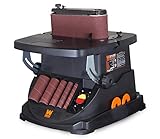
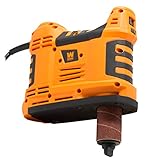
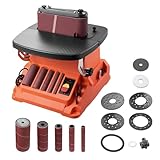

What matters most in a benchtop spindle sander
Spindle sanders look similar on a product page, but the differences become apparent when sanding curved parts or processing several pieces in a row. A useful machine needs more than a motor and a set of sleeves.
- Stable base: A heavy base, rubber feet, or mounting holes reduce movement when a workpiece contacts the spindle. A light machine can still work well if it is clamped or bolted to a bench.
- Practical table size: A table around 11 by 11 inches is adequate for small parts. A table nearer 13 by 13 inches gives better support for cabinet components, templates, and wider curved edges.
- Useful spindle assortment: The most useful sizes are usually 1/2, 3/4, 1, 1-1/2, 2, and 3 inches. Small drums handle tight curves; large drums remove material faster from broad curves.
- Low vibration: Vibration affects both finish quality and control. It commonly comes from an uneven bench, an incorrectly fitted drum, a damaged sleeve, or a spindle washer installed in the wrong order—not only from the motor.
- Simple dust collection: A standard 2-1/2-inch port is easiest to connect to a shop vacuum. A reducer can work, but an awkward hose connection may pull on the machine or restrict airflow.
Best benchtop spindle sander choices by situation
| Model | Published motor / speed | Table and oscillation | Included spindle sizes | Approx. weight | Best fit |
|---|---|---|---|---|---|
| Triton TSPS450 | 450 W; about 2,000 rpm | Approx. 13 x 13 in.; about 58 oscillations/min | 1/2, 3/4, 1, 1-1/2, 2, 3 in. | About 30 lb | Best overall balance of support, assortment, and portability |
| WEN 6524 | 4.5 A; about 2,000 rpm | Approx. 11.5 x 11.5 in.; about 58 oscillations/min | 1/2, 3/4, 1, 1-1/2, 2, 3 in. | About 30 lb | Budget-conscious occasional use |
| Shop Fox W1831 | 1/2 hp; about 2,000 rpm | Approx. 11.5 x 11.5 in.; about 5/8-in. oscillation | Commonly supplied with six drum sizes | About 34 lb | Compact shops wanting a traditional benchtop machine |
Specifications can vary by production run or market, so confirm the current manual before purchase. The important comparison is not a small difference in motor rating. It is whether the table, base, dust port, and spindle kit suit the work you actually do.
Best overall: Triton TSPS450
The Triton TSPS450 is the most convincing general-purpose choice for a small workshop. Its roughly 13-by-13-inch table provides useful support without making the machine excessively large, and the six spindle diameters cover most furniture, craft, and small cabinet tasks.
Its main advantage is versatility. A 1/2-inch drum can refine a tight inside radius, while the 2- and 3-inch drums are better for broad curves. The supplied table inserts and washers also make it possible to set up different drums without immediately buying accessories. The machine remains portable enough to store on a shelf, although securing it to a solid bench is preferable for wide or awkward workpieces.
Best budget choice: WEN 6524
The WEN 6524 offers the core features that make an oscillating spindle sander useful: a six-drum assortment, a roughly 11.5-inch-square table, and a standard dust-collection connection. It is a practical choice for a hobbyist who sands curved parts occasionally rather than running production batches.
The smaller table is not a serious limitation for drawer parts, brackets, toy components, and small furniture pieces. It becomes more noticeable when supporting wide panels or holding a template close to the table edge. Budget machines also benefit more from careful bench mounting because vibration is magnified when the supporting surface flexes.
Best for a compact traditional setup: Shop Fox W1831
The Shop Fox W1831 is worth considering when a relatively compact benchtop footprint and conventional controls matter more than extra table area. Its approximately 1/2-horsepower motor is appropriate for controlled sanding passes, but it should not be treated like a material-removal machine. Let the abrasive do the work and avoid forcing a large workpiece into a small drum.
Decision matrix for a small shop
| Your situation | Prioritize | Recommended direction |
|---|---|---|
| Under roughly $150 and occasional use | Complete spindle kit, standard dust port, easy storage | WEN 6524 or a similar six-drum budget model |
| Frequent furniture and cabinet work | Larger table, rigid base, dependable replacement sleeves | Triton TSPS450 or a heavier equivalent |
| Very limited bench space | Compact footprint and manageable weight | Shop Fox W1831 or another compact benchtop unit |
| New to spindle sanding | Multiple drum sizes and simple controls | A six-size kit with clear table inserts and a 2-1/2-inch port |
| Wide curved workpieces | Maximum table support and firm mounting | A larger-table machine, bolted to the bench |
How to set one up for lower vibration and better dust collection
- Put it on a rigid surface. A thin folding table can resonate. Use a heavy bench, a dedicated platform, or a board that bridges two sturdy supports.
- Check the feet and mounting points. Ensure all feet contact the surface. If the unit has mounting holes, bolt it down when sanding large pieces.
- Install the drum in the correct order. Fit the lower washer, abrasive sleeve, upper washer, and nut exactly as shown in the manual. Over-tightening can distort a sleeve or make removal difficult.
- Choose the smallest suitable spindle. A small drum reaches tight curves, but a large drum supports a longer sanding contact area and usually wears more evenly on broad curves.
- Connect the vacuum before sanding. Use the machine’s 2-1/2-inch port where possible. Keep the hose short enough that it does not pull the sander toward the bench edge.
- Test on scrap. Feed the workpiece gradually and move it around the spindle. Holding one spot too long creates a hollow or changes the intended radius.
The oscillating action moves the abrasive up and down, distributing wear and reducing the continuous groove that a fixed drum can produce. It does not eliminate the need for movement: a stationary workpiece can still burn, dish, or lose its intended shape.
Ownership costs and maintenance
A spindle sander’s consumables are inexpensive individually but easy to underestimate. Suppose a replacement sleeve costs $3 and remains effective for 12 small projects. The abrasive cost is about 25 cents per project. If a sleeve becomes glazed after only four projects because it is used to remove too much material, that cost rises to 75 cents per project. The larger cost is usually lost time and an uneven finish.
- Clean sleeves regularly: A crepe abrasive-cleaning stick can remove packed dust when the sleeve is unplugged and stationary. Replace sleeves that are torn, stretched, or visibly uneven.
- Empty the dust system: Fine sanding dust can restrict airflow. Check the hose, port, and vacuum filter rather than assuming poor collection is a motor problem.
- Inspect table inserts: A missing or damaged insert leaves an unsafe gap around a small drum and can allow a workpiece edge to catch.
- Protect the table: Wax or a suitable dry lubricant can help wood slide smoothly, but keep lubricant away from areas where it could conta
Affiliate disclosure. As an Amazon Associate we earn from qualifying purchases at no extra cost to you. Prices accurate as of the date shown.Best Benchtop Spindle Sander for Small-Shop ProjectsCheck price on Amazon
Related guides