
What's inside
- What to Look For in a Benchtop Belt Sander
- Dust Collection Is a Safety and Maintenance Issue
- How Much Bench Space Do You Really Need?
- Decision Matrix for Beginner Buyers
- Belts, Abrasive Grades, and Ownership Costs
- Setup Steps That Prevent Common Problems
- What Wears First and What to Inspect
- Final Buying Recommendation
- Related Guides
As an Amazon Associate I earn from qualifying purchases. This post may contain affiliate links at no extra cost to you.
The best benchtop belt sander for a beginner is usually a 4-by-36-inch model with a 1/2- to 3/4-horsepower motor, an adjustable sanding table, usable dust collection, and a footprint that leaves room for safe workpiece handling.
As an Amazon Associate we earn from qualifying purchases at no extra cost to you.
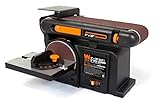
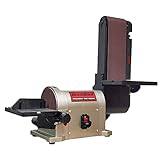

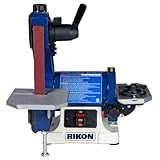
What to Look For in a Benchtop Belt Sander
A benchtop belt sander removes material much faster than a random-orbit sander, but it is less forgiving. The right choice depends on what you plan to sand, how often you will use the machine, and whether your shop can accommodate both the sander and the space needed around it.
Belt size: the most important practical choice
Belt dimensions describe the sanding surface and the replacement belt you will need. The common sizes are 3-by-18, 4-by-36, and 6-by-48 inches, although the first is more typical of handheld sanders and large floor machines use wider belts than most beginners need.
| Belt size | Best for | Typical motor | Approximate machine footprint | Main limitation |
|---|---|---|---|---|
| 3 x 18 in. | Small parts, edge work, occasional shaping | 5–8 amps handheld; limited benchtop support | About 18 x 7 in. when mounted | Narrow sanding area and less stable for large boards |
| 4 x 36 in. | General-purpose woodworking, edges, faces, and small projects | 1/2–3/4 hp | About 20–24 x 18–22 in. | Not ideal for very wide panels or continuous production |
| 6 x 48 in. | Frequent stock removal and larger furniture parts | 1–1 1/2 hp | About 30–36 x 24–30 in. | Higher cost, greater dust output, and much more bench space |
A 4-by-36-inch belt gives a beginner a useful balance. It can flatten narrow boards, smooth rough edges, shape small workpieces, and sand end grain when used carefully. A 6-by-48-inch machine makes sense when you regularly prepare many boards or work on larger furniture components. It is excessive if the sander will be used only for occasional touch-ups.
Motor power and speed
Motor power affects how well the belt maintains speed when you press a workpiece against it. A 1/2-horsepower motor is adequate for light and moderate work. A 3/4-horsepower motor provides more reserve for hardwood, edge jointing, and longer sessions. A 1- to 1 1/2-horsepower machine is better suited to frequent stock removal, but it also demands better dust control and a sturdier bench.
Do not select a machine by horsepower alone. A well-designed 1/2-horsepower sander can be more useful than a poorly supported higher-powered model. Look for a rigid platen, a belt-tracking adjustment, a table that locks securely, and a motor that does not bog down under normal pressure.
Variable-speed control is helpful for beginners, especially when working with softwood, veneer, painted surfaces, or heat-sensitive finishes. Lower speeds reduce the chance of burning and make it easier to control delicate parts. Fixed-speed machines can still be excellent value for ordinary solid-wood work.
Table adjustability and sanding positions
A sanding table should adjust to a true 90-degree position and lock without shifting. This matters when you are squaring the end of a board or sanding a consistent edge. A table that moves during use can turn a flat edge into a slight bevel and make accurate joinery difficult.
Some combination belt-and-disc sanders let the belt operate horizontally and vertically. A horizontal belt is convenient for smoothing broad faces and supporting small parts. A vertical belt is useful for edge work and angled sanding. If the position changes, check that the table remains stable and that the adjustment mechanism does not rely on a loose friction fit.
For angled work, a miter gauge can help, but inexpensive gauges are not always perfectly accurate. Treat it as a guide rather than assuming it is square. Verify the angle with a reliable combination square before sanding a batch of parts.
Dust Collection Is a Safety and Maintenance Issue
Belt sanders produce a large volume of fine dust. A dust port is useful only if the machine’s internal passages direct dust effectively and your extractor has enough airflow. Many benchtop models use a 2 1/4-inch port, while shop-vac hoses commonly range from 1 1/4 to 2 1/2 inches. An adapter may be necessary.
A shop vacuum is generally suitable for occasional use and smaller sanders. A dust extractor with a larger collection capacity is preferable for long sessions. Use a dust separator if practical; it keeps abrasive particles and wood dust from filling the vacuum filter immediately.
Dust collection should not replace respiratory protection. Wear suitable eye protection, keep the work area clear, and use a properly fitted respirator appropriate for fine wood dust when ventilation is limited. Never sand materials that may contain hazardous coatings unless you know how to manage them safely.
How Much Bench Space Do You Really Need?
The machine’s listed footprint is not the whole space requirement. You need room to place both hands safely, support long stock, connect the dust hose, and reach the power switch without leaning over the belt.
For a typical 4-by-36-inch sander occupying roughly 22 by 20 inches, reserve at least a 30-by-30-inch working zone. Add temporary support for boards longer than about 24 inches. A folding stand or a board-mounted base can be useful if permanent bench space is limited, but the mounting surface must be rigid enough to prevent vibration.
Before buying, mark the proposed footprint on your bench with masking tape. Place the longest workpiece you expect to sand beside it and check whether the belt, table, dust hose, and switch remain accessible.
Decision Matrix for Beginner Buyers
| Your situation | Recommended configuration | Why | Expected market range in 2026 |
|---|---|---|---|
| Occasional hobby use, limited bench space | 3 x 18 or compact 4 x 36 in.; 1/2 hp or equivalent | Lower cost and easier storage | About $120–$220 |
| First general-purpose woodworking machine | 4 x 36 in.; 1/2–3/4 hp; adjustable table; dust port | Best balance of capacity, control, and replacement-belt availability | About $180–$350 |
| Weekly furniture or cabinet work | 4 x 36 or 6 x 48 in.; 3/4–1 1/2 hp; rigid stand and effective extraction | Handles longer sessions with less speed loss | About $300–$700 |
| Very small parts and detailed shaping | Compact belt-and-disc combination; narrow belt; adjustable work table | Better control than a large machine | About $150–$300 |
Belts, Abrasive Grades, and Ownership Costs
The belt is a consumable, and abrasive quality often matters more than a small difference in motor specifications. Aluminum-oxide belts are economical for general wood sanding. Zirconia belts cut aggressively and usually last longer on hardwood or heavy stock removal, but they cost more. Ceramic belts are intended for demanding use and can be unnecessary for a beginner’s occasional projects.
A practical starter selection is 80 grit for shaping and removing tool marks, 120 grit for general smoothing, and 180 grit for preparing a surface for finish sanding. A belt sander should not normally be the last sanding step on visible furniture surfaces; follow with a random-orbit sander or hand sanding to remove directional scratches.
As a simple ownership calculation, suppose a replacement belt costs $6 and remains effective for eight moderate sessions. Its abrasive cost is about $0.75 per session. If a $30 premium belt lasts 30 sessions, its cost is $1 per session but may save time and reduce belt changes. The cheapest belt is not always the cheapest option when labor and surface quality matter.
Setup Steps That Prevent Common Problems
- Secure the machine. Bolt it to the bench or use a non-slip mounting board. Vibration makes accurate sanding harder and can pull a workpiece unexpectedly.
- Install the belt in the correct direction. Some belts have directional arrows. Confirm that the belt runs toward the platen or table as specified by the manufacturer.
- Track the belt before sanding. Run the machine briefly and adjust the tracking knob until the belt stays centered. Keep fingers away from the moving belt.
- Connect dust collection. Check for leaks and make sure the hose cannot catch on the workpiece.
- Set the table and test with scrap. Verify the angle with a square and check whether the belt removes material evenly.
- Use light, moving pressure. Let the abrasive cut. Holding one spot too long creates grooves, flat spots, and heat buildup.
What Wears First and What to Inspect
Belts wear first, followed by platen surfaces, drive wheels, tracking components, and sometimes the dust port or table-lock hardware. Replace a belt when it clogs, tears, loses its abrasive, or needs excessive pressure. A glazed belt can generate heat instead of cutting efficiently.
Clean dust from the motor vents and tracking area regularly, but follow the manufacturer’s instructions before using compressed air because it can drive dust deeper into bearings and switches. Inspect the power cord, belt guards, table fasteners, and emergency access to the switch. Do not operate a machine with a damaged guard or a belt that wanders off its rollers.
Final Buying Recommendation
For most beginners, choose a 4-by-36-inch benchtop belt sander with a 1/2- to 3/4-horsepower motor, a rigid adjustable table, a 2 1/4-inch dust port, reliable belt tracking, and a footprint your bench can support with extra working clearance. Move up to a 6-by-48-inch model only when your projects justify the capacity and you have adequate dust extraction. If your work is limited to small parts or occasional edge smoothing, a compact machine can save money and space without sacrificing useful control.