
Our Top Picks
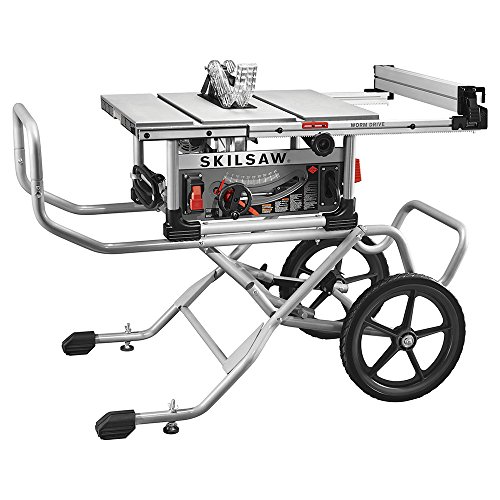 SKIL 10 Inch Heavy Duty Worm Drive Table52.6 x 29.5 x 35 inches52.6 x 29.53 x 35.08 inches94.3 poundsCheck on Amazon


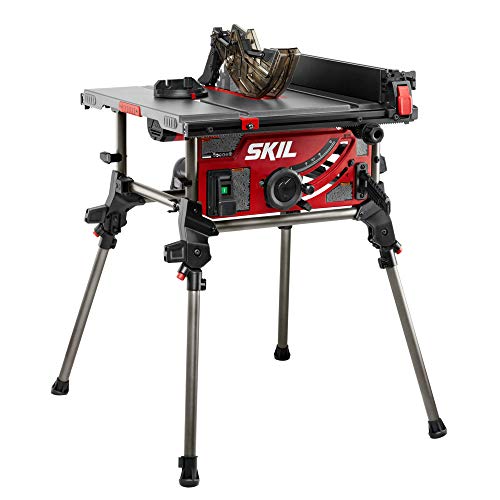
What's inside
As an Amazon Associate I earn from qualifying purchases. This post may contain affiliate links at no extra cost to you.
Furniture work punishes a sloppy saw in ways framing never will. If your rip fence wanders a few thousandths over a 24 inch cut, case sides come out tapered, dadoes stop lining up, and a face frame that should close tight leaves a hairline gap you notice every time you walk past it. Picking a table saw for furniture making is mostly about repeatability and flat reference surfaces, not horsepower, and that is the part spec sheets bury under amp ratings.
I build in a single-car garage with the car parked outside, on a 120V circuit I share with a dust collector when I forget to plan ahead. Everything below is filtered through that. I am not going to tell you to buy a 5 hp cabinet saw and then act surprised that you cannot walk around it.
As an Amazon Associate we earn from qualifying purchases at no extra cost to you.


| Saw Class | Strength | Trade-off You Live With |
|---|---|---|
| Compact 8-1/4 in jobsite | Cheap, stores vertically, light enough to carry | Short arbor blocks most dado stacks |
| Full-size 10 in jobsite | Good rack-and-pinion fence, 120V, rolls out of the way | Aluminum top, loud motor, limited dado support |
| Hybrid or contractor style | Cast iron top, quiet induction motor, real miter slots | Heavy, wants a mobile base, around 30 in rip |
| Cabinet saw | Flattest top, best fence, full joinery capacity | Usually 240V, large footprint, highest cost |
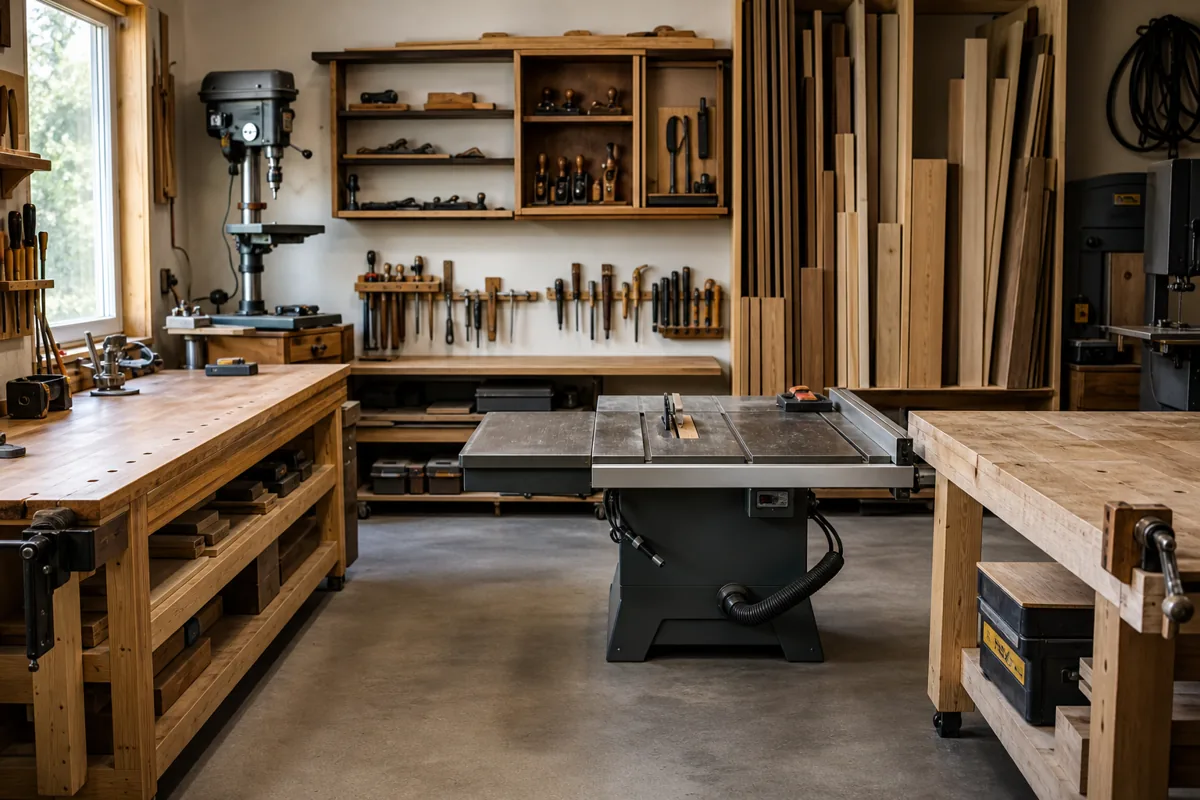
What Actually Matters in a Table Saw for Furniture Making
Four things decide whether a saw can build furniture: the fence, the flatness of the top, how well the blade stays parallel to the miter slot, and the arbor. Motor power comes fifth, and a good thin-kerf blade closes most of the power gap on a 120V saw.
The fence is most of the saw
A fence has one job: land parallel to the blade at the same setting every time, and stay put when your forearm leans on it. The rack-and-pinion fences on modern portable saws are genuinely good at this, which is why so much hobby furniture gets built on jobsite saws. Single-point clamp fences on bargain bench saws are why so much hobby furniture gets scrapped.
Cast iron versus light aluminum
Cast iron gives you a reference plane that ignores humidity, plus mass that steadies the cut when you push 8/4 maple through. Aluminum tops can be flat and are much easier to move, but they flex under a heavy panel and they dent. Lay a straightedge across any used saw before money changes hands.
Arbor length quietly decides your joinery
This is the one that got me. Most compact saws, and some full-size jobsite saws, have a short arbor that will not accept a full dado stack. If you plan to cut shelf dadoes, drawer bottom grooves, and tenon cheeks on the saw, confirm dado capacity in the manual first. Otherwise that work moves to a router, which is fine but slower.
Full-Size Jobsite Table Saw With Rack-and-Pinion Fence
If your shop is also your parking spot, shop this category first. You get real fence accuracy and a stand that rolls away, and you give up cast iron mass and, on some models, dado capacity. Read the arbor spec, not the marketing copy.
Portable, Hybrid, or Cabinet in a One-Car Garage
Portable saws win on storage and on the outlet you already have. They lose on noise, on outfeed support, and on cut quality in thick hardwood, where a universal motor bogs and leaves burn marks. Hybrids and contractor-style saws with cast tops and belt-driven induction motors are the sweet spot for furniture if you can give up the floor space. Cabinet saws are better at everything and worse at fitting into a shared garage.
Whichever class you choose, budget for a mobile base and some outfeed support. A saw you cannot move is a saw you stop using, and panels tipping off the back of a short table is how people get hurt.
- ✔ Frees up floor space and runs on a standard 15A circuit
- ✔ Rack-and-pinion fences repeat well enough for casework
- ✔ Low buy-in leaves money for blades and jigs
- ✘ Universal motors are loud and bog in thick hardwood
- ✘ Many models will not take a dado stack
- ✘ Small tables need outfeed and side support
- ✘ Dust collection is usually an afterthought
Rip Capacity and How You Break Down Sheet Goods
The 50 inch rip capacity everyone wants matters only if you rip full sheets on the saw. Wrestling a 4×8 sheet of 3/4 plywood across a table saw alone in a garage is unpleasant and not especially safe. I break sheets down with a track saw or a circular saw and a straightedge, then bring the parts to the table saw for final width. Work that way and 28 to 30 inches of rip covers almost all casework.
Max blade height at 90 degrees is the spec I would check instead. Around 3 inches lets you rip 8/4 stock and cut tenon shoulders in one pass, so you are not flipping boards and hoping the two cuts meet.
Hybrid Table Saw With Cast Iron Top
If furniture is the main thing you build and you can commit the floor space, this is where the real jump in cut quality lives. Quieter motor, flat top, standard miter slots for sleds and tenon jigs. Put it on a mobile base the day it arrives.
Upgrades That Beat Buying a Bigger Saw
Before you upgrade the saw, upgrade what touches the wood. Swapping the included blade for a 40 to 50 tooth thin-kerf combination blade is the biggest single change in cut quality, and thin kerf asks less of a 120V motor. A zero-clearance insert kills tearout on the underside of plywood and keeps thin offcuts out of the throat. A crosscut sled built from shop scrap turns almost any saw into an accurate crosscut machine.
Then spend an evening tuning: check blade-to-slot parallel, set the fence parallel with a hair of relief at the back, and line up the riving knife. That costs nothing and buys more accuracy than most accessories.
10 in Thin-Kerf Combination Blade
Change the factory blade on day one. A good general-purpose blade cuts cleaner in hardwood and plywood, burns less, and makes a modest saw feel like a better one. Add a dedicated crosscut blade later if you build a lot of face frames.
Mistakes I Made
I bought on price twice. The first saw had a fence I had to tap with a wrench to trust, so I stopped trusting my own parts. The second would not take a dado stack, which I learned halfway into a bookcase. I also skipped dust collection for a year and coated the whole garage, car included, in fine maple dust. If I were starting over I would match the saw class to the work, check the fence and arbor before anything else, and spend the savings on blades, a sled, and a vacuum with a separator.
Frequently Asked Questions
Can I really build furniture on a jobsite saw? Yes. You will add support stands, take lighter passes in thick hardwood, and may cut dadoes with a router. Accuracy comes from the fence and your setup more than the badge on the housing.
Do I need a dado stack, or is a router enough? A router with a straight bit and a guide cuts every joint a stack can. The stack is faster and more repeatable for shelf dadoes and drawer grooves. If your saw cannot take one, treat it as a workflow change, not a dealbreaker.
Is a flesh-detection saw worth it in a hobby shop? If it fits the budget, I think so, mainly because hobby shops are where people work alone and tired. It does not replace a riving knife, push sticks, and standing clear of the kickback zone. Pricing varies a lot by class, so compare current listings.
Buy for the fence, the top, and the arbor, size the saw to your actual floor space, and put the savings into blades and jigs. That order has served me better than chasing amps.
Check prices on Amazon →