Best TIG Welding Machine: AC/DC Picks for Steel and Aluminum
Compare the best TIG welding machines for steel and aluminum, covering AC/DC output, pulse control, duty cycle and foot pedal options for home workshops.
Compare the best TIG welding machines for steel and aluminum, covering AC/DC output, pulse control, duty cycle and foot pedal options for home workshops.
As an Amazon Associate I earn from qualifying purchases. This post may contain affiliate links at no extra cost to you.
As an Amazon Associate we earn from qualifying purchases.
The best TIG welding machine is the one that matches the metal you actually weld. If aluminum is part of your work, you need AC TIG output with adjustable balance and frequency. If you weld only steel and stainless steel, a DC-only machine can cover the job with less complexity and less weight. Output, duty cycle, start method, and pedal control matter more than a long feature list, so this guide compares five current TIG welders on the specifications that change day-to-day results in a small workshop.
Four of the picks below are AC/DC TIG and stick machines, so they handle aluminum as well as steel and stainless. The fifth pick is clearly labeled as DC-only: it is a legitimate TIG machine for steel and stainless, but it cannot TIG weld aluminum, and that limit is stated wherever it appears. Every pick is a dedicated TIG welder first, with stick welding as a secondary process, rather than a general multi-process box where TIG is an afterthought.
Quick comparison
Pick
Processes
Max TIG output
Input
Start
Best for
PrimeWeld TIG225X
AC/DC TIG, stick
225 A
120/240 V dual voltage
High frequency
Most home shops wanting AC/DC and pulse
Everlast PowerTIG 200DV
AC/DC TIG, stick
200 A
120/240 V dual voltage
High frequency and lift
Low-amp starts on thin material
AHP AlphaTIG 203Xi
AC/DC TIG, stick
200 A
110/220 V dual voltage
High frequency and lift
Wide AC frequency and balance adjustment
Lincoln Electric Square Wave TIG 200
AC/DC TIG, stick
200 A
120/230 V dual voltage
High frequency
Simple controls from an established brand
YESWELDER TIG-205P
DC TIG, pulse DC TIG, stick — no AC
200 A on 220 V
110/220 V auto-sensing
High frequency
Lightweight DC TIG for steel and stainless only
How to choose a TIG welding machine
Decide AC or DC first
This is the decision that cannot be fixed later with an accessory. AC output is required for TIG welding aluminum because the alternating current provides the cleaning action that breaks up the oxide layer while the electrode-negative portion puts heat into the work. DC TIG works well on steel, stainless steel, chrome-moly, and copper alloys, but a DC-only machine will not give you a usable aluminum TIG arc. Buy AC/DC if there is any realistic chance aluminum fabrication, cast parts, or boat and trailer repair is in your future. Buy DC-only only when your material list is firmly steel and stainless.
Match output and duty cycle to thickness
A 200-amp class machine covers the range most small shops need, from thin sheet and tubing up to plate in the three-eighths-inch range in a single pass with suitable joint preparation, according to manufacturer guidance for this class. Duty cycle tells you how long the machine can hold a given output in a ten-minute period before it needs to cool. A higher duty cycle at a usable amperage matters more for long seams than a headline maximum you can only hold briefly. Check the duty cycle at the amperage you will actually run, not just at the maximum.
Check the low end, not just the top end
Thin stainless, thin-wall tubing, and sheet work are decided at the bottom of the range. A machine that starts cleanly at very low amperage in DC, and at a modest amperage in AC, gives you control on delicate work without blowing through. Look for the published minimum TIG amperage in both AC and DC, and prefer high-frequency start when you need non-contact arc initiation that does not contaminate the tungsten or the workpiece.
Understand AC balance, AC frequency, and pulse
AC balance shifts the proportion of cleaning versus penetration in the AC cycle. More electrode-positive time increases cleaning on dirty or oxidized aluminum, while more electrode-negative time increases penetration and reduces tungsten heating. AC frequency narrows or widens the arc cone: higher frequencies focus the arc for tight joints and fillets, while lower frequencies give a broader arc. Pulse TIG cycles between a peak and a background current, which helps control heat input on thin material, improves bead consistency, and can reduce distortion. None of these controls replaces good fit-up and clean metal, but together they widen the range of work one machine can handle well.
Plan power, gas, and accessories
Dual-voltage input is practical insurance: a standard household circuit handles lighter work, while a higher-voltage circuit unlocks full output. Confirm the plug type, breaker requirement, and adapter situation for your shop before ordering. TIG also needs pure argon shielding gas, a regulator or flowmeter, tungsten electrodes, filler rod matched to the base metal, and a sound work clamp. Some packages include a foot pedal, torch, and regulator, while others treat the pedal as an add-on, so compare the complete starting setup rather than the power source alone. A foot pedal, or another remote amperage control, makes a real difference on aluminum and on out-of-position work where you need to adjust heat without stopping.
Consider weight, warranty, and support
Inverter machines in this class range from a carry-anywhere box of around ten pounds to bench units near sixty pounds. If the welder will live on one bench, weight is a minor point and a heavier unit with a longer warranty may be the better trade. If it moves between a garage, a driveway, and a job site, weight and handle design become deciding factors. Warranty length and the availability of replacement torches, pedals, and consumables are also worth checking, because a TIG torch lead or pedal failure can idle the whole machine.
The PrimeWeld TIG225X is the most complete all-around package in this group. Manufacturer and listing details describe a 225-amp IGBT inverter with AC and DC TIG, stick welding, and pulse in both AC and DC, running on dual-voltage 120/240 V input. That output gives it headroom above the 200-amp class for thicker sections, while the pulse controls help manage heat on thinner work. The Amazon package referenced for this pick includes a CK17 flex-head torch with a flexible cable, a foot pedal, and a regulator, which matters because torch feel and cable flexibility affect control during long beads.
For a woodworking-adjacent metal shop that builds its own bases, brackets, dust-collection fittings, and trailer or cart frames, the appeal is breadth: AC for aluminum, DC for steel and stainless, and stick for outdoor or dirty-metal repairs where TIG is not practical. The trade-offs are the usual ones for a feature-rich inverter at this level: there are more settings to learn, and buyers should confirm the exact torch length and included accessories on the live listing, because PrimeWeld also sells the same power source in other bundle configurations direct. As a single machine intended to cover nearly all small-shop TIG work, this is the default recommendation.
Everlast PowerTIG 200DV
The Everlast PowerTIG 200DV is a 200-amp AC/DC TIG and stick welder with pulse, dual-voltage 120/240 V input, and IGBT inverter technology. Its distinguishing specification is the low starting amperage: manufacturer details put the DC TIG start as low as 5 amps, with an AC start around 20 amps. That low end is useful for thin stainless sheet and thin-wall tubing, where the first seconds of the arc decide whether the joint survives. Listing and review sources describe a duty cycle of 60 percent at full 200-amp output, which is strong for this class and supports longer runs without thermal interruption.
The package commonly includes a TIG torch and a foot pedal, and Everlast lists a five-year warranty for the machine, which is longer than the coverage on several rivals here. At roughly sixty pounds it is a bench machine rather than a portable one, so plan a permanent spot or a cart. It is also not rated for cellulosic E6010 stick electrodes, per the manufacturer guidance for this Everlast line, so stick users who rely on that rod should note the limit. Choose this pick when thin-material control and duty cycle rank above portability.
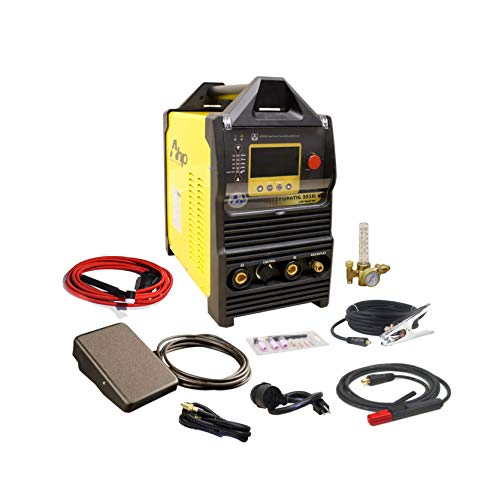
The AHP AlphaTIG 203Xi is a 200-amp AC/DC TIG and stick welder with pulse and dual-voltage 110/220 V input. Its strength is the width of its AC adjustment. Current listing-based sources describe AC frequency adjustment across a broad range, roughly 20 to 200 Hz, and AC balance adjustment across roughly 20 to 80 percent electrode positive. In practice, that range lets you move from aggressive cleaning on oxidized cast aluminum to a focused, penetrating arc on clean sheet without changing machines. High-frequency and lift start options, 2T and 4T trigger control, and pulse in both AC and DC round out the control set.
The listing carries a three-year warranty, and a foot pedal is included in the standard package described by AHP sources, with a wireless pedal sold separately as an option rather than a standard inclusion. Buyers should confirm the exact model-year revision on the live listing, because AHP has updated this line over time and accessory details can differ between revisions. Weight figures also vary between sources for different revisions, so treat the machine as a bench unit and verify the current figure before planning a mobile setup. Choose this pick when detailed AC shaping for varied aluminum work is the priority.
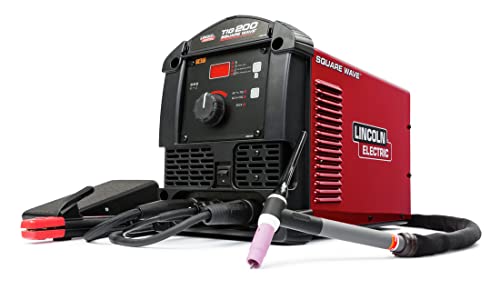
The Lincoln Electric Square Wave TIG 200, model K5126-1, is a 200-amp AC/DC TIG and stick machine built around a simple, set-and-weld interface. The manufacturer specifications list dual-voltage 120/230 V input, a TIG output range of 10 to 125 amps on the lower voltage and 10 to 200 amps on the higher voltage, and a weight of 46.5 pounds. Rated output on the higher voltage is 200 amps at a 25 percent duty cycle, with higher duty cycles at reduced amperage, so it favors short-to-medium fabrication work over continuous production seams.
Lincoln lists adjustable AC frequency and AC balance, plus pulse capability intended to help with heat control and bead appearance. The package described by the manufacturer includes a ready-to-weld TIG torch package, a foot amperage control, a gas regulator and flowmeter with hose, a stick electrode holder, and a work clamp and cable, along with input cords for both voltages. That completeness, plus the support network of a long-established welding brand, is the main reason to choose it over a higher-specification rival. Choose this pick when straightforward controls, a full starting package, and brand support matter more than maximum duty cycle or the widest adjustment ranges.
The YESWELDER TIG-205P is included for one specific buyer: the welder who works only in steel and stainless and wants the lightest, simplest route into high-frequency-start TIG with pulse. It is a DC-only machine. It combines DC TIG, pulsed DC TIG, and stick welding, with auto-sensing dual-voltage 110/220 V input and a DC TIG output range listed by the manufacturer from 10 amps up to 200 amps on the higher voltage. There is no AC output, so it cannot TIG weld aluminum, and no accessory changes that.
Within that limit, the specification is coherent. High-frequency start avoids scratch starting, pulse settings give separate control over frequency, duty cycle, and current for thin sheet and tubing, and a foot pedal interface is provided so a pedal can be added for remote amperage control. The large display and settings memory described in manufacturer material suit a beginner learning on mild steel and stainless projects such as exhaust work, brackets, and frames. Sources differ on the exact weight figure between the bare machine and the shipped package, but by either figure it is by far the lightest pick here and the easiest to store in a small shop. Choose this pick only when aluminum is genuinely off the material list; otherwise, choose one of the AC/DC machines above.
Frequently asked questions
Can a DC-only TIG welder weld aluminum?
Not in any practical TIG sense. Aluminum needs the cleaning action of AC output to break up its oxide layer during welding. A DC-only machine such as the TIG-205P in this guide is for steel and stainless steel. If aluminum is even an occasional material for you, choose an AC/DC machine.
What size circuit do these welders need?
It depends on output. Dual-voltage machines can run lighter work from a standard household circuit and need a higher-voltage circuit for full output. Check the input current figures in the manufacturer specifications for the exact model, and confirm your breaker, receptacle, and plug type before buying rather than after the machine arrives.
Do I need a foot pedal for TIG welding?
A pedal is not strictly required, because torch-switch control with 2T or 4T sequencing can start and stop the arc and hold a set amperage. A pedal, or another remote control, does make aluminum and thin material easier because you can raise and lower heat as the part heats up. If a package does not include one, check that the machine has the correct pedal connector before ordering a pedal separately.
What else do I need besides the welder?
At minimum: an argon cylinder and regulator or flowmeter, tungsten electrodes suited to your material, filler rod matched to the base metal, a welding helmet and gloves, and clamps to hold the work. Confirm what the chosen package already includes, because torch, pedal, and regulator inclusion varies by listing and bundle.
Is stick welding on these machines a substitute for a dedicated stick welder?
For occasional repairs, gates, and outdoor work where wind disturbs shielding gas, the stick mode on these TIG machines is genuinely useful. For all-day stick welding at high duty cycle, a dedicated stick machine may still be the better tool. Note also that some inverter TIG machines are not rated for E6010 cellulosic electrodes, so check the manufacturer guidance for the specific model.
Conclusion
For most small shops, start with the PrimeWeld TIG225X for its combination of 225-amp AC/DC output, pulse control, and a complete torch and pedal package. Choose the Everlast PowerTIG 200DV when low-amp starts and a strong duty cycle for thin work matter most, or the AHP AlphaTIG 203Xi when you want the widest AC frequency and balance adjustment for varied aluminum. Choose the Lincoln Electric Square Wave TIG 200 for simple controls, a complete ready-to-weld package, and established brand support. Reserve the YESWELDER TIG-205P for steel and stainless work only, where its light weight and pulse DC TIG make sense and its lack of AC output is not a compromise. Whichever machine you choose, confirm the bundle contents, pedal inclusion, and specifications on the live listing before purchase, because revisions and packages change.
Disclosure
Disclosure: This article contains affiliate links. If you buy through those links, a commission may be earned at no additional cost to you. Product information was taken from the listings and manufacturer details available at the time of writing, and specifications should be confirmed on the live listing before purchase.
J
JD's Woodworks Editorial Team
We compare specs, warranty terms, long-term owner feedback and street pricing before anything earns a spot. Rankings are never paid.
Affiliate disclosure. As an Amazon Associate we earn from qualifying purchases at no extra cost to you. Prices accurate as of the date shown.
Four hobby TIG welders compared for home shops: AC/DC picks for aluminum, a compact DC model for steel, listed specs, included gear and honest tradeoffs.
The best Creality Falcon engravers compared: Falcon A1 10W, CR-Laser Falcon 10W, Falcon2 Pro 22W and Falcon2 Pro S 40W, by power, work area and enclosure.
The best CNC machines for manufacturing compared: large-bed routers and closed-loop desktop mills with the work area, spindle and control for batch work.

 PrimeWeld TIG225X
 AHP AlphaTIG 203Xi
 Lincoln Electric Square Wave TIG 200
 YESWELDER TIG-205P









