Best Miller Plasma Cutters: 3 Spectrum Models From 30 to 60 Amps
Compare the best Miller plasma cutters in the Spectrum line, from the 19-pound Spectrum 375 X-TREME to the 60-amp Spectrum 875, on cut capacity, duty cycle and input power.
Compare the best Miller plasma cutters in the Spectrum line, from the 19-pound Spectrum 375 X-TREME to the 60-amp Spectrum 875, on cut capacity, duty cycle and input power.
As an Amazon Associate I earn from qualifying purchases. This post may contain affiliate links at no extra cost to you.
As an Amazon Associate we earn from qualifying purchases.
A Miller plasma cutter search is simpler than most plasma searches, because Miller builds exactly one handheld air plasma family: the Spectrum line. There is no crowd of overlapping Miller models to sort through. There is a ladder of three machines, and the rungs are spaced by cutting capacity. The Spectrum 375 X-TREME is a 30-amp portable that rates a clean cut through 3/8-inch mild steel. The Spectrum 625 X-TREME is a 40-amp machine rated for 5/8 inch. The Spectrum 875 is a 60-amp machine rated for 7/8 inch. Choose the rung that matches the thickest steel cut regularly, and the rest of the decision — power supply, air supply, and torch length — follows from that.
OUR TOP PICK
Miller Spectrum 375 X-TREME Plasma Cutter with XT30 Torch
That single-brand focus carries practical benefits. All three machines share Miller’s design language: inverter power sources, automatic air regulation, Auto-Refire pilot arc control, Fan-On-Demand cooling, and a three-year warranty on the power source with one year on the torch. Consumables, torches, and service come from the same Miller dealer network, and each model number echoes the rated cut thickness in fractions of an inch.
This guide compares the three current Miller Spectrum handheld plasma cutters using the specifications Miller and its retailers publish for each model. CNC tables are outside the scope here: every pick below is a complete Miller handheld plasma cutting system with its own hand torch.
Quick comparison
Model
Output
Rated cut, mild steel
Sever cut
Duty cycle at full output
Input power
Weight with torch
Miller Spectrum 375 X-TREME
30 A
3/8 inch
5/8 inch
40 percent at 30 A on 240 V
120/240 V, single-phase, Auto-Line with MVP plugs
19 pounds
Miller Spectrum 625 X-TREME
40 A
5/8 inch
7/8 inch
50 percent at 40 A on 240 V
120/240 V, single-phase, Auto-Line with MVP plugs
21 to 23 pounds
Miller Spectrum 875
60 A
7/8 inch
1-1/4 inch
40 to 50 percent at 60 A, voltage dependent
208/230 V, single-phase
49 pounds
The pattern in the table is the whole story of the range. Output doubles from the smallest machine to the largest, rated cut thickness grows from 3/8 inch to 7/8 inch, and weight climbs from a shoulder-strap 19 pounds to a still-portable 49 pounds. The two smaller machines trade some duty cycle for true dual-voltage field portability, while the largest gives up 120-volt operation entirely in exchange for sustained 60-amp output.
How to choose a Miller plasma cutter
Start with rated cut thickness, not sever thickness
Rated cut thickness is the first specification to settle, because Miller defines it honestly: it is the thickness at which an operator can travel at roughly 15 inches per minute and hold a steady, clean cut. Sever thickness is a different claim. A sever cut separates the metal, slowly, with a rougher edge that usually needs grinding. Every Spectrum model can sever well beyond its rating, and that headroom is useful for the occasional demolition cut, but a machine bought for daily work at its sever limit will feel underpowered from the first week.
The practical rule is to size the machine to the thickest material cut every week, not the thickest material cut every year. Sheet, tube, and plate up to 3/8 inch is the working centre of the Spectrum 375 X-TREME. Regular work in 1/2-inch plate, farm and fabrication repairs, and general shop cutting up to 5/8 inch belongs to the Spectrum 625 X-TREME. Structural work, thick plate, and production cutting that regularly reaches 3/4 inch and beyond is Spectrum 875 territory.
Duty cycle: the second number on the nameplate
Duty cycle is the share of a ten-minute period a machine can cut at a stated output before it needs to cool. It matters most to buyers who cut long seams or many parts in a session. The Spectrum 375 X-TREME delivers 40 percent at its full 30 amps on 240-volt input, and a higher 60 percent at 20 amps on a 120-volt, 15-amp circuit. The Spectrum 625 X-TREME is rated at 50 percent at its full 40 amps on 240 volts. The Spectrum 875 holds 40 amps at a full 100 percent duty cycle, which is the figure that separates a shop machine from a portable one: at moderate output it can cut continuously.
Read duty cycle together with the work pattern. A maintenance user making short cuts with pauses rarely meets a duty-cycle limit on any of these machines. A fabricator cutting long profiles from plate will feel the difference between 40 percent and 100 percent within a single shift.
Input power decides where the machine can work
The two X-TREME models are dual-voltage machines. Miller’s Auto-Line circuitry connects to 120- or 240-volt single-phase power automatically, and the MVP adapter system swaps the plug on the power cord — a standard 120-volt plug for ordinary outlets, a 240-volt plug for full output — without opening the machine or flipping an internal link. Output falls on 120 volts, as the comparison table’s duty-cycle figures show, but the machine remains genuinely useful for sheet and light plate on the power a job site happens to have.
The Spectrum 875 in this guide is a 208/230-volt single-phase machine and needs a proper shop circuit. Miller also builds a separate Spectrum 875 Auto-Line variant that accepts 208 to 575 volts, single- or three-phase, for industrial sites with varied power; that variant is a different listing from the pick below and is the version to seek out when three-phase or high-voltage supply is the deciding factor. Buyers should confirm which of the two 875 versions a listing describes before ordering, because the cabinets and model numbers differ.
Air supply: the specification buyers forget
None of these machines has a built-in air compressor. Each needs clean, dry compressed air or nitrogen at 90 psi minimum and 120 psi maximum, and the flow requirement grows with the machine: about 5.0 cubic feet per minute for the Spectrum 375 X-TREME, 6.0 for the Spectrum 625 X-TREME, and 6.75 for the Spectrum 875. A small pancake compressor will not keep up with any of them on long cuts. Air quality matters as much as quantity, because moisture and oil in the air line are leading causes of short consumable life and ragged cuts, so a filter and dryer on the supply line protect the torch investment. All three machines regulate air pressure to the torch automatically.
Torches, consumables, and portability
Each Spectrum pairs with its own Miller XT torch family: the XT30 on the 375 X-TREME, the XT40 on the 625 X-TREME, and the larger XT60 on the 875. Consumables are torch-specific, so a shop standardizing on one model keeps one consumable drawer. Torch cable length is a real buying decision on the X-TREME models, which are sold in 12-foot and 20-foot torch versions under different stock numbers; the longer torch keeps the power source parked while the operator walks a workpiece. The two X-TREME models ship in Miller’s protective X-CASE with a shoulder strap, and at 19 and 21 pounds they are carry-to-the-work machines. The 875, at 49 pounds with its 20-foot torch, is a move-on-a-cart machine that also offers machine-torch and automation options for buyers who later add a cutting table.
The picks in detail
Miller Spectrum 375 X-TREME Plasma Cutter with XT30 Torch
Top Pick
Miller Spectrum 375 X-TREME Plasma Cutter with XT30 Torch
The Spectrum 375 X-TREME is the entry point to the Miller line and the pick for maintenance work, HVAC ductwork, light construction, and any cutting that happens away from a fixed shop bench. Its defining trait is the combination of a genuine 3/8-inch rated cut with a 19-pound weight and a shoulder strap. Miller rates the machine to sever 5/8-inch mild steel when a rough, occasional separation cut is all that is needed, and its rated capacity on stainless steel matches its mild steel figure, with aluminum rated lower, as on every plasma machine.
Output depends on the supply it is plugged into. On 240-volt input the machine delivers 30 amps at a 40 percent duty cycle. On a 120-volt, 20-amp circuit it delivers 27 amps at 35 percent, and on a common 120-volt, 15-amp household circuit it delivers 20 amps at a 60 percent duty cycle — still enough for sheet, studs, roofing, and thin plate. Auto-Line makes the change automatically, and the MVP plugs in the package cover both connections.
The package follows the X-TREME pattern: an XT30 hand torch on a 12-foot cable in the standard configuration, a heavy-duty work clamp, the MVP power cord and plugs, a consumables box, and the X-CASE carrying case. Automatic air regulation sets torch pressure without operator adjustment, Auto-Refire manages the pilot arc across expanded metal and interrupted cuts, and Fan-On-Demand runs the cooling fan only when needed. Air demand is the lowest in the line at about 5.0 cubic feet per minute at 90 psi. For a buyer whose cutting is sheet, light plate, and repair work where the available outlet is unknown until arrival, this is the Miller to choose; buyers who already know 1/2-inch plate is weekly work should step directly to the next model.
Miller Spectrum 625 X-TREME Plasma Cutter with XT40 Torch
Runner-Up
Miller Spectrum 625 X-TREME Plasma Cutter with XT40 Torch
The Spectrum 625 X-TREME is the middle rung of the ladder and the most balanced Miller for a small fabrication shop. The step up from the 375 is substantial: output rises to 40 amps, the rated cut grows to 5/8-inch mild steel, sever capacity reaches 7/8 inch, and Miller adds gouging capability with the appropriate consumables. That combination covers the working centre of general fabrication — brackets, frames, plate parts, and repair work in material up to half an inch thick, cut at the rated speed with margin to spare.
On 240-volt input the machine is rated at 40 amps and 140 volts DC with a 50 percent duty cycle. On 120-volt input it remains a useful lighter machine, delivering 27 amps at a 20 percent duty cycle on a 20-amp circuit. Auto-Line and MVP plugs carry over from the smaller model, so the same machine works from a shop’s 240-volt receptacle during the week and a household outlet for a weekend repair. Line voltage compensation holds output steady when supply voltage sags, a practical feature on long extension runs and generator power.
Portability survives the step up. The machine weighs 21 pounds with the 12-foot XT40 torch and 23 pounds with the 20-foot version, and it ships in the same style of X-CASE with a shoulder strap. The listing verified for this guide is the 20-foot torch configuration. Air demand rises to 6.0 cubic feet per minute at 90 psi, within reach of a mid-size shop compressor. Automatic air regulation, Auto-Refire, Fan-On-Demand, and Wind Tunnel Technology — Miller’s internal airflow path that shields components from abrasive dust — are all standard. Fabricators choosing one Miller plasma cutter to keep for years, without giving up carry-it-anywhere portability, will land here most often.
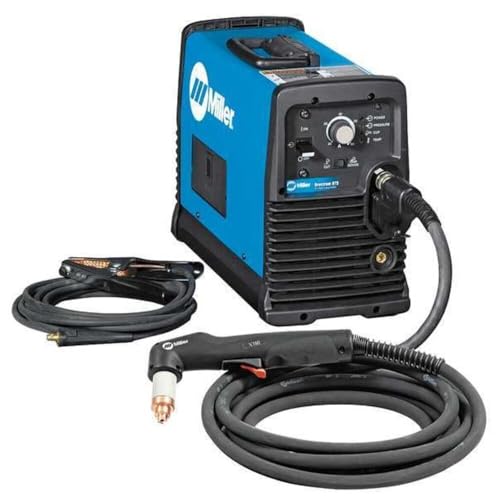
The Spectrum 875 is the top of the handheld Miller line and the machine for construction, maintenance and repair crews, and fabrication shops whose regular work is thick. A 60-amp output drives a rated cut of 7/8-inch mild steel — with stainless steel rated the same and aluminum rated at 5/8 inch — a sever capacity of 1-1/4 inch, and a recommended pierce capacity of 7/16 inch. Those figures move the machine out of the light-plate class entirely: this is the Spectrum for structural sections, heavy plate parts, and demolition-adjacent cutting where the smaller machines would be working at their sever limits.
The duty-cycle figures are the other half of the case. At its full 60 amps the machine is rated between 40 and 50 percent depending on whether it is fed 208 or 230 volts, and at 40 amps it is rated at a full 100 percent duty cycle, so long production cuts at moderate settings run without thermal pauses. Input is 208/230-volt single-phase power through a 10-foot cord; there is no 120-volt mode, and the shop circuit is part of the purchase plan. Buyers whose sites offer only higher or three-phase voltages should look at the separate Spectrum 875 Auto-Line variant instead, and confirm the exact model on any listing, since the two versions share a name and a cabinet style.
Fittings scale with the output. The XT60 hand torch arrives on a 20-foot cable in the configuration verified for this guide, with a heavy-duty work clamp and a starter set of extra consumables in the box. Air demand is the highest in the line at 6.75 cubic feet per minute at 90 psi, which calls for a compressor sized for continuous shop work. At 49 pounds with the torch, the 875 is portable in the job-site sense rather than the shoulder-strap sense, and Miller offers machine torches and automation kits for shops that later mount it on a cutting table. Shops that cut thick material every week are the audience; lighter users will not use what this machine adds over the 625 X-TREME.
FAQ
Which Miller plasma cutter is best for a home shop?
The Spectrum 625 X-TREME fits most home shops best, because its 5/8-inch rated cut covers the plate thickness home fabrication actually uses, while its dual-voltage Auto-Line input and 21-pound weight keep it flexible and easy to store. A home shop that cuts only sheet and light material can save by choosing the Spectrum 375 X-TREME instead, and should step up to the Spectrum 875 only when thick plate is a regular job rather than an occasional one.
What is the difference between rated cut and sever cut on a Miller Spectrum?
Miller’s rated cut is the thickness the machine cuts cleanly at about 15 inches per minute. Sever cut is the maximum thickness the machine can separate at a much slower travel speed, with a rougher edge that typically needs grinding. The Spectrum 375 X-TREME rates 3/8 inch and severs 5/8 inch, the 625 X-TREME rates 5/8 inch and severs 7/8 inch, and the 875 rates 7/8 inch and severs 1-1/4 inch. Buy against the rated figure for regular work.
Do Miller Spectrum plasma cutters have a built-in air compressor?
No. All three machines in this guide need an external supply of clean, dry compressed air or nitrogen at 90 psi minimum. Flow requirements run from about 5.0 cubic feet per minute on the Spectrum 375 X-TREME to 6.75 on the Spectrum 875. Dry air matters: moisture in the supply is a leading cause of worn consumables and poor cut quality, so a filter or dryer on the air line is a worthwhile companion purchase.
Can the Spectrum 375 and 625 X-TREME really run on household power?
Yes, with reduced output. Both X-TREME models use Auto-Line circuitry and MVP plugs to connect to 120-volt or 240-volt single-phase power without internal changes. On a 120-volt, 15-amp circuit the 375 X-TREME delivers 20 amps and the 625 X-TREME delivers a reduced output suited to thinner material; full rated output on either machine requires 240 volts. The Spectrum 875 does not offer a 120-volt mode.
What is the difference between the Spectrum 875 and the Spectrum 875 Auto-Line?
They are two versions of the same 60-amp, 7/8-inch-rated platform. The standard Spectrum 875, the pick in this guide, runs on 208/230-volt single-phase power. The Spectrum 875 Auto-Line accepts 208 to 575 volts, single- or three-phase, which suits industrial sites with varied supplies, and it weighs slightly more. The two versions carry different model numbers, so the version should be confirmed on the listing before purchase.
Conclusion
The best Miller plasma cutter is the one whose rated cut matches the thickest material cut every week, because the Spectrum line is a clean three-rung ladder. The Spectrum 375 X-TREME is the portable choice for sheet, light plate, and field repair, at 19 pounds with true dual-voltage input. The Spectrum 625 X-TREME is the balanced fabricator’s machine: 40 amps, a 5/8-inch rated cut, and gouging capability in a case that still travels by shoulder strap. The Spectrum 875 is the heavy step, with 60 amps, a 7/8-inch rated cut, and a 100 percent duty cycle at 40 amps for shops that cut thick material all day. Confirm the torch length and, on the 875, the exact power version on the live listing before ordering, and size the air supply to the machine’s flow requirement.
Disclosure
Disclosure: This article contains affiliate links. If you buy through those links, a commission may be earned at no additional cost to you. Product information was taken from the listings and manufacturer details available at the time of writing, and specifications should be confirmed on the live listing before purchase.
J
JD's Woodworks Editorial Team
We compare specs, warranty terms, long-term owner feedback and street pricing before anything earns a spot. Rankings are never paid.
Affiliate disclosure. As an Amazon Associate we earn from qualifying purchases at no extra cost to you. Prices accurate as of the date shown.
Four hobby TIG welders compared for home shops: AC/DC picks for aluminum, a compact DC model for steel, listed specs, included gear and honest tradeoffs.
The best Creality Falcon engravers compared: Falcon A1 10W, CR-Laser Falcon 10W, Falcon2 Pro 22W and Falcon2 Pro S 40W, by power, work area and enclosure.
The best CNC machines for manufacturing compared: large-bed routers and closed-loop desktop mills with the work area, spindle and control for batch work.

 Miller Spectrum 375 X-TREME Plasma Cutter with XT30 Torch
 Miller Spectrum 625 X-TREME Plasma Cutter with XT40 Torch
 Miller Spectrum 875 Plasma Cutter with XT60 Torch









