As an Amazon Associate I earn from qualifying purchases. This post may contain affiliate links at no extra cost to you.
A multiprocess welder only earns its bench space if it can replace several single-process machines without forcing compromises in any one mode. The defining requirement in this category is AC TIG. Plenty of multiprocess units handle MIG, flux-cored, stick, and DC TIG, but DC TIG cannot clean the oxide layer from aluminum as the arc runs. An AC DC multiprocess welder adds AC TIG output, with adjustable balance and frequency on better models, so the same machine that runs wire on steel frames can also TIG weld aluminum sheet, tubing, and castings.
That combination matters most in mixed-material shops: a woodworking and fabrication shop building steel bases, aluminum fixtures, and repair parts, a motorsports or marine shop switching between steel and aluminum in the same day, or a maintenance crew that cannot predict the next repair. The four machines below are all true AC DC multiprocess welders. Each one runs MIG, flux-cored, stick, DC TIG, and AC TIG, each one works on dual-voltage input, and each one is sold as a complete system with torches and controls rather than as a bare power source. They differ in output, duty cycle, display, and how much TIG control they put in front of the operator.
As an Amazon Associate, we earn from qualifying purchases.
How to Choose an AC DC Multiprocess Welder
Start with the TIG specification, because it is the feature that separates this class from cheaper DC-only multiprocess machines. Confirm that AC TIG is a built-in process, not an add-on or a spool-gun substitute. Spool-gun MIG can join aluminum, but it does not give the puddle control, bead appearance, or thin-sheet capability of AC TIG. Look for high-frequency arc starting, which starts the TIG arc without scratching the tungsten across the work, and for AC balance and frequency adjustment if aluminum work is frequent. Balance shifts cleaning action against penetration, while frequency narrows or widens the arc cone.
Next, compare output and duty cycle by process, not by the headline number alone. A machine rated at 220 or 275 amps may reach that figure in only one process, and its rating on 120-volt input will always be lower than on 240-volt input. Duty cycle, written as a percent of a ten-minute period at a given amperage, decides how long the machine can weld before it needs to cool. Short repair welds tolerate a modest duty cycle. Long MIG seams on frames or repeated TIG work on aluminum benefit from a higher rating at working amperage.
Input power and portability come together. Dual-voltage machines run on a standard household circuit for light work and on a 240-volt circuit for full output, which suits shops that move between a garage, a barn, and a job site. Weight still varies widely in this class, from roughly fifty pounds for the most portable units to substantially heavier high-output models, so check the bare machine weight against how often it will actually be carried rather than rolled on a cart.
MIG details decide daily convenience. Check the spool sizes the feeder accepts, the wire sizes it can drive with included and optional rolls, and whether a spool gun is supported for aluminum wire. Synergic or auto-set MIG controls estimate voltage and wire feed speed from wire type and thickness, which shortens setup, while manual override remains important for fine tuning. For stick work, confirm electrode compatibility, including whether the manufacturer rates the machine for 6010 electrodes, which some inverter machines handle poorly.
Finally, look at what is included and how settings are stored. A complete package should include a MIG gun, a TIG torch, a foot control or fingertip control option, an electrode holder, a work clamp, and regulators for the gas connections. Memory slots that save settings per process reduce setup errors when several operators share one machine. A clear color display is not a luxury on a multiprocess unit, because the operator changes parameters across four or five processes and needs to see the active mode at a glance.
The Miller Multimatic 220 AC/DC, model 907757, is the benchmark machine in this class and the one most often used as the comparison point for the others. It runs MIG, flux-cored, DC stick, and AC and DC TIG from a dual-voltage 120-volt and 240-volt input, and it uses Miller Auto-Set Elite controls that set parameters from material type and thickness for MIG, TIG, and stick. QuickTech technology allows the machine to sense which torch or gun is connected and recall the last process used, reducing setup steps when switching between MIG and TIG work during a single project.
On TIG, the Multimatic 220 offers high-frequency start, pulsed TIG on DC, and AC output for aluminum, with a TIG output range that reaches 210 amps on 240-volt input. MIG output reaches 230 amps on 240-volt input, and the feeder accepts 4-inch and 8-inch spools with wire sizes from .023 inch to .035 inch using the standard drive system. At 56 pounds for the bare unit in manufacturer comparison data, it is portable enough for one person to load into a vehicle, and the standard package includes a foot control for TIG amperage adjustment.
Who It Suits
This machine suits fabrication and repair shops that want the most established support network in the category and a control system that shortens setup for less experienced operators. It is a strong fit for mixed steel and aluminum work at moderate thickness. Buyers who need higher MIG output for long, heavy seams, or who want advanced AC waveform shaping and AC pulse TIG, should compare the Everlast model below before deciding.
The Lincoln Electric POWER MIG 220 AC/DC, product number K5379-1, is Lincoln’s entry in this class and it leans on display and setup guidance. A 7-inch full-color display with push-and-turn controls presents settings for MIG, flux-cored, DC stick, and AC and DC TIG, and Ready.Set.Weld technology supplies recommended settings as a starting point. ArcFX technology gives visual feedback on how parameter changes affect the weld, which helps an operator understand the effect of a setting rather than simply accepting a preset.
Output reaches 230 amps, and the machine stores 10 memory locations per process, the most generous memory provision in this group. Dual gas connections allow MIG shielding gas and TIG shielding gas to stay connected at the same time, so switching processes does not require moving a regulator between bottles. The TIG side includes high-frequency starting for AC TIG on aluminum and pulse settings on DC TIG, and the stick mode is rated for 6010 electrodes. The included package lists a Magnum PRO 175L MIG gun, a flexible-head TIG torch, a foot pedal, an electrode holder, and gas regulators. Manufacturer comparison data lists the bare unit at 51 pounds, the lightest figure in this guide.
Who It Suits
This machine suits shops that value guided setup, a large readable display, and many saved settings, for example a shared shop where several people weld different materials across a week. It also suits buyers who switch between MIG and TIG often enough that dual gas connections save real time. Buyers focused on maximum duty cycle at high MIG amperage should check the Everlast specification closely, since headline output alone does not describe sustained output.
The ESAB Rebel EMP 205ic AC/DC, part number 0558102553, takes a different approach to MIG control. Its sMIG technology monitors arc characteristics and adapts the arc for stability, and the machine offers both a basic mode for straightforward setup and an advanced mode that exposes inductance control, pre-flow and post-flow settings, spot weld settings, and trim adjustment. The multilingual TFT display provides four programmable memory locations for each process.
The Rebel covers MIG, flux-cored, stick including 6010 electrodes, DC TIG, DC pulse TIG, and AC TIG, with high-frequency start available in both AC and DC TIG. Maximum output is 205 amps, the lowest headline figure in this group, but the machine compensates with portability: the bare unit weighs 49 pounds and sits inside a five-handle roll cage designed for job-site handling. The listed package dimensions are 23 by 9 by 16 inches. The system package includes a Tweco Fusion 180 MIG gun, a TIG torch outfit, a foot control, an argon flowmeter regulator, drive rolls, and contact tips.
Who It Suits
This machine suits mobile repair work and smaller shops that move the welder frequently and want a protective cage rather than a bare case. The adaptive MIG arc and the advanced TIG controls suit operators who fine-tune settings for different joints. Buyers who regularly weld thicker sections at high amperage, or who need the highest available duty cycle, will find the output ceiling lower here than on the Miller, Lincoln, or Everlast machines.
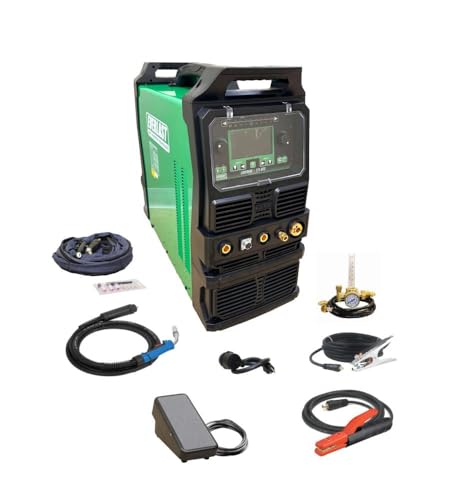
The Everlast LightningMTS 275 is the high-output option in this class. It delivers 275 amps of MIG and TIG output on 240-volt input and 200 amps of stick output, with output on 120-volt input capped at 150 amps for MIG and TIG and 120 amps for stick. A 5.1-inch high-definition TFT color display presents the PowerSET synergic setup system, which guides settings by process and material and stores recalled programs for repeat work.
The TIG specification is the deepest in this group. The LightningMTS 275 offers AC and DC TIG with high-frequency and lift start, pulse capability, advanced AC waveform options including advanced square and triangular waveforms, and AC advanced pulse that mixes AC and DC output for aluminum. Dual gas solenoids are built in, the wire feeder accommodates spools up to 12 inches in diameter, and burn-back control is included for MIG. The package includes a TIG torch, a foot pedal, and a regulator. That output and feeder capacity come in a substantially heavier shop machine than the Miller, Lincoln, or ESAB units, so it is best treated as a cart-based welder rather than a carry-around unit.
Who It Suits
This machine suits a fixed fabrication bench that needs the highest output and the most complete AC TIG control set in the category, including waveform shaping for aluminum specialists. It also suits shops running larger wire spools to reduce changeovers. Buyers who carry a welder between sites, or who prefer the dealer networks of the larger brands, should weigh the portability and support trade-offs against the output advantage.
Frequently Asked Questions
Why does AC TIG matter in a multiprocess welder?
Aluminum forms a surface oxide layer that melts at a much higher temperature than the metal beneath it. AC TIG alternates the current direction, and the electrode-positive portion of the cycle breaks up that oxide while the electrode-negative portion puts heat into the work. A DC-only multiprocess machine cannot provide that cleaning action, so aluminum TIG on such a machine produces contaminated, unstable welds. AC output is the single feature that makes a multiprocess welder a genuine all-metal machine.
Can one of these machines replace a separate MIG welder and TIG welder?
For most home, farm, and small fabrication shops, yes. Each machine in this guide runs MIG with gas or flux-cored wire, stick, and AC and DC TIG at outputs that cover common steel and aluminum thicknesses. A dedicated production MIG machine may still offer a higher duty cycle for all-day wire work, and a dedicated TIG machine may offer finer low-amperage control for very thin material, but a single AC DC multiprocess welder covers the range that mixed repair and fabrication work actually uses.
What power supply do these welders need?
All four machines are dual-voltage designs that run on 120-volt input for light work and 240-volt input for full output. On 120-volt power, maximum amperage drops substantially, in the Everlast example to 150 amps for MIG and TIG, so heavier sections should be planned around a 240-volt circuit. The circuit and breaker requirements at full output differ by model, so the manual for the chosen machine should be checked before an electrician installs or confirms an outlet.
Is a spool gun still useful with an AC TIG capable machine?
A spool gun feeds soft aluminum wire through the MIG process without the feeding problems that a standard MIG liner causes, and it remains useful for longer aluminum MIG seams where TIG would be slow. It does not replace AC TIG for thin sheet, tubing, or appearance-critical joints, where TIG gives direct control over heat and filler. Machines in this class generally support spool guns as an accessory, so the two methods can coexist on one power source.
Final Verdict
The right choice depends on which specification limits the work. The Miller Multimatic 220 AC/DC is the balanced default: established support, automatic setup across all three main processes, and a portable 56-pound package. The Lincoln Electric POWER MIG 220 AC/DC adds the largest display, the most memory locations, and dual gas connections for shops that switch processes constantly. The ESAB Rebel EMP 205ic AC/DC is the mobile option, with an adaptive MIG arc and a caged 49-pound frame built for transport. The Everlast LightningMTS 275 is the output and TIG-control leader, with 275 amps, advanced AC waveforms, and a feeder that accepts 12-inch spools, at the cost of portability.
Whichever machine is chosen, the purchase check is the same: confirm AC TIG is built in, compare duty cycle at the amperage the work actually uses rather than the maximum figure, confirm the included torches, foot control, and regulators, and confirm the shop has the 240-volt circuit that full output requires. A machine that passes those checks replaces three separate welders on the bench and covers steel, stainless, and aluminum in a single setup.
Product and ASIN Reference
Product
ASIN
Miller Multimatic 220 AC/DC
B07K3CTMJ2
Lincoln Electric POWER MIG 220 AC/DC
B0FMS7R4H9
ESAB Rebel EMP 205ic AC/DC
B07RQW37QF
Everlast LightningMTS 275
B086Z9574Y
J
JD's Woodworks Editorial Team
We compare specs, warranty terms, long-term owner feedback and street pricing before anything earns a spot. Rankings are never paid.
Affiliate disclosure. As an Amazon Associate we earn from qualifying purchases at no extra cost to you. Prices accurate as of the date shown.
Four hobby TIG welders compared for home shops: AC/DC picks for aluminum, a compact DC model for steel, listed specs, included gear and honest tradeoffs.
The best Creality Falcon engravers compared: Falcon A1 10W, CR-Laser Falcon 10W, Falcon2 Pro 22W and Falcon2 Pro S 40W, by power, work area and enclosure.
The best CNC machines for manufacturing compared: large-bed routers and closed-loop desktop mills with the work area, spindle and control for batch work.

 Miller Multimatic 220 AC/DC
 Lincoln Electric POWER MIG 220 AC/DC
 ESAB Rebel EMP 205ic AC/DC
 Everlast LightningMTS 275









