4 Best Hobby TIG Welders for Home Shops (November 2026)
Four hobby TIG welders compared for home shops: AC/DC picks for aluminum, a compact DC model for steel, listed specs, included gear and honest tradeoffs.
Four hobby TIG welders compared for home shops: AC/DC picks for aluminum, a compact DC model for steel, listed specs, included gear and honest tradeoffs.
As an Amazon Associate I earn from qualifying purchases. This post may contain affiliate links at no extra cost to you.
A first TIG welder raises one decision that shapes everything else: whether your projects will include aluminum. AC output is what lets a TIG machine clean and weld aluminum, while DC-only machines cost less and stay simpler but stop at steel and stainless. Around that choice sit the practical questions of a home shop — whether the machine runs on a household 110-volt circuit or needs 220 volts, how much output your typical material thickness demands, and whether a foot pedal is included or sold separately.
The four machines below are all inverter TIG welders positioned for hobby and home-shop use. Two are AC/DC models that cover aluminum as well as steel, one adds waveform shaping for thin material, and one is a compact DC-only machine for steel and stainless work. Each entry is drawn from its Amazon product page name and listed specifications, including the accessories the box actually contains, so the comparison reflects what arrives rather than what a brand family offers in other bundles.
Quick Picks
As an Amazon Associate we earn from qualifying purchases.
Product
Best for
Key spec from title
LOTOS TIG200ACDC
A first TIG machine for mixed steel and aluminum projects
200 A AC/DC output with foot pedal and argon regulator included
YESWELDER TIG-205P
Steel and stainless work in a compact footprint
205 A DC TIG with pulse in a dual-voltage body
TOOLIOM TL-200TP ACDC Pro
Hobbyists who want pulse control for thin work
6-in-1 AC/DC TIG with pulse and a large LED display
AHP AlphaTIG 203Xi
Home shops that weld aluminum regularly
200 A AC/DC with 200 Hz pulse and a Nova foot pedal included
How to Choose
Decide whether you need AC output for aluminum
Aluminum is the dividing line in this class. Its surface oxide melts at a far higher temperature than the metal underneath, and the alternating current of AC TIG is what breaks that layer up during welding. A DC-only machine physically cannot do that job, no matter how the listing phrases it. If aluminum boat parts, intake tubing, brackets or castings are anywhere in your plans, limit the shortlist to AC/DC models. If every project is mild steel or stainless — gates, brackets, exhaust work, furniture frames — a DC-only machine covers it and usually leaves more of the budget for gas, tungsten and filler.
Match output and duty cycle to your material
A common rule of thumb in TIG work is roughly one amp of output for each thousandth of an inch of material thickness, so a 200-amp ceiling covers most hobby material up to about 1/4 inch on the right circuit. Duty cycle matters just as much for longer beads: it states how many minutes in ten the machine can run at a given output before it needs to cool. A rating of 60 percent at full output is generous in this class. Thin sheet asks the opposite question — check the low end of the amperage range, because a machine that starts at 10 amps is far easier to manage on 18-gauge steel than one that starts at 30.
Check your circuit before you fall for a spec sheet
Every machine here is dual voltage, but the headline amperage only arrives on a 220-volt circuit. On a 110-volt household outlet, output drops substantially — down to about 160 amps in one case here — and the breaker size in your panel becomes part of the decision. Some models auto-sense the input voltage, while others use an adapter pigtail to convert between plugs. Measure your actual setup before ordering: the distance from panel to bench, the receptacle type, and whether a 220-volt run is realistic in your space. A welder that matches your wiring beats a stronger one that trips breakers.
Count what is in the box, not just the machine
The welder itself is only part of a working TIG setup. A foot pedal gives far finer heat control than a torch switch alone, and some of these machines include one while others sell it separately. An argon regulator or flow meter is likewise included in some boxes and missing from others. None of them include the shielding gas cylinder, tungsten electrodes or filler rod, and every setup still needs an auto-darkening helmet and welding gloves that match the maker’s guidance. Add the missing pieces to the real cost of each option before deciding which machine is actually the cheaper start.
The 4 Best Options
LOTOS TIG200ACDC
Top Pick
LOTOS TIG200ACDC
Best for: first-time TIG buyers who want aluminum capability and a pedal in the box.
Processes: AC TIG, DC TIG and DC stick welding
Output: 10 to 200 A TIG range
Input: 110/220V dual voltage with converter pigtail
The TIG200ACDC is the straightforward starter package in this group: a square-wave AC/DC inverter that welds aluminum and steel, with the foot pedal and argon regulator already in the box. High-frequency start keeps the tungsten off the workpiece at arc initiation, and the dual-voltage design runs on 220 volts or converts down to a household circuit with the included pigtail. Stick mode is DC only, which still covers basic repair rods. For a first machine bought to learn on both steel and aluminum without assembling an accessory list first, this is the most complete carton here.
YESWELDER TIG-205P
Runner-Up
YESWELDER TIG-205P
Best for: hobbyists who weld steel and stainless and want the smallest, lightest machine here.
Processes: stick, DC TIG and pulse TIG (3 in 1)
Output: 10 to 160 A on 110V and 10 to 200 A on 220V
The TIG-205P is the steel specialist of the group. It combines stick, DC TIG and pulse TIG in a body light enough to carry to the work instead of wheeling a cart, and its large LED display keeps settings readable at a glance. Pulse mode, with adjustable frequency and duty, helps manage heat on thin stainless and sheet steel. The hard limit is current type: this is a DC-only machine with no AC mode, so aluminum is off the table entirely. A 5-pin foot pedal socket is provided, but the pedal itself is a separate purchase.
TOOLIOM TL-200TP ACDC Pro
TOOLIOM TL-200TP ACDC Pro
Best for: hobbyists who enjoy dialing in settings and plan thin aluminum or stainless work.
Processes: AC TIG, DC TIG, AC pulse TIG, DC pulse TIG, spot TIG and stick (6 in 1)
Output: 10 to 200 A
Input: 110/220V dual voltage
Waveform: software-controlled square wave AC/DC with pulse
The TL-200TP ACDC Pro is the control-heavy option. Its 6-in-1 process list runs from plain AC and DC TIG through AC and DC pulse modes to spot TIG and stick, all driven by a software-controlled square-wave inverter with a pulse function shaped for thin material. Settings read out on a large LED display, and the output range starts low enough for thin sheet while still reaching a full 200 amps on a 220-volt circuit. The box covers the torch and work leads, so the main extra to budget for is a foot pedal, which the machine accepts but does not include.
AHP AlphaTIG 203Xi
AHP AlphaTIG 203Xi
Best for: home shops that weld aluminum often and want a complete, durable setup.
Processes: AC/DC TIG and stick welding
Output: 200 A at a 60 percent duty cycle
Input: 110/220V dual voltage
Pulse: pulse and AC frequency adjustment up to 200 Hz
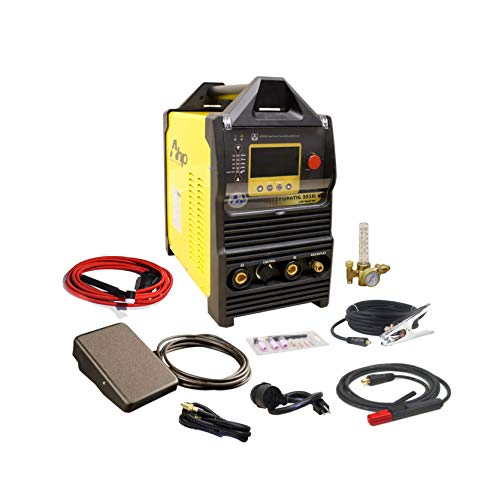
The AlphaTIG 203Xi is the step-up AC/DC machine in this set, built around a 200-amp output with a 60 percent duty cycle and pulse and AC frequency adjustment up to 200 Hz. That frequency control narrows or widens the arc cone on aluminum, which is the adjustment experienced hobby welders reach for most. The accessory kit is the strongest here: a Nova foot pedal on a 25-foot cord, a Nova Rotaflex torch and a floating-ball argon regulator are all included, along with a stick electrode holder and a plug adapter. It is also the heaviest machine in the group, so plan on a cart or a fixed bench spot.
Which One Fits Your Situation
Your bench is a garage corner on household power
Start with the LOTOS TIG200ACDC or the YESWELDER TIG-205P. Both run on a 110-volt circuit through their dual-voltage designs, accepting the lower output ceiling that comes with it. The LOTOS keeps the pedal and regulator in the box, while the YESWELDER is far lighter if the machine has to be put away after every session. Either way, confirm your breaker size before the first long bead.
Every project is steel or stainless
The YESWELDER TIG-205P is the focused pick. Paying for AC output you will never switch on buys nothing, and this machine puts the money into pulse control and portability instead. Thin stainless tubing, sheet steel repairs and frame work all sit inside its DC range. Just be honest about aluminum: the day an aluminum project appears, this welder cannot follow you there.
Thin material is the main event
Look at the TOOLIOM TL-200TP ACDC Pro. Pulse modes on both AC and DC, a square-wave output and a 10-amp starting floor all serve the same goal — putting less heat into thin sheet before it warps or burns through. The spot TIG mode helps tack thin panels in place before the full bead. The trade is complexity: expect to spend bench time learning the panel.
Aluminum work will be weekly, not occasional
The AHP AlphaTIG 203Xi fits the committed aluminum hobbyist. AC frequency adjustment up to 200 Hz, a long-cord foot pedal and a proper regulator in the box make it the most complete aluminum setup here, and the 60 percent duty cycle holds up through longer sessions. It asks for a permanent spot in the shop, and rewards it.
Common Mistakes
Buying a DC-only machine when aluminum is on the project list; no setting or tungsten choice adds AC output later.
Assuming the headline amperage is available on a 110-volt outlet, when every dual-voltage machine here derates on household power.
Forgetting that no welder in this guide includes the argon cylinder, tungsten electrodes or filler rod, so the first project stalls without them.
Skipping the foot pedal budget on machines that sell it separately, then trying to learn heat control with only a torch switch.
Welding without the helmet, gloves and ventilation the machine’s manual calls for; follow the maker’s instructions for protective gear on every session.
Frequently Asked Questions
Can a hobby TIG welder run on a regular household outlet?
Yes, within limits. All four machines here accept 110-volt input, but output drops compared with a 220-volt circuit — the YESWELDER, for example, tops out at 160 amps instead of 200. Short beads on thinner material work fine on household power. Thick aluminum or long runs are what push buyers toward installing a 220-volt receptacle.
Do I really need AC output to weld aluminum?
For TIG welding, yes. Aluminum’s oxide layer needs the cleaning action that only alternating current provides during the electrode-positive half of the cycle. DC-only machines such as the YESWELDER TIG-205P are limited to steel, stainless and similar metals. Every AC/DC model in this guide handles aluminum within its listed amperage and duty cycle ratings.
What else do I need to buy besides the welder?
Plan on an argon cylinder from a local gas supplier, tungsten electrodes, filler rod matched to your metal, and an auto-darkening helmet and gloves that meet the welder manual’s guidance. Some boxes here include the regulator and foot pedal; others sell the pedal separately. A steel work surface or welding table completes a safe, practical starter setup.
Is a foot pedal necessary for learning TIG?
Not strictly, but it makes learning noticeably easier. A pedal lets you ease into the puddle and taper off at the end of a bead, which is where most beginner defects happen. Two machines here include a pedal, and the other two accept one as an accessory. If a pedal is a separate purchase, include it in the budget from the start.
J
JD's Woodworks Editorial Team
We compare specs, warranty terms, long-term owner feedback and street pricing before anything earns a spot. Rankings are never paid.
Affiliate disclosure. As an Amazon Associate we earn from qualifying purchases at no extra cost to you. Prices accurate as of the date shown.
The best Creality Falcon engravers compared: Falcon A1 10W, CR-Laser Falcon 10W, Falcon2 Pro 22W and Falcon2 Pro S 40W, by power, work area and enclosure.
The best CNC machines for manufacturing compared: large-bed routers and closed-loop desktop mills with the work area, spindle and control for batch work.


 AHP AlphaTIG 203Xi