As an Amazon Associate I earn from qualifying purchases. This post may contain affiliate links at no extra cost to you.
Choosing a WEN jointer looks simple until the model numbers blur together: three benchtop machines, two cutting widths, two cutterhead styles and two table materials, all wearing the same orange and black paint. The real decision is not the brand, since every machine here is a WEN, but the combination of width, cutterhead and table that matches the boards you actually mill. Picking on headline width alone is how a shop ends up with a jointer that sits unused.
This guide compares the three WEN benchtop jointers that fit the keyword and are still listed on Amazon US: the JT630H and JT6561 in the 6-inch class, and the JT833H in the 8-inch class. First-time jointer buyers get a plain-English split between spiral and two-knife cutterheads, while upgraders coming from a smaller or older machine can jump straight to the width and table differences. Every specification below comes from the Amazon product page for that exact model.
Quick Picks
As an Amazon Associate we earn from qualifying purchases.
Product
Best for
Key spec from title
WEN JT630H 6-Inch Spiral Benchtop Jointer
Spiral finish in a small shop
12 staggered HSS blades
WEN JT6561 6-Inch Benchtop Jointer with Cast Iron Table
Cast iron tables with a two-knife head
6-1/4 by 28-1/2-inch cast iron table
WEN JT833H 8-Inch Spiral Benchtop Jointer with Extendable Table
Wider boards and long stock
Table extends to 51 inches
How to Choose
Start with cutting width
Cutting width decides which boards the machine can face joint in a single pass, so measure your typical project stock before anything else. The two 6-inch models suit the boards most small shops run: drawer parts, table aprons, cutting boards and face frames. The 8-inch JT833H covers wider cabinet and tabletop stock without splitting the work across two passes or flipping the board. Width is a hard ceiling rather than a preference, because a board wider than the cutterhead cannot be face jointed flat in one setup, whatever the motor size.
Pick a cutterhead style
The JT630H and JT833H use spiral cutterheads with staggered HSS blades, 12 in the 6-inch head and 16 in the 8-inch head, so each cut is a small shearing slice rather than a full-width hit. The JT6561 uses a two-blade cutterhead that makes up to 20,000 cuts per minute. Spiral heads run quieter and let you replace individual blades when one nicks, while a two-knife head asks for a full knife change and careful setting each time. Neither style changes the width or depth limits of the machine.
Compare table material and length
Table material changes how a benchtop jointer feels day to day. The JT6561 pairs cast iron tables with a cast iron fence, which adds weight that damps vibration and resists scratches, at 68 pounds all-in. The JT630H keeps a compact 30-inch table and a 36.8-pound build that one person can lift onto a bench and store away. The JT833H splits the difference: a 33-inch table whose support arms stretch the working length to 51 inches for long boards, trading the iron surface for a lighter machine that still supports full-length stock.
Check the fence, dust port and setup steps
All three fences bevel up to 45 degrees for angled edges, but their sizes differ: the JT6561 carries the largest fence at 20-3/4 by 4-1/2 inches, while the two spiral models share a 19-3/4 by 4-1/4-inch fence. Dust hookup is a 2-1/2-inch port on the 6-inch machines, and the JT833H adds a 4-inch port for a full dust collector. Before the first board, the manual for each model walks through squaring the fence and checking the tables, and every model ships with push blocks or a push stick for keeping hands clear of the cutterhead.
The 3 Best Options
The three machines below are the complete set of WEN benchtop jointers that match this keyword and hold a current Amazon US listing with a verifiable model number. They are ordered by cutting width, not by rank: the right choice follows the width of your stock, then the cutterhead style you prefer to maintain.
WEN JT630H 6-Inch Spiral Benchtop Jointer
Top Pick
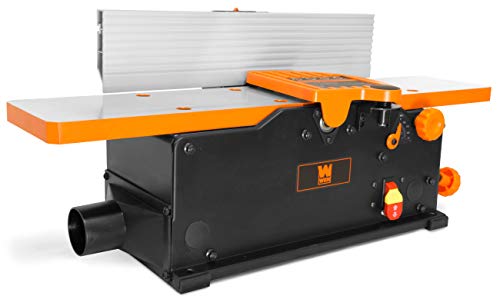
WEN JT630H 6-Inch Spiral Benchtop Jointer
Best for: small shops that want a spiral cutterhead and a machine that stores away easily.
The JT630H is the WEN most small shops should look at first. Its spiral cutterhead carries 12 staggered HSS blades turned by a 10-amp motor at up to 12,000 RPM, a combination the listing pairs with a 30-by-6-inch table and an onboard depth-of-cut scale for repeatable light passes. At 36.8 pounds it is the lightest machine here, so it suits a bench that also hosts a miter saw or assembly work. The fence bevels to 45 degrees, and two push blocks are included in the box.
WEN JT6561 6-Inch Benchtop Jointer with Cast Iron Table
Runner-Up
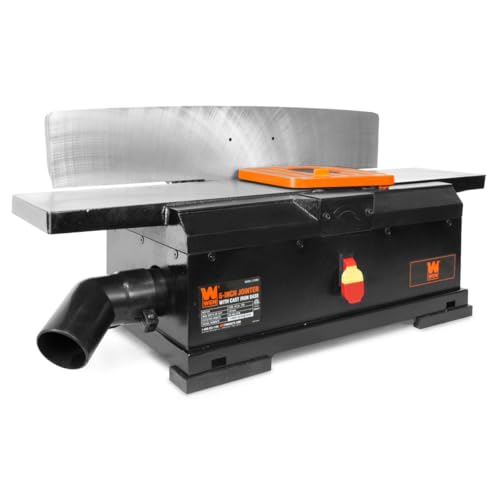
WEN JT6561 6-Inch Benchtop Jointer with Cast Iron Table
Best for: buyers who want cast iron surfaces and a straightforward two-knife head.
The JT6561 is the traditionalist of the three: a two-blade cutterhead, cast iron tables and a cast iron fence on a 6-inch frame. The listing credits the 10-amp motor with up to 20,000 cuts per minute and a depth range of 0 to 1/8 inch, and the table measures 6-1/4 by 28-1/2 inches. That iron shows up on the scale at 68 pounds, which steadies the machine in use and argues for a semi-permanent home on a stand or bench. A filter bag and dust chute are included.
WEN JT833H 8-Inch Spiral Benchtop Jointer with Extendable Table
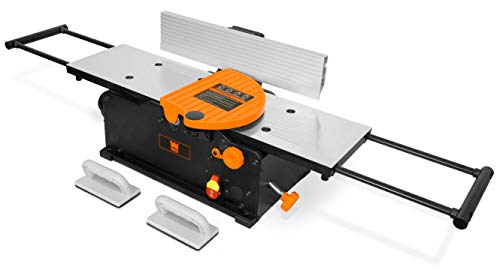
WEN JT833H 8-Inch Spiral Benchtop Jointer with Extendable Table
Best for: face jointing wider boards and long stock on a benchtop footprint.
The JT833H answers the width problem without leaving the bench. Its 8-inch spiral cutterhead runs 16 staggered HSS blades on a 10-amp motor, and the 33-by-8-inch table carries support arms that extend the working surface to 51 inches, the longest support in this lineup. It also adds a 4-inch dust port beside the standard 2-1/2-inch port, which suits shops that already run a dust collector rather than a vacuum. At about 55 pounds it stays movable, though the extended arms want a clear bench run.
Which One Fits Your Situation
Your stock is mostly narrow boards
If your lumber runs come home as 1×4, 1×6 and cutoffs from sheet goods, the 6-inch class covers nearly everything. The JT630H adds the quieter spiral head and the lightest body of the three, so it is the natural pick when the jointer shares a bench with other tools and gets lifted down between sessions.
You want cast iron and a permanent spot
A shop with a dedicated jointer stand can trade portability for mass. The JT6561 puts cast iron under the board and under the fence, and its 68 pounds stop mattering once the machine is bolted down. Buyers who already know two-knife setup from an older jointer will find the routine familiar.
You joint wide or long boards
Cabinet doors, tabletop panels and long rails push past both limits of the 6-inch machines. The JT833H is the only pick here that face joints 8-inch stock in one pass, and its support arms stretch to 51 inches so a long board stays level instead of tipping off the outfeed end mid-pass.
You run a dust collector, not a shop vacuum
Shops plumbed with 4-inch dust hose have a simpler hookup on the JT833H, which lists both 2-1/2-inch and 4-inch ports. The 6-inch models speak only the smaller size, so they pair naturally with a shop vacuum or need an adapter at the collector. Match the port to the hose you already own before ordering.
Common Mistakes
Buying the 6-inch model for a project list full of 7- and 8-inch boards; cutting width cannot be worked around with technique.
Taking the full 1/8-inch depth in one pass through hardwood instead of sneaking up with light passes, which overloads a benchtop motor and roughens the surface.
Skipping the setup checks in the manual — fence square, table alignment and guard function — because the machine cut fine on the first board.
Feeding short stock without the included push blocks, or reaching over the cutterhead to catch an offcut; the maker instructions cover the safe feed routine for each model.
Assuming the spiral and two-knife models share blades; the JT630H, JT6561 and JT833H each take their own blade style and size.
Frequently Asked Questions
What is the difference between the WEN JT630H and JT6561?
Both are 6-inch, 10-amp benchtop jointers, but they cut differently. The JT630H uses a spiral cutterhead with 12 staggered HSS blades and a 30-inch table at 36.8 pounds. The JT6561 uses a two-blade cutterhead, cast iron tables measuring 6-1/4 by 28-1/2 inches, and weighs 68 pounds. Choose the head style and table material first; the width is identical.
Can these jointers flatten a board wider than the cutting width?
Not in a single face-jointing pass. The listed cutting width — 6 inches on the JT630H and JT6561, 8 inches on the JT833H — is the widest face the cutterhead covers. Wider boards are normally ripped to width first, jointed, and glued back up, or handled on a wider machine. Edge jointing is unaffected, since the edge rides the fence.
Do WEN benchtop jointers need a dust collector?
They need some form of extraction to keep the cutterhead area clear. The JT630H and JT6561 list a 2-1/2-inch port that fits a typical shop vacuum hose, and the JT6561 also ships with a filter bag. The JT833H lists both 2-1/2-inch and 4-inch ports, so it can connect to a shop vacuum or a full-size dust collector.
Are replacement blades shared between these models?
No. The spiral models use individual staggered HSS blades — the JT630H takes the WEN BP510H replacement spiral blades named in its listing — while the JT6561 uses two full-length 6-1/8-inch knives. Blade count also differs, at 12 for the JT630H and 16 for the JT833H, so order by exact model number rather than by cutting width.
J
JD's Woodworks Editorial Team
We compare specs, warranty terms, long-term owner feedback and street pricing before anything earns a spot. Rankings are never paid.
Affiliate disclosure. As an Amazon Associate we earn from qualifying purchases at no extra cost to you. Prices accurate as of the date shown.
Four hobby TIG welders compared for home shops: AC/DC picks for aluminum, a compact DC model for steel, listed specs, included gear and honest tradeoffs.
The best Creality Falcon engravers compared: Falcon A1 10W, CR-Laser Falcon 10W, Falcon2 Pro 22W and Falcon2 Pro S 40W, by power, work area and enclosure.
The best CNC machines for manufacturing compared: large-bed routers and closed-loop desktop mills with the work area, spindle and control for batch work.