
Our Top Picks
 Jig Saw Corded: DEKOPRO Electric Jigsaw Tool Power9.25 x 3.54 x 11.2 inches4.9 PoundsCheck on Amazon
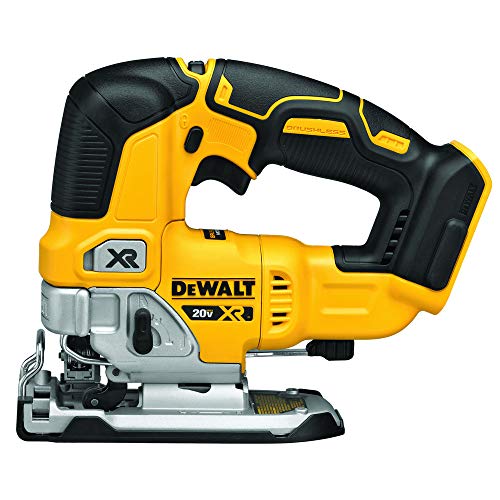


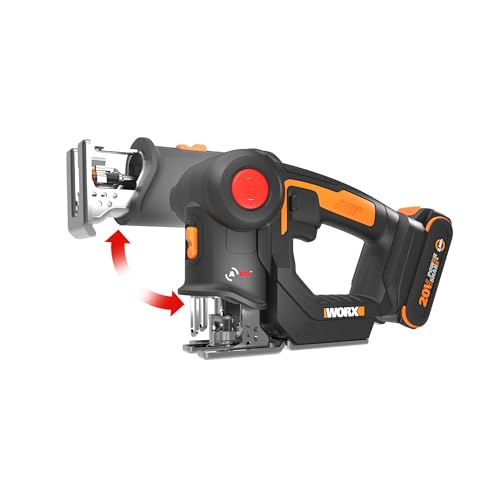
What's inside
- The Short Version: What Actually Separates Good From Bad
- Barrel Grip Or Top Handle? The Only Debate Worth Having
- Choosing The Best Cordless Jigsaw For Woodworking In A Small Shop
- Blades Matter More Than The Saw You Buy
- How I Actually Get A Straight Cut With A Jigsaw
- Frequently Asked Questions
- What I Would Do With Your Money
As an Amazon Associate I earn from qualifying purchases. This post may contain affiliate links at no extra cost to you.
Most of the jigsaw complaints I hear are not really about the saw. They are about a cut that wandered off the line, or a bevel on the underside of a plywood panel that nobody asked for. I spent two years blaming my tool before I figured out that my blade choice, my feed rate and my habit of pushing the saw like a snowplow were doing most of the damage. That said, the tool does matter, and picking the best cordless jigsaw for woodworking is mostly about a handful of mechanical details that separate a saw that tracks true from one that fights you.
I work out of a one-car garage. No panel saw, no dedicated cutoff station, and my track saw came a lot later than my jigsaw did. For years the jigsaw was how I cut curves, notched around outlets, rough-sized sheet goods before final trimming, and made every interior cutout in every cabinet I built. If that sounds like your shop, this is written for you.
As an Amazon Associate we earn from qualifying purchases at no extra cost to you.


The Short Version: What Actually Separates Good From Bad
Cordless jigsaws have converged on similar specs, so the differences that matter are ones you feel rather than ones printed on the box. Here is how I weigh the main variables when I am shopping.
| Feature | Why It Matters For Wood | My Take |
|---|---|---|
| Tool-free blade clamp | You change blades constantly when mixing curves and straight cuts | Non-negotiable. A clamp that grips off-center ruins tracking |
| Blade guide bearing/roller | Supports the blade behind the teeth so it does not deflect under side load | The single biggest factor in square cuts through thick stock |
| Orbital action settings | Trades speed for finish quality | Three or four settings plus zero orbit is plenty |
| Brushless motor | More runtime per charge, better torque under load | Worth it, but not the reason a saw cuts well |
| Variable speed trigger + dial | Lets you slow down for plywood and veneer | Trigger alone is workable, dial is better |
| Base plate rigidity | A flexing stamped shoe lets the whole cut drift | Cast or thick stamped base beats thin sheet metal |
| Dust blower | Keeps the pencil line visible | Underrated. More useful than most dust ports on a jigsaw |
Notice that battery voltage is not on that list. An 18V or 20V class saw from any of the major lines has more than enough power for hardwood. If you already own a battery platform, the honest answer is to buy the bare tool in that platform and spend the difference on blades. Cross-shopping platforms because one saw has a slightly better spec sheet is how you end up with four chargers and a drawer full of dead adapters.
Barrel Grip Or Top Handle? The Only Debate Worth Having
This is the one choice that will actually change how you work, and it is close to a religious argument in woodworking circles. I own a top-handle saw and I use a barrel grip when I borrow one, so here is my honest read.
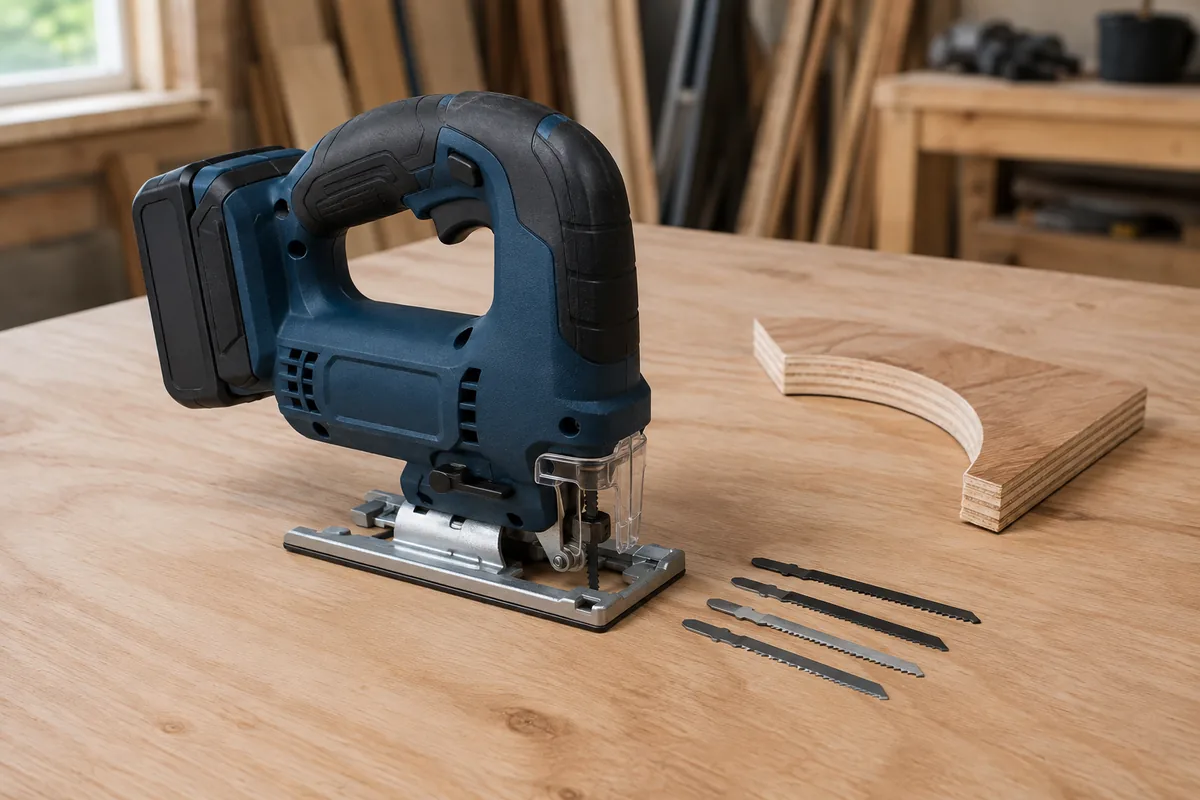
A top-handle saw puts your hand above the tool with the trigger under your index finger. It is intuitive, it is what most people learn on, and it is easier to control one-handed when your other hand is holding a workpiece down. The downside is that you are steering from a point several inches above the blade, which amplifies any wrist wobble into blade deflection.
A barrel grip puts your palm around the body of the saw, right down near the base. Your hand is closer to the cutting action and you get noticeably better feedback about whether the blade is loading up. For following a tight curve on a template or scribing a cabinet to a wavy wall, I think barrel grip wins. The trade-off is real though: the power switch is usually a thumb slider or a paddle that takes getting used to, and you often want a second hand on the tool, which means the workpiece needs to be clamped. In a garage shop where you are frequently cutting on sawhorses with one hand pinning a panel, that is a genuine limitation.
Barrel Grip Cordless Jigsaw
If most of your jigsaw work is curves, templates and scribing, the barrel grip is worth adapting to. Filter for a tool-free clamp and a roller blade guide, and confirm whether the listing is bare tool or a kit before you click buy. Bare tools are usually the better value if you are already on a battery platform.
Choosing The Best Cordless Jigsaw For Woodworking In A Small Shop
Here is the part nobody puts in the marketing copy: the jigsaw is a rough-cut tool that occasionally does finish work, and buying for the finish-work scenario is usually a mistake. In my shop the jigsaw’s real job is getting close to a line so a router, sander or track saw can make it perfect.
What that means practically:
Buy for blade support, not for stroke speed. Cutting 3/4 inch hardwood, a well-supported blade with a moderate stroke rate leaves a cut I can clean up with two passes of a block plane. A poorly supported blade at max speed leaves a cut that is out of square by enough that I have to re-rip the piece.
Bevel adjustment is a nice-to-have that I almost never use. Every jigsaw claims 45 degrees each way. Almost none of them hold it accurately under load. If you need repeatable bevels, that is a table saw or track saw job. Do not pay extra for a fancy detented bevel base.
Skip the dust extraction fantasy. Jigsaws are terrible at dust collection because the blade throws chips in every direction and the shoe cannot seal against the work. I run mine with a shop vac hose loosely nearby and accept that I will sweep. A working dust blower that clears the line matters far more.
Weight and balance beat raw specs. With a large battery attached, some of these saws get top-heavy enough to tip when you set them down mid-cut on a narrow rail. If you can hold one in a store, do it. I would rather have a compact 2.0Ah pack on a well-balanced saw than a 5.0Ah brick that makes the tool nose-heavy.
- ✔ Cordless freedom matters more on a jigsaw than almost any other tool, since you are constantly repositioning around a panel
- ✔ Brushless motors have made runtime a non-issue for typical shop sessions
- ✔ Tool-free blade changes make it realistic to switch blades for each cut type
- ✔ One saw covers curves, cutouts, notches and rough sizing
- ✘ Even good jigsaws cut slightly out of square in thick hardwood; plan to clean up the edge
- ✘ Dust collection is poor across the board
- ✘ Barrel grip models need two hands, which means more clamping
- ✘ Kits with batteries cost a lot more than bare tools you may not need
Blades Matter More Than The Saw You Buy
I will say this plainly: upgrading from stock blades to good bimetal or high-carbon wood blades improved my cuts more than any tool purchase. Stock blades are usually a general-purpose tooth pattern that is a compromise for everything.
For plywood and veneered panels I use a reverse-tooth or down-cut blade with zero orbit and a slow feed. It cuts the top face clean because the teeth push down instead of tearing up. It is slower and it wants to lift the saw off the work, so you keep steady downward pressure. For hardwood I want a wider blade with fewer, larger teeth and I turn orbital action up to clear chips. For tight curves I use a narrow scroll blade and accept a rougher edge.
Buy blades in a variety pack first, figure out which two you reach for, then buy those in bulk. Also: replace blades sooner than feels reasonable. A dull jigsaw blade wanders, and a wandering blade is the number one cause of the out-of-square cuts people blame on the saw.
Wood Cutting Jigsaw Blade Assortment
Get a T-shank assortment with at least one down-cut blade for plywood and a coarse blade for hardwood. T-shank is the standard on essentially every modern cordless saw and the selection is far better than U-shank. This is the least glamorous purchase on the list and the one that will change your cuts the most.
How I Actually Get A Straight Cut With A Jigsaw
I said the tool matters less than technique, so here is the technique. First, I stopped pushing. The saw feeds itself if the blade is sharp; my job is to steer, not to force. When I push, the blade bows backward and the bottom of the cut lags behind the top, which is exactly how you get a beveled edge on a panel.
Second, I clamp a straightedge and run the shoe against it whenever I need a long straight cut. A scrap of MDF and two clamps costs nothing and turns a wandering cut into a decent one. You have to account for the offset from the blade to the edge of the shoe, so measure once and mark that offset on the straightedge itself.
Third, I cut on the waste side of the line and leave about a sixteenth for cleanup. Trying to cut exactly to the line with a jigsaw is how you end up undersized. Third-and-a-half, honestly: I stopped trusting the shoe to be square to the blade out of the box. Check it with a small square, adjust it, then check it again after a few months.
Fourth, support the work properly. Half of the tear-out I used to get on the underside of plywood was because the panel was flexing between sawhorses. A sacrificial sheet of foam insulation on the shop floor solved that better than any blade change.
Frequently Asked Questions
Is a cordless jigsaw powerful enough for hardwood? Yes. Any brushless 18V or 20V class saw will cut 3/4 inch to 1-1/2 inch hardwood without complaint. Power is rarely the limiting factor. Blade sharpness, blade width and how hard you push are what determine whether the cut is clean and square.
Should I buy a jigsaw or a track saw first? If you mainly break down sheet goods into rectangles, a track saw or even a circular saw with a straightedge will serve you better. If you cut curves, interior cutouts or scribe pieces to walls, the jigsaw does things a track saw simply cannot. I would buy the jigsaw first because it is the more versatile of the two, then add straight-line capability later.
Do I need to match the jigsaw to my drill’s battery brand? It is the single easiest way to save money. Bare tools in a platform you already own typically cost a fraction of a full kit. The performance gap between the major cordless lines on jigsaws specifically is small enough that platform loyalty is the rational choice here, not a compromise.
What I Would Do With Your Money
If you are on a battery platform already, buy the brushless bare-tool jigsaw in that platform, get a barrel grip if your work is curve-heavy and a top handle if you often work one-handed on sawhorses, then spend forty dollars on decent blades and a couple of clamps for a straightedge. That combination will outperform a more expensive saw running stock blades, and it fits the way a garage shop actually operates.
If you are starting from zero with no batteries, pick the platform first based on what other tools you plan to buy, not based on the jigsaw. The jigsaw is not the tool you should let dictate a decade of battery purchases.
Check prices on Amazon →