5 Best 4000 Watt Portable Generators (November 2026)
Compare the best 4000 watt portable generators for RV trips, camping, and home backup. Output, runtime, fuel, and noise compared to pick the right one.
As an Amazon Associate I earn from qualifying purchases. This post may contain affiliate links at no extra cost to you.
A 4000-watt portable generator sits in a useful middle ground: strong enough to start an RV air conditioner or keep a refrigerator, a few lights, and a phone charger running during an outage, yet still light enough for one person to load into a truck bed. The real decision is not the headline number on the box. Two models can both claim 4000 starting watts while delivering different running watts, very different runtimes, and very different noise levels.
This guide is for RV owners, campers, and homeowners who need backup power for essentials without stepping up to a large open-frame unit. It also suits workshop users who run one power tool at a time. The five generators below were chosen from the names and specifications shown on their Amazon product pages, with a mix of gasoline-only and dual-fuel models, and all five deliver 4000 watts at startup.
Quick Picks
As an Amazon Associate we earn from qualifying purchases
Starting watts cover the brief surge a motor needs to turn over, while running watts are what the generator can sustain hour after hour. A 4000-watt label usually means 4000 starting watts, so the running figure is the one that decides what you can actually power. In this class, running watts commonly land between 3000 and 3300. Add up the running watts of everything you plan to run at once, then leave headroom for the largest motor startup. A refrigerator compressor, an RV air conditioner, and a well pump all draw extra power for a few seconds when they start. If the total startup load exceeds the generator, the overload protection will trip and everything stops.
Fuel Type and Runtime
Most 4000-watt portables run on gasoline, but dual-fuel models also accept propane, which stores far longer without going stale and burns cleaner in storage. That matters if the generator sits unused for months between outages. Check runtime at a stated load rather than the headline figure, because a tank that lasts all night at quarter load may empty in a few hours at half load. A 1.69-gallon tank can run about seven hours at light load, while larger tanks stretch further. Also confirm the fuel tank size, the oil capacity, and whether the unit shuts off fuel flow when you store it, since stale gasoline is the most common reason a generator refuses to start.
Noise and Where You Will Use It
Sound level decides whether a generator is welcome at a campground or a quiet neighborhood. In this class, advertised noise ranges from around 52 dBA for enclosed inverter models to about 64 dBA for open-frame style inverters, and every few decibels make a real difference to nearby ears. Enclosed inverter generators run quieter because the case muffles the engine and the engine speed varies with load. Check the distance the noise figure was measured at, since figures taken at different distances cannot be compared directly. If you camp in a national forest, also confirm the unit includes a spark arrestor, which many campgrounds require.
Outlets, Safety Shutoffs, and Weight
Match the outlets to the gear you own. An RV needs a TT-30R 30-amp outlet, while most household gear uses standard 20-amp duplex outlets, and phones and tablets benefit from built-in USB ports. Parallel capability lets you link two matching units later if your needs grow. Safety shutoffs matter just as much: look for low-oil shutdown and a carbon monoxide sensor that stops the engine when exhaust gas builds up. Finally, weigh the unit honestly. A generator under 48 pounds can be carried by one person, while a 60-plus-pound model with wheels and a telescoping handle is easier to roll than to lift into a vehicle.
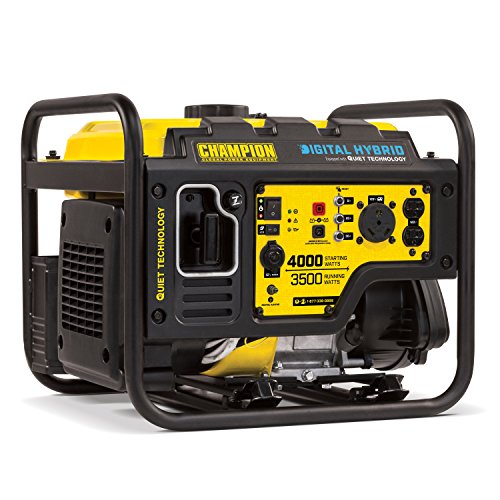
The Champion 100302 is the lightest model in this roundup, weighing under 48 pounds, which makes it the easiest 4000-watt generator to carry from a truck bed to a campsite table. Its inverter design produces clean power for phones, laptops, and other sensitive electronics, and the EZ Start dial simplifies startup to a single control. A TT-30R RV outlet and household outlets cover most camping setups, while economy mode stretches fuel by slowing the engine when demand drops. CO Shield adds automatic carbon monoxide shutoff for safer operation.
The Champion 201050 adds propane to the same 4000-watt starting output, which is a real advantage when gasoline goes stale in storage or when a storm keeps fuel stations closed. Propane burns cleanly and stores for years, and the listing claims up to 25 hours of runtime on a propane tank at light load. It keeps the RV-ready outlet and CO Shield from the gasoline-only model, plus quiet technology that keeps sound down at campsites. Dual-fuel flexibility means you can run whichever fuel you have on hand, which matters most during a long outage.
The Westinghouse iGen4000DFc is the quietest generator here, rated as low as 52 dBA, and it pairs that with remote start from a key fob, so you can start it from inside an RV on a cold morning. Dual-fuel operation gives you gasoline or propane, with 3300 running watts on gasoline and 2970 on propane. The LED data center shows fuel level, output, and remaining runtime at a glance. A telescoping handle and wheels make the 62.8-pound unit easy to move, and the inverter output stays under 3 percent total harmonic distortion for sensitive electronics.
The Pulsar GD400BN is a dual-fuel inverter generator built for campers who want propane as a backup fuel without giving up portability. It delivers 4000 peak watts with parallel capability, so two matching units can be linked if you later need more power. The RV-ready design and CARB compliance make it usable in more states and campsites, including California. Its super-quiet operation suits campgrounds where loud open-frame generators draw complaints, and the lightweight build keeps it easy to load and unload from a vehicle.
The Pulsar PGD40ISCO is the simplest pick in this roundup: a gasoline-only inverter generator that trades fuel flexibility for light weight and easy handling. Its ultra-light design and quiet operation suit campers, tailgaters, and anyone who moves the generator often. The inverter output is clean enough for laptops, phones, and other sensitive electronics. With no propane hardware to maintain, startup and storage are straightforward, which suits owners who use the generator a few times a year and want it to work the first time they pull it out.
Which One Fits Your Situation
Running an RV Air Conditioner at a Campsite
An RV air conditioner needs a strong startup surge, so pick a model with enough running watts left over for lights and a fridge. The Westinghouse iGen4000DFc fits here: its 3300 running watts, remote start, and quiet 52 dBA operation suit campsites, and the TT-30R outlet plugs straight into the RV. The Champion 100302 is the lighter alternative if you carry the generator by hand, though its 3000 running watts leave less headroom.
Keeping Essentials Running During a Home Outage
During an outage, the goal is a fridge, a few lights, phone charging, and maybe a fan, not the whole house. The Champion 201050 fits this job because propane stores for years and the listing claims up to 25 hours on propane, so you are not hunting for gasoline during a storm. Keep the load under the running watts, run the generator outside away from windows, and rotate the fridge and freezer if you need to stretch fuel.
Powering Tools in a Workshop or on a Job Site
A workshop user usually runs one tool at a time, so running watts matter more than the peak number. The Pulsar GD400BN fits here with parallel capability for later growth and dual-fuel operation if gasoline runs short on site. Its RV-ready outlets and quiet running also suit outdoor work near neighbors. Check each tool’s starting watts first, since a circular saw or air compressor can demand far more at startup than its nameplate suggests.
Camping Somewhere Quiet With Strict Noise Rules
Some campgrounds limit generator hours or ban loud units outright, so noise becomes the deciding factor. The Westinghouse iGen4000DFc is the pick here, with sound as low as 52 dBA and an enclosed design that muffles the engine. The Pulsar PGD40ISCO is the lighter backup choice for short trips where you only need to charge devices and run small gear. Either way, confirm the campground’s generator hours and keep the unit as far from neighboring sites as your cords allow.
Common Mistakes
Buying for the starting watts number and ignoring running watts, then tripping the overload on the first heavy load.
Running a generator indoors or in a garage, where carbon monoxide can build up even with a door open.
Leaving gasoline in the tank for months without stabilizer, then finding the generator will not start when the power goes out.
Plugging in an RV air conditioner without checking whether the running watts leave room for anything else.
Skipping the break-in oil change and first service, which shortens engine life on a new unit.
Frequently Asked Questions
How many watts do I need for an RV air conditioner?
Most RV air conditioners need 2800 to 3500 running watts once started, plus a larger surge at startup. A 4000-watt portable generator with 3000 to 3300 running watts can usually handle one air conditioner along with lights and a phone charger. Check the air conditioner nameplate for its exact running and starting watts before you buy, since larger units may need a bigger generator or a soft-start kit.
Can a 4000-watt generator power a refrigerator and a freezer?
Yes, in most cases. A modern refrigerator draws around 100 to 200 running watts once the compressor is going, and a chest freezer is similar. The startup surge is the hard part, so start one appliance at a time and let each settle before adding the next. Together they fit easily within 3000 running watts, leaving room for lights and phone charging during an outage.
Is dual fuel worth it on a 4000-watt generator?
Dual fuel is worth it if the generator will sit unused for months between outages. Propane does not go stale the way gasoline does, and a propane tank is easy to store and swap. The trade-off is slightly lower output on propane. If you use the generator often for camping, gasoline-only is simpler, but for storm backup, propane flexibility is hard to beat.
How loud is a 4000-watt portable generator?
Noise depends on the design. Enclosed inverter models in this class advertise sound as low as 52 dBA, while louder inverter models sit near 64 dBA. Distance matters too, so figures measured at different distances cannot be compared directly. For campgrounds, pick the quietest model you can and run it only during allowed hours, keeping it as far from neighboring sites as possible.
J
JD's Woodworks Editorial Team
We compare specs, warranty terms, long-term owner feedback and street pricing before anything earns a spot. Rankings are never paid.
Affiliate disclosure. As an Amazon Associate we earn from qualifying purchases at no extra cost to you. Prices accurate as of the date shown.
Table saws under the 1500 mark compared: the Grizzly G0771Z and Shop Fox W1837 hybrid saws with cast iron tables, 2 HP motors and T-square fences, specs from their listings.
Table saws for fine woodworking compared: the SawStop Professional Cabinet Saw and Powermatic PM1000, judged on fence precision, table flatness and vibration from listing specs.
Table saw combos explained: saws sold with a stand and accessories in one listing, what to check in the box, and which bundle fits your shop or jobsite.
Compare the best planer digital thickness gauges and digital readout kits for portable planers, with fit, resolution and mounting checks before you buy.
Model table saws for scale modelling and hobby work compared: the precision Proxxon FET 37070 and the compact Saker mini table saw, with specs taken from their Amazon listings.
Three CoreXY 3D printers for product development, each with the architecture stated on its listing: an enclosed multicolor machine, a large-format enclosed model and a heated-chamber model.



 Pulsar GD400BN 4000-Watt Dual Fuel Portable Inverter Generator
 Pulsar PGD40ISCO 4000-Watt Ultra Light Portable Inverter Generator









