Best Drive Centers for Wood Lathes: 5 Top Picks Compared
Compare the best drive centers for wood lathes, from crown and four-prong spur centers to drive and live center sets, with specs, sizing and buying advice.
Compare the best drive centers for wood lathes, from crown and four-prong spur centers to drive and live center sets, with specs, sizing and buying advice.
As an Amazon Associate I earn from qualifying purchases. This post may contain affiliate links at no extra cost to you.
A drive center is the small fitting that does the hardest job in spindle turning: it seats in the headstock spindle, bites into the end of the blank, and transfers every bit of the motor’s torque to the workpiece. When the stock center that came with a lathe slips, wobbles, or chews up blank ends, an upgrade to a better drive center is one of the cheapest ways to make between-centers work feel solid again. The five options below cover the main styles a woodturner will meet: crown centers with a ring of small teeth, classic four-prong spur centers in two diameters, and combination sets that pair a drive center with a matching live center for the tailstock.
As an Amazon Associate, we earn from qualifying purchases.
Quick Answer
For most turners, a crown-style drive center in the 5/8 inch size is the easiest upgrade: its ring of teeth grips without deep seating cuts, and a spring-loaded point aids alignment. Four-prong spur centers remain the traditional choice for secure drive on spindle blanks, while a drive and live center set suits anyone replacing both ends at once.
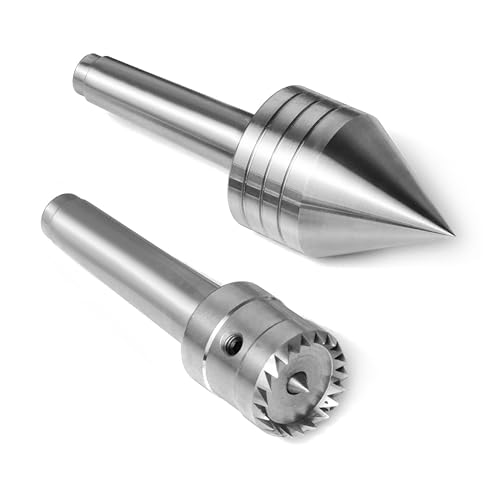
The PSI Woodworking Crown Super Drive Center replaces the traditional cross-cut spur with a crown: a ring of small teeth around a spring-loaded center point. Instead of cutting kerfs into the blank end and driving four prongs home, the crown’s many contact points spread the driving force around the rim of the blank, which reduces the splitting risk on smaller or drier spindle stock. The spring-loaded point retracts as the tailstock advances, so the teeth engage evenly, and the point also makes it easier to re-seat a blank in the same position after removing it for inspection. In the 5/8 inch diameter, it suits pen-sized through medium spindle work on lathes with a #2 Morse taper headstock.
BMWOOD MT2 Live Center and Crown Drive Center Set
Runner-Up
BMWOOD MT2 Live Center and Crown Drive Center Set
Type: Crown drive center plus live center set
Drive center: 1 inch crown, spring-loaded center point
The BMWOOD set pairs a crown drive center for the headstock with a live center for the tailstock, which makes it a tidy one-purchase refresh for a lathe whose original centers are worn, rusty, or missing. The drive side uses a 1 inch crown with a spring-loaded center point, so it grips the blank with many small teeth rather than four deep prongs. The tailstock side is a 1-5/8 inch live center that supports the free end of the blank while rotating with it. Both pieces mount on MT2 tapers, matching the headstock and tailstock bores of most mini and midi lathes. Turners setting up a secondhand lathe, or keeping a spare set in the drawer, get the most from this pairing.
Hurricane Turning Tools 4 Prong Drive Center, 5/8 Inch
Hurricane Turning Tools 4 Prong Drive Center, 5/8 Inch
Hurricane Turning Tools’ 5/8 inch four-prong drive center is the traditional pattern most turners learn on: four chisel-point prongs set at right angles around a central point. The prongs bite along the grain lines scribed or sawn into the blank end, giving a positive, non-slip drive for roughing spindle blanks down to round. The 5/8 inch diameter is the smaller of Hurricane’s two common sizes and is the better match for slim work such as chair spindles, tool handles, and finials, where a larger center would mark a wider area than the finished diameter allows. It mounts in a #2 Morse taper headstock and belongs to Hurricane’s Standard Series of lathe accessories.
Hurricane Turning Tools 4 Prong Drive Center, 1 Inch
The 1 inch version of Hurricane’s four-prong drive center covers the heavier end of everyday spindle work. The wider prong spread grips a bigger circle of end grain, which matters when roughing larger blanks for table legs, newel posts, and rolling pins, where torque loads are higher and a small center can spin inside the blank. It shares the same #2 Morse taper mount and four-prong layout as the 5/8 inch model, so turners who already work with the smaller center will find the seating routine identical: mark the end, cut or press the prong lines, and bring the tailstock up firmly. Owning both diameters is common, since the pair covers most spindle diameters a midi lathe can swing.
Specs
Type: Four-prong spur drive center
Diameter: 1 inch
Mount: #2 Morse taper (2MT)
Series: Hurricane Standard Series
Intended use: Larger spindle blanks and heavier roughing
Lathe Drive Spur and Live Center Set
This two-piece set from Belts, Bearings and More combines a multi-prong drive spur for the headstock with a live center for the tailstock, and it is aimed squarely at owners of older lathes: the published compatibility list names the Sears Craftsman 534-0601 wood lathe among the models it fits. The drive spur uses multiple prongs to grip the workpiece, while the live center’s rotating point supports the tailstock end so the blank can spin freely without friction burning the end grain. For someone bringing an older Craftsman lathe back into service, a matched set like this replaces both wear points in one step. Note that the manufacturer does not publish a taper size for this set, so confirming the fit against your lathe’s headstock and tailstock bores before ordering is essential.
Specs
Type: Drive spur plus live center set
Drive spur: Multiple prongs for gripping the workpiece
Live center: Rotating point
Model: FVXNX-3775
Stated compatibility: Sears Craftsman 534-0601 and similar lathes with compatible tapers
Taper size: Not stated by the manufacturer
How to Choose a Drive Center
Start with the taper. Nearly every mini and midi wood lathe uses a #2 Morse taper in both the headstock and tailstock, but older and larger machines may use #1 or #3 tapers, and a center with the wrong taper simply will not seat. Check the lathe manual or measure the bore before ordering, and treat any listing that does not state its taper as a risk.
Next, pick the style. Four-prong spur centers give the most positive drive and are the default for roughing spindle blanks, but they need the blank end prepared with saw kerfs or firm mallet seating, and they can split dry or small-diameter stock. Crown centers trade a little of that bite for gentleness: the ring of teeth needs no kerfs, seats with tailstock pressure alone, and is kinder to small blanks and to work that will be removed and remounted. Spring-loaded center points, found on the crown centers above, help keep the blank registered on the same center mark.
Size matters too. Match the center diameter to the blank: a 5/8 inch center suits slim spindles and leaves little waste at the ends, while a 1 inch center spreads drive over more end grain for large blanks. Finally, consider the tailstock at the same time. A drive center only does half the job; a worn or fixed dead center at the tailstock will burn end grain and add drag, which is why paired drive and live center sets exist.
Who Should Skip a New Drive Center
Turners who work almost entirely with a chuck — bowl and hollow-form turners who mount blanks on a faceplate or scroll chuck and rarely turn between centers — will see little benefit from upgrading a drive center that sits in a drawer. Anyone whose lathe uses a threaded spindle nose rather than a Morse taper bore for headstock accessories should also skip these listings and look at thread-on drive options instead. And if your current center is simply dull or rusty, a wire brush and a few minutes of cleaning may restore it; drive centers have no moving parts to wear out beyond the prong edges and, on live centers, the bearings.
FAQ
What is the difference between a spur center and a crown center?
A spur center drives the blank with two or four large prongs that bite deeply into the end grain, usually after the turner cuts shallow kerfs to receive them. A crown center uses a ring of many small teeth plus a center point, so it grips with tailstock pressure alone, needs no kerfs, and is less likely to split small or dry blanks.
How do I know which Morse taper my lathe uses?
Check the lathe’s manual or specification plate first; most mini and midi lathes use #2 Morse taper in both headstock and tailstock. If the documentation is gone, the taper can be identified by measuring the large end of the bore or of an existing center that fits. Never force a center that does not seat fully, since a partial seat causes runout and can eject under load.
Can I use a drive center in the tailstock?
No. A drive center belongs in the headstock, where the motor turns it. The tailstock needs a live center, which rotates with the workpiece on its own bearings, or a dead center designed to be lubricated. Putting a fixed drive center in the tailstock would drag against the spinning blank, burn the end grain, and loosen the workpiece.
Why does my blank keep slipping on the drive center?
Slipping usually means the prongs are not seated deeply enough, the blank end is not flat, or the tailstock pressure is too light. For spur centers, cut cross kerfs in the blank end and seat the prongs with a mallet before mounting. For crown centers, increase tailstock pressure slightly and make sure the end grain is clean and square so every tooth makes contact.
Final Verdict
For a single all-around upgrade, the PSI Woodworking Crown Super Drive Center is the easiest recommendation: the crown teeth and spring-loaded point make mounting faster and gentler on small blanks, and it fits the #2 Morse taper headstocks found on most hobby lathes. Turners who prefer the traditional pattern should pick the Hurricane four-prong center in the diameter that matches their usual blanks — 5/8 inch for slim spindles, 1 inch for heavier stock — or keep both sizes on hand. Anyone reviving an older lathe, or replacing worn centers at both ends, is better served by a set: the BMWOOD pairing for modern MT2 machines, and the Belts, Bearings and More set for the older Craftsman models it names. Whichever style you choose, confirm the taper first; fit, more than any other factor, decides how well a drive center works.
Product and ASIN Reference
Product
ASIN
PSI Woodworking Crown Super Drive Center 5/8 Inch
B000KIADT0
BMWOOD MT2 Live Center and Crown Drive Center Set
B0CMQGCYLQ
Hurricane Turning Tools 4 Prong Drive Center 5/8 Inch
B079HJCCRX
Hurricane Turning Tools 4 Prong Drive Center 1 Inch
B079HJLSDC
Lathe Drive Spur and Live Center Set FVXNX-3775
B0D7WGN63X
J
JD's Woodworks Editorial Team
We compare specs, warranty terms, long-term owner feedback and street pricing before anything earns a spot. Rankings are never paid.
Affiliate disclosure. As an Amazon Associate we earn from qualifying purchases at no extra cost to you. Prices accurate as of the date shown.
Find the best tools for car wrapping, from felt squeegees and wrap knives to heat guns and complete kits, and choose the right set for a smooth finish.
Find the radiator hose clamps best for leak-free cooling: worm-gear, T-bolt and spring picks sized for upper and lower radiator hoses, plus a sizing guide.
Find the best brake caliper press tool for smooth, even piston compression. Compare ratcheting presses, dual-piston tools, and spreaders for your brake job.
Compare three Japanese water stones for chisels and plane irons, from a King combination stone to a splash-and-go Shapton, with grit and soaking guidance.
Compare three carving knife kits built around basswood blanks, with guided projects, stropping gear and safety extras, plus criteria for choosing well.
Compare four chip carving knives for lettering by edge shape, steel and handle, from a skewed BeaverCraft C6 to a Swiss Pfeil, for plaques, signs and lids.
The best spindle sanders for guitar making shape cutaways, waist curves, and neck heels cleanly. Compare five benchtop and portable picks by drum size.