As an Amazon Associate I earn from qualifying purchases. This post may contain affiliate links at no extra cost to you.
The real decision when buying a Miller TIG welder is not how many amps sit at the top of the dial. It is whether the machine’s output type matches the metal you actually weld, because a DC-only unit will never run a proper aluminum bead no matter how skilled the operator is. After that comes a quieter question: does the machine fit your power supply and the way you work, at a bench all day or moving between jobs?
This guide serves three kinds of buyers: home-shop welders who want one approachable machine for steel and aluminum, mobile repair welders who need DC precision in a light package, and small fabrication shops that want a complete TIG station. Each pick below is a Miller TIG welder chosen from the model names and specifications published on its Amazon listing.
Quick Picks
As an Amazon Associate we earn from qualifying purchases.
Product
Best for
Key spec from title
Miller Diversion 180
First TIG machine for steel and aluminum at home
AC/DC TIG with 10–180 A output
Miller Maxstar 161 STL
Portable DC TIG and stick work on steel and stainless
5–160 A range in a 13 lb body
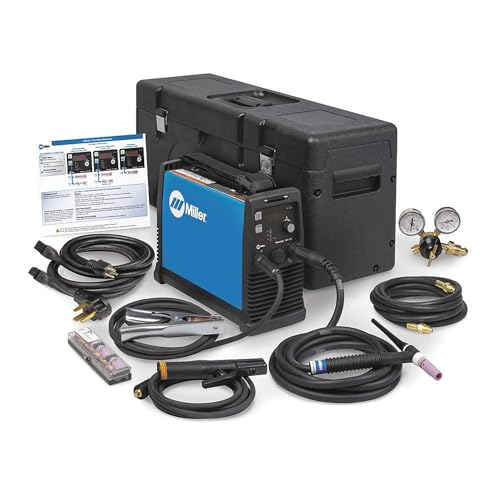
Miller Syncrowave 210 TIG/MIG Package
A complete shop station with TIG, stick and spool-gun MIG
AC/DC TIG with 5–210 A on 240 V
How to Choose
Decide Between AC and DC Output First
Aluminum is the dividing line in this category. TIG welding aluminum needs AC output so the arc can clean the oxide layer while it welds, and no setting or accessory converts a DC-only machine later. Steel and stainless steel weld on DC, which is why Miller sells the DC-only Maxstar line alongside AC/DC machines like the Diversion and Syncrowave families. List every metal you realistically expect to join over the next few years, including the occasional aluminum repair you might otherwise turn away, and let that list settle the question before you compare anything else.
Match Amperage Range and Duty Cycle to Your Metal
Maximum amperage tells you the thickest material a machine can handle in a single pass, while the low end of the range controls how gently it treats thin sheet and tubing. Just as important is duty cycle, the share of a ten-minute window the machine can weld at a stated output before it needs to rest. A welder rated at 150 amps with a 20 percent duty cycle behaves very differently on long seams from one rated at 125 amps with a 60 percent duty cycle. Compare the duty cycle at the amperage you will actually use, not the headline maximum.
Check Input Power, Size and Weight
Every machine in this guide accepts both household and shop power, but they do it differently. The Diversion 180 swaps plug ends with Miller’s Multi-Voltage Plug system, while the Maxstar and Syncrowave use Auto-Line circuitry that adapts to whatever voltage it is fed. Output drops on 120 volt power, so a machine that feels strong on a 240 volt circuit will weld noticeably thinner material from a wall outlet. Weight matters just as much: a 13 pound inverter travels to the work, a 50 pound unit moves around the shop, and a runner package stays where you park it.
Look at Arc Starting, Controls and What Is Included
How the arc starts shapes daily work more than most buyers expect. High-frequency start fires without touching the tungsten to the metal, which keeps the tungsten clean, while Lift-Arc starting asks you to touch and lift, a simple and reliable method on DC machines. Control layouts range from the Diversion’s two-dial simplicity to preset systems that suggest settings once you pick a material and thickness. Finally, compare what each listing actually bundles: torch, foot control, regulator and hose, ground clamp, and on the Syncrowave package, a spool gun for MIG work.
The 3 Best Options
Miller Diversion 180
Top Pick
Miller Diversion 180
Best for: Home and hobby welders who want one machine that handles steel, stainless and aluminum without a steep learning curve.
Processes: AC/DC TIG (GTAW)
Amperage range: 10–180 A
Input power: 120/240 V with Multi-Voltage Plug (MVP)
Rated output: 150 A at 20 percent duty cycle on 240 V
Home and hobby welders who want one machine that handles steel, stainless and aluminum without a steep learning curve.
Watch out for
Duty cycle falls to 10 percent at the full 180 amp output, so plan breaks on long, thick seams; confirm the exact package contents and seller on the listing before ordering.
The Diversion 180 is the Miller most home welders should look at first, because it removes the two barriers that stall beginners: complicated controls and the wrong output type. Its panel asks only for a material and thickness selection plus an amperage setting, and the AC/DC output covers mild steel, stainless and aluminum in one machine. Dual-voltage plugs let it run from a household outlet for thin work or a 240 volt circuit for thicker stock. At 50 pounds with built-in handles, it moves around a garage easily, and the included foot control and torch make the package feel complete from the first session.
Watch out for: Duty cycle falls to 10 percent at the full 180 amp output, so plan breaks on long, thick seams; confirm the exact package contents and seller on the listing before ordering.
Miller Maxstar 161 STL
Runner-Up
Miller Maxstar 161 STL
Best for: Mobile maintenance and repair welders who need precise DC TIG and stick capability in the lightest package Miller sells.
Mobile maintenance and repair welders who need precise DC TIG and stick capability in the lightest package Miller sells.
Watch out for
This is a DC-only machine, so it cannot TIG weld aluminum; listings circulate in several configurations, from machine-focused packages to X-Case contractor kits, so check what the torch and remote options include.
The Maxstar 161 STL is built for welders whose TIG work happens on steel and stainless and rarely stays in one place. The power source weighs 13 pounds and hangs from a shoulder strap, yet it still delivers a 5 to 160 amp DC range that starts arcs gently on thin stainless tubing and runs up to heavier repair work on 240 volt power. Lift-Arc starting keeps the tungsten uncontaminated without high-frequency electronics, and the same box stick welds when a repair calls for an electrode instead. Process pipe, food and beverage equipment, and restaurant kitchen repair are exactly the jobs Miller designs this series for.
Watch out for: This is a DC-only machine, so it cannot TIG weld aluminum; listings circulate in several configurations, from machine-focused packages to X-Case contractor kits, so check what the torch and remote options include.
Miller Syncrowave 210 TIG/MIG Package
Miller Syncrowave 210 TIG/MIG Package
Best for: Small fabrication shops that want one complete station for TIG, stick and occasional spool-gun MIG work.
Part number: 951684 (TIG/MIG Complete Package)
Processes: AC/DC TIG, DC stick, MIG with included Spoolmate 150 spool gun
Small fabrication shops that want one complete station for TIG, stick and occasional spool-gun MIG work.
Watch out for
It is a heavy, floor-standing package that needs dedicated space, and Miller has since introduced a Syncrowave 212 line, so confirm the listing is the 210 package (951684) before ordering.
The Syncrowave 210 package suits a small shop that wants one station to cover nearly everything. The power source delivers AC/DC TIG for steel, stainless and aluminum, DC stick for heavier repair work, and MIG through the included Spoolmate 150 spool gun, which is genuinely useful on aluminum jobs where feeding soft wire through a standard gun frustrates. It stands upright on running gear with a cylinder rack, so it lives in one bay rather than traveling. Preset assistance helps less experienced staff dial in a starting point, while the 5 to 210 amp TIG range on 240 volt power handles thin sheet through quarter-inch plate.
Watch out for: It is a heavy, floor-standing package that needs dedicated space, and Miller has since introduced a Syncrowave 212 line, so confirm the listing is the 210 package (951684) before ordering.
Which One Fits Your Situation
You Are Buying Your First TIG Welder
Start with the Diversion 180. Its simplified controls shorten the path from unboxing to a clean bead, the AC/DC output means aluminum projects do not force a second purchase later, and the bundled torch, foot control and regulator cover the core setup. Run it on 240 volt power when the circuit is available, because the thicker end of its range only appears there, and grow into the full amperage as your technique improves.
You Repair Stainless and Steel Away From the Bench
Choose the Maxstar 161 STL. At 13 pounds it rides in a truck or hangs from a strap on a ladder, the Auto-Line input accepts whatever receptacle the site provides, and Lift-Arc starts keep tungsten clean on sanitary stainless work. The stick mode covers the rough repairs that TIG cannot reach, so one small case replaces two machines on most maintenance calls.
Your Shop Needs One Station That Does Almost Everything
Take the Syncrowave 210 package. The AC/DC TIG range covers the metals a general fabrication shop sees weekly, the spool gun adds MIG for faster aluminum and sheet work, and the 60 percent duty cycle at working amperage suits repeated production seams. Park it beside the gas cylinders, keep the foot control connected, and it becomes the bench every odd job gravitates toward.
You Weld Aluminum on Household Power
The Diversion 180 is again the sensible pick, with one honest caveat. On a 120 volt outlet its output tops out well below the 180 amp ceiling, which is still enough for thin aluminum sheet, small brackets and hobby fabrication. Anything thicker waits for a 240 volt circuit. If your aluminum work is mostly heavier plate in a fixed shop, the Syncrowave 210 on shop power is the better long-term answer.
Common Mistakes
Buying a DC-only machine and discovering later that your projects include aluminum, which needs AC output for TIG work.
Comparing maximum amperage alone and ignoring the duty cycle at the output you will actually weld with most days.
Assuming every listing of the same model includes the same torch, foot control and regulator, when packages differ.
Planning to weld thick material from a 120 volt outlet, even though every machine here loses output on household power.
Forgetting the running costs beyond the machine itself: shielding gas, tungsten electrodes, filler rod, and a proper helmet.
Frequently Asked Questions
Can these Miller TIG welders run on a normal household outlet?
Yes, all three accept 120 volt input, the Diversion 180 through its swappable Multi-Voltage Plug and the other two through Auto-Line circuitry. Expect reduced output on household power, though: thinner material and lower duty cycles are the trade. For regular work near the top of any machine’s range, a 240 volt circuit is the sensible setup.
Which of these machines can TIG weld aluminum?
The Diversion 180 and the Syncrowave 210, because both produce AC output, which aluminum TIG welding requires for cleaning action at the arc. The Maxstar 161 STL is DC only, so it is limited to steel and stainless steel for TIG work, though it stick welds a wider range of repair jobs than its size suggests.
What else do I need before I can start TIG welding?
Beyond the machine, plan on a cylinder of argon shielding gas, tungsten electrodes matched to your material, filler rod, and an auto-darkening helmet with suitable gloves. The Diversion 180 and Syncrowave 210 listings bundle a torch, foot control and regulator, which shortens the list considerably, but gas and consumables are always separate purchases.
Is the Syncrowave 210 still worth choosing now that a newer line exists?
For many small shops, yes. The 210 package remains a complete, proven station with AC/DC TIG, stick and spool-gun MIG in one purchase, and its control layout is familiar to anyone trained on earlier Syncrowave machines. Just verify the listing describes the 951684 complete package and check the seller carefully before ordering.
J
JD's Woodworks Editorial Team
We compare specs, warranty terms, long-term owner feedback and street pricing before anything earns a spot. Rankings are never paid.
Affiliate disclosure. As an Amazon Associate we earn from qualifying purchases at no extra cost to you. Prices accurate as of the date shown.
Find the best steel plasma cutter for your shop. Compare four proven machines for clean cuts in mild steel, from a portable 12-amp unit to a 60-amp workhorse.
Best high frequency TIG welder guide: four HF-start AC/DC welders compared on output, duty cycle, dual voltage, torch, foot pedal and warranty for home shops.
Find the best gas shielded MIG welder for your shop. Compare four gas MIG machines by output range, duty cycle, voltage, weight, and included gas hardware.
Find the best 110 volt plasma cutter for home shops: dual-voltage 50-amp and 55-amp picks compared on cut capacity, pilot arc and air needs before you buy.
Compare deep cut portable band saws in the Milwaukee 6230 class: the 6232-21 kit, DEWALT DWM120K and two cordless rivals, by capacity, speed and weight.