Find the best Vevor air compressor for your workshop. Compare four Vevor models by tank size, airflow, pressure, and noise to pick the right fit for your tools.
VEVOR 25-Gallon Air Compressor, 2HP 5.5 SCFM at 90PSI, Max 200PSI Pressure Oil-Lubricated Air Compressor Tank, Portable on Wheels for Auto Repair, Tire Inflation, Spray Painting, Woodwork Nailing 120V — ASIN B0GDFQLGFN
Best for: Owners who want the highest working pressure on standard household power for impact tools and demanding inflation work.
VEVOR 2.1 Gallon Air Compressor, 1.2HP 2.2 CFM@90PSI Air Compressors with Max. 116PSI Pressure, Oil Free Compressor Tank for Auto Repair, Tire Inflation, Spray Painting, Woodwork Nailing — ASIN B0BV5R8LMX
Best for: Portable nailing, tire inflation, and light spray work where the compressor must move around the shop or travel to a job.
Find the best Vevor air compressor for your workshop. Compare four Vevor models by tank size, airflow, pressure, and noise to pick the right fit for your tools.
As an Amazon Associate I earn from qualifying purchases. This post may contain affiliate links at no extra cost to you.
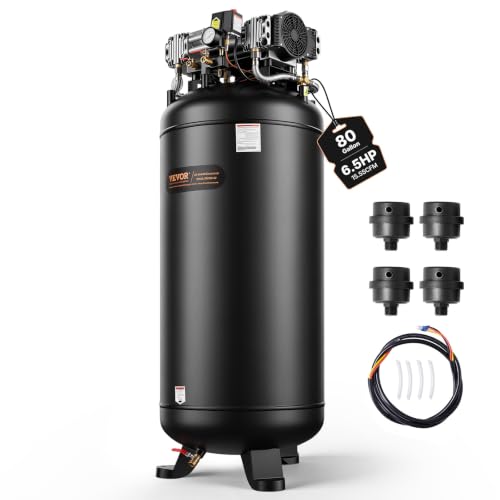
The best Vevor air compressor for most home workshops is the VEVOR 80 Gallon Air Compressor, with a 6.5 HP oil-free motor delivering 15.5 SCFM at 90 PSI and a 145 PSI maximum pressure for continuous air tool use. For smaller shops and quieter operation, the VEVOR 13-Gallon Air Compressor pairs a 2 HP motor with 4.6 SCFM at 90 PSI and a published 66 dB noise level. Match tank size and airflow to your tools first, because a compressor that cannot keep up with a spray gun or sander will cycle constantly and slow your work.
Introduction
An air compressor is one of the most useful machines in a woodworking shop. It powers nail guns and staplers, blows dust out of joinery, inflates tires, and runs spray guns for finishing. Vevor builds a wide range of tank compressors, from a small 2.1-gallon portable unit up to a large 80-gallon stationary model, so the right choice depends on which tools you run and how long you run them.
Our top pick: VEVOR 80 Gallon Air Compressor. Runner-up: VEVOR 13-Gallon Air Compressor.
This guide compares published specifications only: tank capacity, motor power, airflow in SCFM at 90 PSI, maximum pressure, noise level, and power requirements, all taken from the manufacturer listings on Amazon. No performance claim here comes from personal use. The four models below cover the full range of Vevor workshop compressors, from a compact unit for nailing and inflation to a large stationary unit that can feed several air tools in sequence.
Before choosing, think about the hungriest tool you own. A brad nailer sips air in short bursts and works happily on a small tank. A random-orbit sander or a paint sprayer drinks air continuously and needs both a large tank and high airflow. Buying for the biggest tool you plan to use is the simplest way to avoid a compressor that runs nonstop and still falls behind.
At a Glance
Product
Best for
Key specification
VEVOR 80 Gallon Air Compressor
Large workshops and continuous air tool use
6.5 HP, 15.5 SCFM at 90 PSI, 80-gallon tank
VEVOR 25-Gallon Air Compressor
High-pressure tools on standard 120V power
2 HP, 5.5 SCFM at 90 PSI, 200 PSI maximum pressure
VEVOR 13-Gallon Air Compressor
Quiet home workshops and woodworking
2 HP, 4.6 SCFM at 90 PSI, 66 dB noise level
VEVOR 2.1 Gallon Air Compressor
Portable nailing, inflation, and small jobs
1.2 HP, 2.2 CFM at 90 PSI, 2.1-gallon tank
How to Choose
1. Tank Size and Recovery Time
Tank size decides how long a tool can run before the motor must refill the tank. A 2.1-gallon tank holds enough air for short bursts from a nail gun, then cycles frequently. A 13-gallon tank stretches those intervals noticeably, while a 25-gallon tank supports longer spray sessions. The 80-gallon tank is built for sustained work, giving the motor long rest periods between cycles. Larger tanks also mean steadier pressure at the tool, which shows up as more consistent results from a spray gun. If your shop has the floor space and a 220V circuit, a large tank is the most comfortable option. If space is tight, a mid-size tank with adequate airflow is the practical compromise.
2. Airflow (SCFM at 90 PSI)
SCFM at 90 PSI is the number that matters most for running air tools. It tells you how much air the compressor delivers while a tool is working. A nail gun needs very little, often under 1 SCFM in average use, so even the 2.1-gallon model at 2.2 CFM at 90 PSI handles it. A spray gun or a die grinder needs far more, and a compressor rated below the tool’s demand will lose pressure mid-pass. The 13-gallon model delivers 4.6 SCFM at 90 PSI, the 25-gallon model delivers 5.5 SCFM at 90 PSI, and the 80-gallon model delivers 15.5 SCFM at 90 PSI. Compare the published SCFM figure of each compressor with the air consumption printed on your tools, and choose a compressor whose output meets or exceeds the hungriest tool.
3. Maximum Pressure
Maximum pressure sets the ceiling for the air your tools receive. Most nail guns, staplers, and blow guns work in the 70 to 100 PSI range, so a 116 PSI or 125 PSI ceiling leaves enough headroom. Tools that need higher pressure, such as some impact wrenches and heavy-duty inflation jobs, benefit from a higher ceiling. The 25-gallon Vevor stands out here with a 200 PSI maximum pressure, the highest of the four models in this guide. The 80-gallon model reaches 145 PSI, the 13-gallon model reaches 125 PSI, and the 2.1-gallon model reaches 116 PSI. A higher maximum pressure is not automatically better, but it gives the regulator more range to work with when a tool calls for it.
4. Oil-Free or Oil-Lubricated
Three of the four models in this guide use oil-free pumps, while the 25-gallon model uses an oil-lubricated pump. Oil-free pumps need no oil changes and no oil level checks, which suits owners who want the compressor ready whenever they walk into the shop. They also keep oil out of the air line, a plus when spraying finishes. Oil-lubricated pumps need periodic oil checks and changes, but the oil bath reduces friction and heat in the pump, which is one reason the 25-gallon model pairs its oil-lubricated pump with a belt-driven design and a 200 PSI ceiling. If you spray finishes, add a moisture trap and an inline filter to the air line either way, because water in the line causes more finish defects than pump oil ever will.
5. Noise Level
Noise matters in a home workshop, especially in a basement or a shared garage. The published figures show a wide spread. The 13-gallon model is the quietest of the four at 66 dB, which makes it the easiest to live with during long sessions. The 2.1-gallon model is rated at 70 dB. The 25-gallon model is rated at 85 dB, and the 80-gallon model is rated at 86 dB, both loud enough that hearing protection is sensible when working nearby. Noise figures are measured under the manufacturer’s own conditions, so treat them as a comparison between models rather than an absolute guarantee. If the compressor will sit in the same room where you work, give the quieter models extra weight in your decision.
6. Power Supply and Voltage
Three of these compressors run on standard 120V household power, while the 80-gallon model needs a 220V single-phase circuit. That difference decides where each unit can live. The 2.1-gallon, 13-gallon, and 25-gallon models plug into a normal workshop outlet, with the 25-gallon model drawing 2000 watts at full load. The 80-gallon model needs a dedicated 220V circuit, which may mean an electrician visit if your shop does not already have one. Check the voltage and amperage of your shop circuits before ordering a 220V unit, and confirm that the outlet matches the plug on the machine. A compressor that cannot be plugged in is no use at all.
7. Portability and Footprint
Weight and shape decide whether a compressor stays in one place or moves around the shop. The 2.1-gallon model weighs 27 pounds and carries a portable handle, so it moves easily from the bench to the driveway. The 13-gallon model weighs 71 pounds and rolls on wheels. The 25-gallon model weighs 134.92 pounds and rolls on two 6-inch plastic wheels with a handrail for moving it around the shop. The 80-gallon model is a stationary unit that belongs in a fixed spot with a short hose run to the work area. Measure the space where the compressor will sit, allow room for airflow around the motor and for draining the tank, and remember that a long air hose loses a little pressure along its length.
This is the largest and most powerful Vevor compressor in this guide. Its 6.5 HP oil-free motor delivers 15.5 SCFM at 90 PSI into an 80-gallon tank, with a maximum pressure of 145 PSI. The two-stage pump design and the large tank mean long intervals between motor cycles, even when feeding air-hungry tools. The published noise level is 86 dB, and the unit runs on 220V single-phase power with a 60 Hz supply.
Consideration: It needs a dedicated 220V circuit and a fixed floor location, so it suits a permanent shop rather than a space that changes layout often.
VEVOR 25-Gallon Air Compressor, 2HP 5.5 SCFM at 90PSI, Max 200PSI Pressure Oil-Lubricated Air Compressor Tank, Portable on Wheels for Auto Repair, Tire Inflation, Spray Painting, Woodwork Nailing 120V — ASIN B0GDFQLGFN
Runner-Up
VEVOR 25-Gallon Air Compressor, 2HP 5.5 SCFM at 90PSI, Max 200PSI Pressure Oil-Lubricated Air Compressor Tank, Portable on Wheels for Auto Repair, Tire Inflation, Spray Painting, Woodwork Nailing 120V — ASIN B0GDFQLGFN
Best for: Owners who want the highest working pressure on standard household power for impact tools and demanding inflation work.
This model has the highest maximum pressure in this guide at 200 PSI, from a 2 HP motor delivering 5.5 SCFM at 90 PSI. The oil-lubricated, belt-driven pump sits on a 25-gallon carbon steel tank built from 2.75 mm steel with a powder coating, and an oil observation mirror makes the oil level easy to check. It runs on 120V power, draws 2000 watts, and rolls on two 6-inch plastic wheels with a handrail. Two outlets allow two tools to connect at once.
Consideration: The oil-lubricated pump needs periodic oil checks, and at 134.92 pounds it is a two-person lift if it ever needs to go up or down stairs.
VEVOR 13-Gallon Air Compressor, 2HP, 4.6 SCFM@90PSI, Oil-Free Tank, 66dB Quiet Operation, Ideal for Tire Inflation, Woodworking, Auto Repairs, and Spray Painting (Maximum Pressure 125 PSI) — ASIN B0FB2T1NNF
VEVOR 13-Gallon Air Compressor, 2HP, 4.6 SCFM@90PSI, Oil-Free Tank, 66dB Quiet Operation, Ideal for Tire Inflation, Woodworking, Auto Repairs, and Spray Painting (Maximum Pressure 125 PSI) — ASIN B0FB2T1NNF
Best for: Home woodworking shops where low noise and low maintenance matter as much as airflow.
This is the quietest compressor in this guide, with a published noise level of 66 dB. Its 2 HP oil-free motor delivers 4.6 SCFM at 90 PSI into a 13-gallon tank, with a maximum pressure of 125 PSI. The unit weighs 71 pounds, rolls on wheels, and runs on 120V power. The oil-free pump needs no oil maintenance, and the tank size is large enough for nailing, inflation, and intermittent spray work without constant cycling.
Consideration: The 125 PSI ceiling and 4.6 SCFM output set a limit on the most demanding continuous-use tools, so check the air demand of a spray gun before pairing it with this unit.
VEVOR 2.1 Gallon Air Compressor, 1.2HP 2.2 CFM@90PSI Air Compressors with Max. 116PSI Pressure, Oil Free Compressor Tank for Auto Repair, Tire Inflation, Spray Painting, Woodwork Nailing — ASIN B0BV5R8LMX
VEVOR 2.1 Gallon Air Compressor, 1.2HP 2.2 CFM@90PSI Air Compressors with Max. 116PSI Pressure, Oil Free Compressor Tank for Auto Repair, Tire Inflation, Spray Painting, Woodwork Nailing — ASIN B0BV5R8LMX
Best for: Portable nailing, tire inflation, and light spray work where the compressor must move around the shop or travel to a job.
This is the smallest and lightest compressor in this guide, built around a 900W oil-free motor running at 3500 r/min. It delivers 2.2 CFM at 90 PSI into a 2.1-gallon tank, with a maximum pressure of 116 PSI. The tank is built from Q235B structural steel with a 3.5 MPa maximum bearing pressure and seamless welding, and the unit carries two silencers, two cooling fans, and automatic overheating protection. It weighs 27 pounds, measures 19.9 by 19.5 by 10 inches, and is rated at 70 dB.
Consideration: The small tank cycles often under continuous use, so it is not the right match for a sander or a spray gun used for long stretches.
Which One Is Right for You?
Choose the 80-gallon model if your shop runs air tools for hours at a time and you have a 220V circuit. Its 15.5 SCFM at 90 PSI is far above anything else in this guide, and the large tank keeps pressure steady during long spray sessions. Choose the 25-gallon model if you want the highest maximum pressure on standard 120V power and you are comfortable checking oil now and then. Its 200 PSI ceiling and belt-driven pump make it a strong match for impact tools and heavy inflation work.
Choose the 13-gallon model if your shop is in a basement or a shared space and noise matters. At 66 dB it is the quietest of the four, its oil-free pump needs no oil maintenance, and its 4.6 SCFM at 90 PSI covers nailing, inflation, and intermittent spraying. Choose the 2.1-gallon model if you need a compressor that moves easily and your work is mostly nailing and inflation. It is light, compact, and inexpensive to run, but its small tank means frequent cycling with continuous-use tools.
A simple rule covers most buyers: add up the air demand of the tools you use most, then pick the smallest compressor in this guide whose SCFM at 90 PSI meets that demand. Buying one step above your current needs leaves room for a bigger tool later without replacing the compressor.
Frequently Asked Questions
What size Vevor air compressor do I need for a nail gun?
A brad nailer or finish nailer uses air in short bursts, so even the 2.1-gallon Vevor model with 2.2 CFM at 90 PSI handles nailing well. A framing nailer used all day benefits from a larger tank, such as the 13-gallon or 25-gallon model, because the bigger reserve means fewer motor cycles. Check the air consumption printed on your nail gun and compare it with the compressor’s published SCFM figure.
Can a Vevor air compressor run a spray gun?
It depends on the spray gun’s air demand and the compressor’s output. A small touch-up gun works with the 13-gallon or 25-gallon models, while a full-size HVLP gun needs the airflow of the 80-gallon model at 15.5 SCFM at 90 PSI. Always compare the gun’s published air consumption with the compressor’s SCFM at 90 PSI before pairing them. A moisture trap and an inline filter on the air line help keep water out of the finish.
Is an oil-free Vevor compressor better than an oil-lubricated one?
Neither design is better in every case. Oil-free pumps need no oil changes and keep oil out of the air line, which suits spraying and owners who want minimal upkeep. Oil-lubricated pumps need periodic oil checks, but the oil bath reduces friction and heat, which is one reason the 25-gallon model uses an oil-lubricated, belt-driven pump with a 200 PSI ceiling. Choose oil-free for low maintenance and oil-lubricated for heavy, sustained use.
What does SCFM at 90 PSI mean?
SCFM stands for standard cubic feet per minute, and the 90 PSI figure is the working pressure at which the airflow was measured. It tells you how much air the compressor delivers while a tool is running at normal pressure. A higher SCFM at 90 PSI means the compressor can feed hungrier tools without losing pressure. Compare this figure with the air consumption listed for each of your tools.
Does a Vevor air compressor need a 220V outlet?
Only the 80-gallon model in this guide needs 220V single-phase power. The 2.1-gallon, 13-gallon, and 25-gallon models run on standard 120V household power. If your shop does not already have a 220V circuit, the 80-gallon model will need an electrician to install one. Confirm the voltage, amperage, and plug type of your shop circuits before ordering any compressor.
Bottom Line
The best Vevor air compressor for a serious home workshop is the VEVOR 80 Gallon Air Compressor, with 15.5 SCFM at 90 PSI and an 80-gallon tank that keeps up with continuous air tool use. The VEVOR 13-Gallon Air Compressor is the best fit for quieter home shops, pairing a 66 dB noise level with 4.6 SCFM at 90 PSI and no oil maintenance. The 25-gallon model is the pick for the highest working pressure on 120V power, and the 2.1-gallon model is the portable choice for nailing and inflation. Match the compressor to the hungriest tool you own, check your shop’s power supply, and confirm the ASIN and specifications on the Amazon listing before ordering.
Disclosure: As an Amazon Associate, this site earns from qualifying purchases.
J
JD's Woodworks Editorial Team
We compare specs, warranty terms, long-term owner feedback and street pricing before anything earns a spot. Rankings are never paid.
Affiliate disclosure. As an Amazon Associate we earn from qualifying purchases at no extra cost to you. Prices accurate as of the date shown.
Miter saw vs table saw: compare crosscuts, rip cuts, accuracy, space, and value to choose the right saw for your shop and your first woodworking projects.
Compare five solar portable generators for shops, campsites, and outages, covering battery size, output, solar charging, outlets, and what to check first.
The best portable CNC machines for small shops and shared spaces, compared by footprint, weight, work area, and setup. Compact benchtop picks for wood, acrylic, and soft metal.
Find the best Penn Industries dust collector on Amazon: the PSI Woodworking DC3XX blower and the DC725 tabletop unit, compared on airflow, pressure, and shop fit.
Compare five large stationary horizontal metal band saws for fabrication shops on cutting capacity, motor, power supply, blade speed, and mitering before buying.
Find the best mortising chisel bits for clean square mortises in this guide: hollow-chisel sets and singles compared by size, shank, steel, and machine fit.
Find the best drill press base for your shop. Compare rolling stands and mobile bases by capacity, footprint, casters, locking, and setup before you buy.
Find the best dewalt planer dw734 blades for your 12-1/2-inch thickness planer. Compare OEM and aftermarket 3-knife sets, steel types, and fit before you buy.



 VEVOR 2.1 Gallon Air Compressor, 1.2HP 2.2 CFM@90PSI Air Compressors with Max. 116PSI Pressure, Oil Free Compressor Tank for Auto Repair, Tire Inflation, Spray Painting, Woodwork Nailing — ASIN B0BV5R8LMX









