As an Amazon Associate I earn from qualifying purchases. This post may contain affiliate links at no extra cost to you.
The best saddle squares for woodworking solve one specific layout problem: carrying a line around the corner of a board in a single setup. A flat square marks one face, then must be repositioned to mark the edge, and every repositioning risks a wandering line. A saddle square straddles the edge with legs on two faces at once, so face and edge lines are scribed in a single setup and guaranteed to meet at the corner. For dovetail baselines and mortise layout, that continuity is the whole point.
OUR TOP PICK
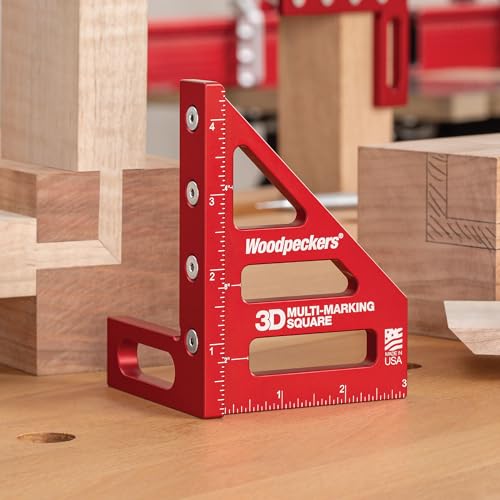
Woodpeckers 3D Multi-Marking Square (Inch Version)
The five picks below cover the saddle styles actually sold through Amazon: a premium machined wrap-around square that doubles as a machine setup tool, a compact stainless Japanese three-dimensional square, and three 3D multi-angle squares that fold angle layout and hole scribing into the same wrap-over form. One honest note: classic one-piece saddle squares and fixed-angle dovetail saddle markers from specialty retailers are rarely listed on Amazon, so this roundup concentrates on designs Amazon shoppers can actually buy.
As an Amazon Associate, we earn from qualifying purchases.
Quick Answer
For most woodworkers, the Woodpeckers 3D Multi-Marking Square is the best saddle square for woodworking: its two full-length legs wrap the edge of the stock, milled steps mark common offsets without measuring, and it stands alone for machine setup. Traditionalists should look at the stainless Shinwa 12102, and anyone who lays out angles should step up to the SakerPlus 3D triangle square with its preset angle guides.
Table of Contents
Quick Answer
Woodpeckers 3D Multi-Marking Square
Shinwa Sokutei 12102 Three-Dimensional Square
SakerPlus 3D Carpenter’s Triangle Square
ArtyMaster WT102A Mini 3D Multi-Angle Square
Baowox 3D Carpenter Square Rule
How to Choose a Saddle Square
Who Should Skip a Saddle Square
FAQ
Conclusion
Woodpeckers 3D Multi-Marking Square
Top Pick
Woodpeckers 3D Multi-Marking Square
Material: aircraft-grade aluminum, precision milled from solid billet
Construction: blade and base joined with stainless steel screws, center groove keeps the blade perpendicular
Height: stands 4-1/2 in tall for hands-free blade and bit setup
Marking steps: precision-milled steps for 1/4 in, 3/8 in, and 1/2 in offsets
Woodpeckers builds this square around the purest version of the saddle idea: two full-length legs joined to a base, so the tool wraps over the edge of a board and registers on face and edge at the same time. Because both legs are full length, it stays stable on narrow stock where a short saddle can rock, and the centered blade gives equal shoulders for laying out mortise and tenon cheeks.
The step system is what separates this from a plain saddle. Instead of measuring an offset and then marking it, you hook the right milled step over the edge and scribe, making repeated offsets on a batch of parts fast and consistent. Standing it on the saw table turns it into a setup reference: the tall, perpendicular body leaves both hands free to adjust blade or bit height against the engraved scale. This is the premium pick, the one to choose if the square will live on the bench full time. A metric version is sold under a separate listing, so check the scale system before ordering.
Shinwa Sokutei 12102 Three-Dimensional Square
Shinwa’s 12102 is the traditional end of this roundup: a small stainless steel three-dimensional square with equal graduations on front and back faces. It does one job, carrying a square line around the corner of small stock, with the rigidity only a one-piece steel tool has. There are no screws to loosen and no assembly to drift out of true.
Specs
Material: stainless steel
Size: 3 x 1.5 in
Model: Shinwa Sokutei 12102
Scales: equal graduations on front and back faces
Angles: 90 degree wrap-around layout
Weight: not stated
The small footprint is the point. At 3 in long, it fits inside drawers, small boxes, and model-scale work where the bigger 3D squares cannot register, and rides in an apron pocket unnoticed. Stainless construction shrugs off glue and shop humidity. The trade-offs are reach and features: no angle guides, no scribing holes, and short legs that give less bearing surface on wide boards. Buy it as a dedicated corner-transfer square, not a general layout system.
SakerPlus 3D Carpenter’s Triangle Square
The SakerPlus takes the wrap-over form and loads it with angle work. Its triangle body carries preset guides for the angles carpenters reach for most, so one tool wraps a corner for a square line, then lays out a miter or hip angle without a separate protractor. Drill guide holes add hardware-layout utility.
Specs
Material: anodized aluminum alloy
Dimensions: about 4.41 x 3.35 x 3.11 in (112 x 85 x 79 mm)
Preset angles: 22.5, 30, 45, 60, 67.5, and 75 degrees, plus 0 to 90 degree marking
Drill guides: holes sized from 2 mm to 10 mm
Color: red anodized finish
Model: 3D Carpenter’s Triangle Square
Preset angle guides matter because they remove the setting step entirely. A sliding bevel has to be set from a reference and can drift; a machined guide is the angle, every time, which is what you want when the same miter repeats across a frame. The anodized body keeps it light enough for site work, and the red finish is easy to find in a cluttered toolbox. This is the mid-range all-rounder: less refined than the Woodpeckers, far more versatile than the Shinwa, and the best fit for carpenters who split time between joinery layout and angle marking.
The WT102A packs the 3D concept into the smallest body here. It combines two triangle rulers and a square ruler in one 3.8 in tool, so it wraps an edge for square and 45 degree lines, then comes apart into flat rulers for tight spots. It ships as a small kit with a carpenter pencil and refills, making it the easiest of the five to hand a beginner as a first layout tool.
Hole scribing is the WT102A’s party trick: a grid of precision holes lets a pencil draw lines parallel to an edge at repeatable offsets, speeding up hinge and joinery layout on small parts. The mini size also sets its limits. On long boards the short reference edges are easier to skew, and the multi-piece construction depends on its screws staying snug, so check it against a known square after assembly and after any drop. As a budget-tier starter or apron square, it earns its place.
The Baowox is the big, simple option: a one-piece aluminum 3D square with an 8.46 in face that straddles stock and carries lines around corners on larger work. Where the mini squares suit boxes and drawers, its longer legs and deeper saddle suit framing lumber, posts, and tubular stock that a small square cannot span.
Simplicity is the selling point. There is nothing to assemble, adjust, or lose, and the long reference edges average out small surface irregularities on rough stock better than a short tool can. What you give up is finesse: no preset angle detents, no scribing-hole grid, and a size that helps on posts but turns clumsy inside casework. Treat it as the jobsite saddle of the five, and reach for a smaller square at the bench.
How to Choose a Saddle Square
Start with stock size. A saddle square only works when both legs bear fully on the workpiece, so match the tool to the stock you lay out most: mini squares for drawer parts, mid-size 3D squares for furniture stock, and the long Baowox-style body for posts and framing lumber. If the saddle bridges a corner without full contact, the line it draws is a guess.
Next, decide how much angle work you need. A pure 90 degree saddle like the Shinwa is the most rigid and fastest for baseline and shoulder lines. Preset-angle 3D squares like the SakerPlus and WT102A trade a little rigidity for miter and polygon angles in the same tool, which pays off on mixed projects.
Material and construction come third. One-piece stainless or machined billet aluminum holds its geometry through drops and years of use, and anodized finishes resist corrosion. Multi-piece budget squares can be accurate out of the box, but their truth lives in their fasteners, so verify them against a known-good square at setup and after knocks. Finally, etched scales close to the work surface reduce parallax error, and scribing holes turn repeat offsets into a no-measuring step.
Who Should Skip a Saddle Square
Skip this tool class if your layout is mostly sheet goods and long boards. A saddle square’s legs are short by design, and a large combination square carries lines across plywood far better. Also skip it if you own a good sliding bevel and a dovetail marker and cut dovetails only occasionally: the saddle square speeds up repetition, and without repetition there is little time to save. Finally, woodworkers who want the classic fixed-angle dovetail saddle markers, the one-piece tools sold in 1:6, 1:7, and 1:8 slopes, will not find them here; those remain specialty-retail tools, and a preset-angle 3D square is only a partial substitute.
FAQ
What is a saddle square used for in woodworking?
A saddle square transfers a layout line around the corner of a board in one setup. Its legs rest on the face and edge simultaneously, so shoulder lines, dovetail baselines, and mortise marks stay continuous and aligned on both surfaces instead of being marked twice.
What is the difference between a saddle square and a dovetail saddle marker?
A saddle square marks a 90 degree line around a corner. A dovetail saddle marker does the same wrap-around trick with an angled edge set to a fixed dovetail slope such as 1:6 or 1:8. The square is the general tool; the marker is single-purpose.
Can a 3D multi-angle square replace a saddle square?
For most work, yes. A 3D multi-angle square wraps the edge the same way and adds preset angles and scribing holes. The trade-off is construction: one-piece saddle squares are more rigid, while multi-piece 3D squares should be checked for square after assembly and drops.
How do I check that a saddle square is accurate?
Draw a line along one leg on a board with a known straight edge, flip the square over, and draw a second line from the same starting point. If the lines coincide, the square is true. Any visible fork shows the error doubled, making even small problems easy to spot.
Conclusion
A saddle square earns its bench space by making one layout move perfectly repeatable: the line that wraps the corner. The Woodpeckers 3D Multi-Marking Square is the best of these five for shop use, with the Shinwa 12102 as the compact traditional alternative and the SakerPlus as the angle-heavy all-rounder. The WT102A suits beginners and small work, and the Baowox covers posts and rough stock. Pick by the stock you mark most, verify the tool against a known square when it arrives, and the corner-transfer problem goes away.
Product and ASIN Reference
Product
ASIN
Woodpeckers 3D Multi-Marking Square (Inch Version)
B0DG981DLF
Shinwa Sokutei 12102 Three-Dimensional Square
B001LGZL0G
SakerPlus 3D Carpenter’s Triangle Square
B0FSKZ17HK
ArtyMaster WT102A Mini 3D Multi-Angle Square
B0CTMGL543
Baowox 3D Carpenter Square Rule
B08QCHN2CK
J
JD's Woodworks Editorial Team
We compare specs, warranty terms, long-term owner feedback and street pricing before anything earns a spot. Rankings are never paid.
Affiliate disclosure. As an Amazon Associate we earn from qualifying purchases at no extra cost to you. Prices accurate as of the date shown.
Find the best tools for car wrapping, from felt squeegees and wrap knives to heat guns and complete kits, and choose the right set for a smooth finish.
Find the radiator hose clamps best for leak-free cooling: worm-gear, T-bolt and spring picks sized for upper and lower radiator hoses, plus a sizing guide.
Find the best brake caliper press tool for smooth, even piston compression. Compare ratcheting presses, dual-piston tools, and spreaders for your brake job.
Compare three Japanese water stones for chisels and plane irons, from a King combination stone to a splash-and-go Shapton, with grit and soaking guidance.
Compare three carving knife kits built around basswood blanks, with guided projects, stropping gear and safety extras, plus criteria for choosing well.
Compare four chip carving knives for lettering by edge shape, steel and handle, from a skewed BeaverCraft C6 to a Swiss Pfeil, for plaques, signs and lids.
The best spindle sanders for guitar making shape cutaways, waist curves, and neck heels cleanly. Compare five benchtop and portable picks by drum size.