As an Amazon Associate I earn from qualifying purchases. This post may contain affiliate links at no extra cost to you.
The best wooden mallets for woodworking deliver a firm, controlled blow that moves a chisel without damaging its handle or denting the work during assembly. A steel hammer concentrates force on a small face and can split a wooden chisel handle in a single session; a wooden or urethane mallet spreads that force over a broad face, absorbs part of the shock, and lets the edge do the cutting. Weight is the main decision: light mallets around 11 ounces suit detail carving, mid-weight mallets near a pound cover general chisel work, and heavy mallets near two pounds drive large mortise chisels with fewer swings.
The five picks below cover the mallet styles actually sold through Amazon for shop use: two turned European beech carving mallets from Narex in light and heavy weights, a quiet urethane-head carving mallet from Schaaf Tools, the traditional English joiner’s mallet from Crown, and the heavyweight Wood Is Good WD202. Between them they span budget, mid-range, and premium tiers.
As an Amazon Associate, we earn from qualifying purchases.
Quick Answer
For most shops, the Crown 106 is the best wooden mallet for woodworking: its kiln-dried beech head and contoured handle cover everyday chisel and assembly work. Carvers who work quietly should pick the Schaaf 15 oz urethane-head mallet, while anyone driving large mortise chisels should step up to the 30 oz Wood Is Good WD202.
Table of Contents
Quick Answer
Narex Beech Wood Carving Mallet 825100
Schaaf Tools Precision Wood Carving Mallet
Crown 106 Beechwood Mallet
Narex Round Turned Carving Mallet 825702
Wood Is Good WD202 Mallet
How to Choose a Wooden Mallet
Who Should Skip These Mallets
FAQ
Conclusion
Product and ASIN Reference
Narex Beech Wood Carving Mallet 825100
The Narex 825100 is the lightest mallet in this roundup and the natural starting point for carving and detail chisel work. It is turned from unfinished European beech, head and handle alike, and at 11 ounces it delivers measured taps rather than heavy blows. That makes it a good match for carving gouges and small bench chisels, where the cut advances a fraction at a time and control matters more than force.
The head measures 4 3/4 inches long by 2 1/4 inches in diameter, so it presents a generous striking face, and the 12-inch overall length gives enough leverage for a relaxed swing from the wrist. Because the beech is unfinished, the surface can be sanded smooth or oiled to suit the owner’s grip, and the wood-on-wood contact is kind to chisel handles. Buyers who routinely chop deep mortises will find it too light, but as a first carving mallet, it is the budget pick of this group.
The Schaaf Tools Precision mallet pairs a 15 oz urethane head with a beech wood handle, aimed squarely at carvers who want a quieter, softer strike. Urethane transmits the blow to the chisel while absorbing the sharp crack that a wooden head produces, and it does not dent wooden chisel handles the way repeated wood-on-wood contact eventually can. At 15 ounces it sits in the middle of the weight range, heavy enough for general carving and light mortise work without tiring the arm.
The turned wooden handle is shaped for a secure grip during repetitive tapping, and the round head profile means the mallet lands squarely from almost any angle, which matters when the other hand is guiding a gouge. The published listing data positions it for wood carving, joinery, and mortise and tenon work. Buyers who want the traditional feel of solid beech should look at the Narex or Crown picks instead; buyers who carve in a shared space will appreciate the softer report.
The Crown 106 is the traditionalist’s pick: a classic English joiner’s mallet made in Sheffield, England, from kiln-dried beech. Where the turned carving mallets above use a cylindrical head, the Crown uses the flat-faced joiner’s pattern with a 4 1/2 inch head, a shape that has served bench work for generations. The broad flat faces land flush on chisel handles and are equally at home tapping joints together during assembly, where a wooden face will not bruise the workpiece.
The contoured handle fills the hand and balances the head for the short, controlled swings used at the bench. Kiln-dried beech is dense and fine-grained, so the faces wear slowly and resist splitting. Crown does not publish a weight for this model, so buyers comparing on weight alone should treat that figure as not stated; in the hand it sits between the light Narex carving mallet and the heavy turned 825702. For a general bench mallet covering chisel work and assembly, this is the most versatile wooden option here.
The Narex 825702 is the heavy end of the turned carving mallet family. At 600 grams, roughly 21 ounces, it carries close to twice the mass of the 11 oz 825100, and that mass shows up in the cut: each swing drives a gouge or chisel noticeably deeper, which speeds up waste removal in carving and makes it a credible choice for medium mortise work as well. It is turned from solid beech, like its smaller sibling.
The round turned profile keeps the handling familiar for carvers, since the mallet can be swung without checking its orientation, and the extra weight lets gravity do more of the work on each stroke. It is more mallet than detail carvers need for fine finishing cuts, where the lighter 825100 gives finer control, so the two Narex models complement rather than replace each other. Buyers who want one substantial wooden carving mallet for demanding work should start here.
Wood Is Good WD202 Mallet
Wood Is Good WD202 Mallet
Weight class: 30 oz (maker rating; listing item weight about 1.61 lb)
Head material: Polyurethane (urethane)
Head diameter: 3 1/2 in
Handle material: Turned New England hardwood, polish sanded
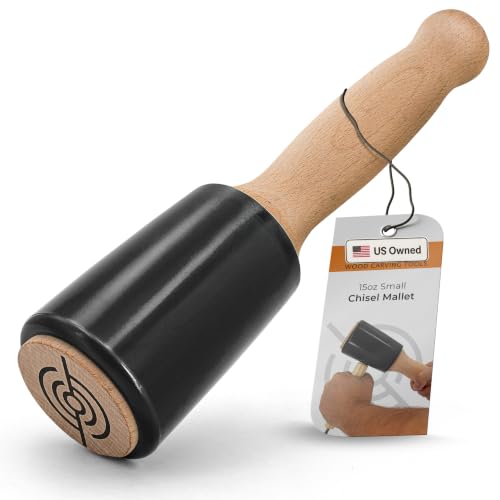
The Wood Is Good WD202 is the heavyweight of this roundup and the premium pick. Its 30 oz class head is molded from tough urethane that the maker describes as unbreakable, engineered to be quiet while still transmitting the maximum blow to the tool. That suits the hardest striking jobs in a woodworking shop: driving large mortise and timber chisels and working a froe, tasks where a wooden head would eventually split or wear. The urethane face is also gentle on chisel handles relative to its weight.
The handle is turned from selected New England hardwood and polish sanded, with a contoured grip, and the head measures 3 1/2 inches in diameter. The listing’s technical details put the item weight at about 1.61 pounds despite the 30-ounce class rating, a discrepancy worth knowing about: the rating reflects the maker’s weight class rather than a scale figure. Even so, it remains the hardest-hitting mallet here, and the one to choose when lighter mallets bounce off the work.
How to Choose a Wooden Mallet
Weight comes first. Mallets near 11 ounces, like the Narex 825100, suit carving and detail chisel work. The 15 to 21 ounce middle range covers general bench chisels, mortise work in furniture-scale stock, and most assembly tapping. Mallets in the 30 oz class are specialty tools for large mortise and timber chisels and froe work; they are tiring and imprecise for fine cuts. Match the mallet to the heaviest job it will do weekly.
Head material comes second. Solid beech, as on the Narex and Crown mallets, gives the traditional firm, direct blow and a face that can be dressed flat again when it wears. Urethane heads, as on the Schaaf and Wood Is Good mallets, strike more quietly, resist splitting, and are kinder to chisel handles, at the cost of a slightly softer feel. Head shape matters too: round turned heads suit carving because they land squarely from any angle, while flat-faced joiner’s heads suit bench chisels and assembly.
Finally, check the handle and dimensions. A mallet between 10 1/2 and 12 inches long balances reach and control for bench work. Where a maker does not publish a figure, such as the Crown 106’s weight, treat it as not stated rather than assuming it matches a similar-looking model.
Who Should Skip These Mallets
Skip this roundup if the striking work is mostly metal. Driving cold chisels, nail sets, and steel punches calls for a brass, rawhide, or dead blow mallet, and striking steel with a wooden face will chew the face up quickly. Skip it as well if the main job is demolition, framing, or driving stakes, where a steel hammer is the right tool.
Also skip the heavier picks here if the work is fine detail carving: a 21 or 30 oz mallet makes delicate gouge control harder, not easier. And if the shop already owns a sound joiner’s mallet with an undamaged face, none of these is an urgent purchase; a worn wooden face can usually be dressed flat again first.
FAQ
What weight wooden mallet is best for chisel work?
For general bench chisels, a mallet in the 15 to 21 ounce range is the most versatile choice, heavy enough to chop mortises in furniture stock without exhausting the arm. Drop to about 11 ounces for carving, and reserve 30 oz class mallets for large mortise and timber chisels.
Is a urethane mallet head better than a wooden one?
Neither is better outright. Urethane heads, like those on the Schaaf and Wood Is Good mallets, are quieter, resist splitting, and are gentle on chisel handles. Wooden beech heads give a firmer, more direct blow and can be dressed flat when they wear. Choose by noise and feel.
Can a wooden mallet damage chisel handles?
A wooden mallet is the striking tool least likely to damage a chisel handle, which is why it is the standard choice for the job. Damage usually comes from steel hammers or from a mallet face that has split, so inspect the face and dress it flat if it roughens.
How long does a wooden mallet last?
A solid beech mallet used on wooden chisel handles typically lasts for years of regular shop work. The face wears gradually and can be flattened again with a plane or coarse sandpaper. Urethane heads last longer still under heavy striking.
Conclusion
For a single general-purpose wooden mallet, the Crown 106 covers the widest range of bench work with its traditional flat-faced beech head. Carvers should choose between the light Narex 825100 for detail work, the quiet Schaaf 15 oz, and the turned Narex 825702 when waste has to move quickly. When the work turns to large mortise and timber chisels, the Wood Is Good WD202 is the hardest hitter here and the one built to survive it.
Product and ASIN Reference
Product
ASIN
Narex Beech Wood Carving Mallet 825100
B0012YYI1U
Schaaf Tools Precision Wood Carving Mallet
B0DB2XK5TZ
Crown 106 Beechwood Mallet
B002S0OIW6
Narex Round Turned Carving Mallet 825702
B018JOUYG8
Wood Is Good WD202 Mallet
B002LVUWQS
J
JD's Woodworks Editorial Team
We compare specs, warranty terms, long-term owner feedback and street pricing before anything earns a spot. Rankings are never paid.
Affiliate disclosure. As an Amazon Associate we earn from qualifying purchases at no extra cost to you. Prices accurate as of the date shown.
Find the best tools for car wrapping, from felt squeegees and wrap knives to heat guns and complete kits, and choose the right set for a smooth finish.
Find the radiator hose clamps best for leak-free cooling: worm-gear, T-bolt and spring picks sized for upper and lower radiator hoses, plus a sizing guide.
Find the best brake caliper press tool for smooth, even piston compression. Compare ratcheting presses, dual-piston tools, and spreaders for your brake job.
Compare three Japanese water stones for chisels and plane irons, from a King combination stone to a splash-and-go Shapton, with grit and soaking guidance.
Compare three carving knife kits built around basswood blanks, with guided projects, stropping gear and safety extras, plus criteria for choosing well.
Compare four chip carving knives for lettering by edge shape, steel and handle, from a skewed BeaverCraft C6 to a Swiss Pfeil, for plaques, signs and lids.
The best spindle sanders for guitar making shape cutaways, waist curves, and neck heels cleanly. Compare five benchtop and portable picks by drum size.



 Wood Is Good WD202 Mallet