Best MIG Welding Machine: 4 Picks for Home Shops and Light Fabrication
Compare the best MIG welding machines for home shops: 120V and dual-voltage picks from Hobart, Miller and YESWELDER, with duty cycle and thickness guidance.
Compare the best MIG welding machines for home shops: 120V and dual-voltage picks from Hobart, Miller and YESWELDER, with duty cycle and thickness guidance.
As an Amazon Associate I earn from qualifying purchases. This post may contain affiliate links at no extra cost to you.
As an Amazon Associate we earn from qualifying purchases.
A MIG welding machine earns its place in a small shop by doing one job well: feeding wire smoothly, holding a stable arc on the thicknesses you actually weld, and running on the power you actually have. Two machines can claim a similar maximum amperage while behaving very differently on thin sheet, on a long run of quarter-inch steel, or on a shared household circuit.
This guide compares four wire-feed machines that cover the realistic range for a home workshop, a farm shop, and light fabrication work. Two are straightforward MIG and flux-core machines from Hobart, one is a dual-voltage inverter from Miller with automatic setup features, and one is a higher-output multi-process unit from YESWELDER where MIG is the headline process. Every pick below is a genuine MIG machine — gas-shielded solid wire and self-shielded flux-core are both supported — and the multi-process model is flagged as such so there is no confusion about what you are buying.
The short version is this: if your shop only has household power and your work is sheet metal, brackets, gates, and repairs up to a quarter inch, a good 120-volt-class machine is enough and will be easier to live with. If you regularly weld thicker steel, want to work away from a single outlet, or expect your projects to grow, a dual-voltage machine that can run on both standard and higher-voltage circuits gives you headroom without forcing a second purchase later. Output, duty cycle, and wire handling matter more than a long feature list, and the sections below explain how to weigh them before the detailed picks.
Figures in this table come from manufacturer specifications and listing details; confirm the exact configuration and included accessories on the live listing before ordering, because bundles and included guns, regulators, and leads can vary by seller.
How to choose a MIG welding machine
Start with your power supply, not the amperage headline
The single most practical question is where the machine will plug in. A 115- or 120-volt machine runs from a standard household outlet, which makes it the natural choice for a garage without a dedicated high-voltage receptacle. The trade-off is a ceiling on output and on the thickness you can weld in a single pass. Dual-voltage machines solve that by accepting both: run them on household power for thin work near the house, then move to the higher-voltage circuit when a project calls for thicker steel. If you already have, or can add, a suitable higher-voltage outlet in the shop, a dual-voltage pick is usually the longer-lived purchase. If you cannot, there is no shame in the smaller machine — an undersized outlet will limit a big welder far more than a modest rating limits a small one.
Match output and duty cycle to your thickest regular job
Amperage range tells you the span the machine can deliver; duty cycle tells you how long it can sustain a given output before resting. A rating such as 20 percent at 90 amps means two minutes of arc time in a ten-minute window at that output. For short tacks, brackets, and repairs, a modest duty cycle rarely matters because you stop to reposition and clamp far more often than you weld continuously. For long seams on thicker material, duty cycle becomes the real limit. Choose for the thickest job you do regularly, not the thickest job you can imagine once — multi-pass technique extends what a smaller machine can join, at the cost of time.
Wire, drive system, and spool size decide day-to-day smoothness
Most feeding frustration traces back to the drive system and wire path rather than the power source. A cast aluminium drive housing, a quick-change drive roll that matches your wire size, and a gun liner in good condition do more for consistent feeding than any display feature. Check which wire diameters the machine accepts — the picks here cover the common solid and flux-core sizes used for mild steel, plus aluminium wire where a spool gun is supported — and whether it takes the spool sizes you prefer. Larger spools mean fewer changes on repetitive work; smaller spools keep wire fresher if you weld infrequently. If aluminium is on your project list, confirm spool-gun compatibility rather than assuming the standard gun will feed soft wire reliably over its full length.
Gas MIG versus flux-core is a working-condition choice
With gas shielding and solid wire, MIG produces cleaner beads with less spatter and less cleanup, which suits visible work, painted assemblies, and indoor benches. Flux-core wire carries its own shielding, tolerates outdoor air movement and less-than-perfect surface preparation better, and needs no gas bottle — which is why every machine here supports both. Many owners start with flux-core because the setup is simpler, then add a bottle and solid wire when finish quality starts to matter. Neither is universally better; the right default is the one that matches where you weld and how much cleanup you accept.
Controls: tapped settings versus automatic setup
Traditional machines use a voltage tap selector plus a wire-feed dial. That arrangement is predictable, repairable, and easy to learn from the chart inside the door. Newer inverter machines add automatic or synergic setup: you select the material and thickness, and the machine proposes voltage and wire speed, which you can then trim. Automatic setup shortens the learning curve and speeds up changeovers between thicknesses, but it does not replace understanding what a good bead looks and sounds like. If several people share the machine, or you switch materials often, guided setup is a genuine convenience. If you weld one thickness of steel most days, simple tapped controls lose very little.
Weight and portability are not the same thing
A transformer-style machine in the 55-to-80-pound range is movable, but you will plan those moves and probably want a cart. A modern inverter at roughly half that weight changes how you work: carrying it to a gate or trailer becomes routine. Consider gun length as part of portability too — a longer gun lets the power source stay put while you work around a larger assembly. And budget space for the bottle if you run gas; the bottle, regulator, and hose are part of the real footprint.
The picks in detail
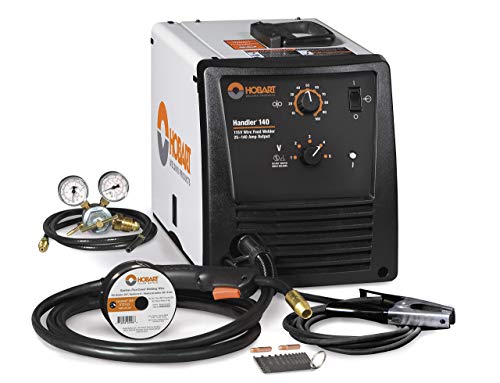
Hobart Handler 140 — the household-power starting point
Top Pick
Hobart Handler 140 — the household-power starting point
The Handler 140 (model 500559) is the classic first MIG machine formula: a 115-volt wire-feed welder with a 25-to-140-amp output range, five voltage settings, and infinite wire-feed adjustment within that range. Hobart rates it for mild steel from 24 gauge up to a quarter inch, which covers the bulk of home, farm, and light automotive work — patch panels, exhaust repairs, brackets, frames for carts and stands, and general fabrication in square tube and angle.
Two details explain its long popularity. First, the industrial cast aluminium drive system with a quick-select drive roll is a step above the plastic feed assemblies on the cheapest wire welders, and consistent feeding is exactly what a beginner needs while learning. Second, the package is genuinely ready to weld flux-core out of the box, with a 10-foot MIG gun, work cable and clamp, and a dual-gauge regulator and gas hose included for when you add a bottle and switch to solid wire. It is spool-gun ready as well, which gives aluminium work a workable path later.
The limits are the honest ones for its class. The 20 percent duty cycle at 90 amps suits intermittent work, not continuous production seams, and 57 pounds makes it portable in the sense that one person can move it, not in the sense that you will carry it far for fun. There is no higher-voltage option, so its ceiling is fixed. Within those limits, it remains the pick to beat for a first machine on household power: simple controls, a maker-stated specification you can verify, and a thickness range that matches what most home shops actually weld.
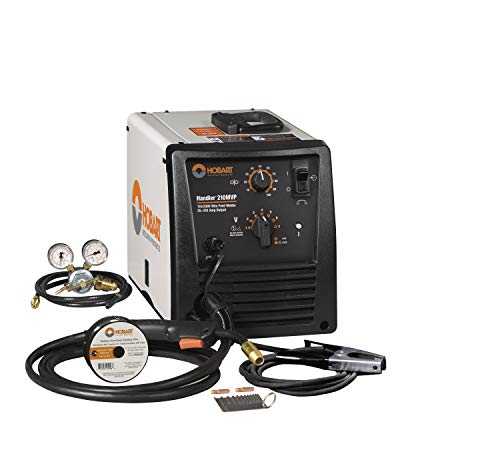
Hobart Handler 210 MVP — dual voltage without leaving the portable format
Runner-Up
Hobart Handler 210 MVP — dual voltage without leaving the portable format
The Handler 210 MVP (model 500553) answers the obvious follow-up question: what if the 140-amp class is nearly enough, but not quite? Its multi-voltage plug system lets the same machine run on 115-volt or 230-volt power with a simple plug swap, and output rises with the supply — up to 140 amps on the lower voltage and 210 amps on the higher one. Hobart rates it for steel from 24 gauge to three-eighths of an inch in a single pass, which moves gates, heavier brackets, trailer work, and farm repairs from multi-pass patience into straightforward single-pass territory.
Control steps up accordingly, with seven voltage settings on the higher-voltage side and four on the lower, plus infinite wire-feed control. The drive system is again a cast aluminium industrial unit with a quick-select roll, the gun is a 10-foot unit, and the regulator, gas hose, and sample flux-core spool are included. Spool-gun circuitry is built in for the optional spool gun, so aluminium feeding is supported by design rather than by workaround.
At 79 pounds this is the heaviest pick here, and it should be chosen for its output-per-case-size rather than its carry comfort — a cart is the natural companion. It also keeps tapped voltage control rather than automatic setup, which some buyers will prefer for its predictability and others will see as dated next to the Miller below. As a long-term single purchase for a shop that has, or plans to add, a higher-voltage outlet, it is the most conservative upgrade path in this group: same brand logic, same wire and consumable habits, substantially more headroom.
Miller Millermatic 211 PRO — the guided-setup dual-voltage inverter
Miller Millermatic 211 PRO — the guided-setup dual-voltage inverter
The Millermatic 211 PRO (model 907839) is the modern interpretation of the same dual-voltage idea. It runs on 120- or 240-volt power through multi-voltage plugs, delivers a 30-to-230-amp range, and Miller rates it for steel from 24 gauge to three-eighths of an inch on the higher voltage, with aluminium capacity in the same range when set up correctly. Where it separates itself is duty cycle and weight: the manufacturer specification lists 60 percent duty cycle at useful outputs on both voltages, and the inverter design brings net weight down to about 35 pounds — less than half the Handler 210 MVP — which changes how often the machine gets moved to the work instead of the work being dragged to the machine.
Setup help is the other headline. Auto-Set provides predefined settings by material and process, pulsed MIG is available for suitable work, and the machine auto-detects a connected spool gun. The included gun is a longer 15-foot MDX-100, which pairs well with the light chassis: leave the power source by the outlet and walk the gun around a frame or vehicle. A flow-gauge regulator and gas hose are included in the standard package description, and program memory and software-update support reflect its newer platform.
The cautions are about configuration, not capability. Confirm exactly which package the listing describes — base machine versus running-gear bundles differ — and remember that aluminium still requires the appropriate spool gun and gas setup, sold separately. Buyers who prefer purely manual tapped controls may also find the feature set more than they need. For a shop that welds varied thicknesses, shares the machine between users, or wants the strongest duty-cycle figures in this comparison, it is the most complete pick here.
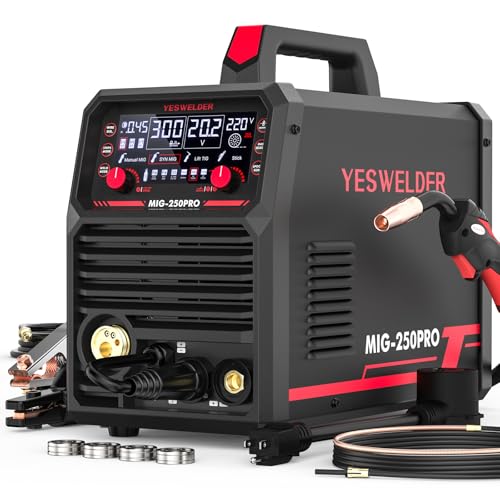
YESWELDER MIG-250 PRO — highest output, explicitly multi-process
YESWELDER MIG-250 PRO — highest output, explicitly multi-process
The MIG-250 PRO is included with a clear label: this is a multi-process machine in which MIG is the primary, headline function, not a MIG-only box. Its listed modes cover gas MIG, pulsed MIG, flux-core, spool-gun MIG, lift TIG, and stick, with up to 250 amps of MIG output on 220-volt power and reduced output on 110-volt power. A digital display and synergic control — where selecting material thickness drives starting settings — aim to make that output approachable, and spool-gun compatibility addresses aluminium feeding directly.
On paper it offers the most headroom in this group, and at roughly 32.5 pounds it does so in an inverter package that is easy to store and move. The wire range covers the common solid, stainless, and flux-core sizes, with aluminium wire handled through the spool gun. For a buyer who genuinely expects to use stick for outdoor repairs or lift TIG occasionally, consolidating those processes into one chassis can be the deciding argument, and the MIG side does not appear to be an afterthought: pulsed MIG and synergic modes are features the dedicated machines above mostly do not offer at this output.
The trade-offs are equally clear. The TIG torch and spool gun are separate purchases, so the full multi-process promise costs more than the base box. A newer brand also means a shorter long-term track record than the Hobart and Miller names, and buyers who value a local dealer network should weigh that. Choose this pick for maximum output and process flexibility per machine; choose one of the dedicated MIG picks above if you want the narrowest, simplest tool for wire-feed work alone.
Frequently asked questions
Can a 120-volt MIG machine weld a quarter inch of steel?
Yes, within limits. The 140-amp-class pick here is maker-rated to a quarter inch of mild steel, and the dual-voltage machines exceed that figure on their higher-voltage supply. In practice, joint preparation, a bevel on thicker sections, correct wire and settings, and accepting a modest duty cycle matter as much as the headline rating. If quarter-inch work is your daily norm rather than your occasional maximum, a dual-voltage machine run on the higher-voltage circuit will do it with less waiting.
Do I need a gas bottle to start MIG welding?
No. Every pick here welds with self-shielded flux-core wire and no bottle, and the Hobart packages include a sample flux-core spool. Gas-shielded solid wire gives cleaner results with less cleanup and is worth adding when finish matters, but it is an upgrade to a working setup, not a prerequisite for one.
What is a spool gun, and do I need one?
A spool gun carries a small spool of wire in the gun itself, shortening the feed path. That matters for soft aluminium wire, which can buckle in a long standard liner. If aluminium is a definite part of your plans, choose a machine with spool-gun support — all four picks here have a stated path — and budget for the gun separately, since it is not part of the standard packages described above.
Tapped controls or automatic setup for a first machine?
Both can teach you to weld. Tapped controls with a settings chart force you to learn the relationship between voltage and wire speed, and they remain predictable for years. Automatic or synergic setup gets a beginner to a workable bead faster and speeds up changes between thicknesses. Pick based on how varied your work is, not on which sounds more advanced.
Conclusion
There is no single best MIG welding machine here, only a best match for a power supply and a workload. The Hobart Handler 140 is the dependable household-power answer for sheet metal and quarter-inch repairs. The Hobart Handler 210 MVP keeps that same straightforward character and adds dual-voltage headroom up to three-eighths of an inch. The Miller Millermatic 211 PRO is the pick for guided setup, strong duty cycle, and genuine portability in one dual-voltage inverter. The YESWELDER MIG-250 PRO, clearly a multi-process machine with MIG at its centre, offers the highest output and the widest process list for buyers who will use them.
Whichever you choose, verify the package contents, voltage plugs, and included regulator and gun on the live listing before purchase, confirm your circuit can supply the machine, and start with the manufacturer’s settings chart for your wire and thickness. A well-matched modest machine used weekly builds more skill than an oversized one waiting for an outlet that never gets installed.
Disclosure
Disclosure: This article contains affiliate links. If you buy through those links, a commission may be earned at no additional cost to you. Product information was taken from the listings and manufacturer details available at the time of writing, and specifications should be confirmed on the live listing before purchase.
J
JD's Woodworks Editorial Team
We compare specs, warranty terms, long-term owner feedback and street pricing before anything earns a spot. Rankings are never paid.
Affiliate disclosure. As an Amazon Associate we earn from qualifying purchases at no extra cost to you. Prices accurate as of the date shown.
Four hobby TIG welders compared for home shops: AC/DC picks for aluminum, a compact DC model for steel, listed specs, included gear and honest tradeoffs.
The best Creality Falcon engravers compared: Falcon A1 10W, CR-Laser Falcon 10W, Falcon2 Pro 22W and Falcon2 Pro S 40W, by power, work area and enclosure.
The best CNC machines for manufacturing compared: large-bed routers and closed-loop desktop mills with the work area, spindle and control for batch work.

 Hobart Handler 140 — the household-power starting point
 Miller Millermatic 211 PRO — the guided-setup dual-voltage inverter
 YESWELDER MIG-250 PRO — highest output, explicitly multi-process









