Best Milwaukee Air Compressors: One Tank Compressor and the Inflators Buyers Actually Find
Milwaukee makes one true tank air compressor, the M18 FUEL 2840-20 2-gallon quiet compressor. Compare it with the M18 and M12 Milwaukee inflators on pressure, airflow and fit.
Milwaukee makes one true tank air compressor, the M18 FUEL 2840-20 2-gallon quiet compressor. Compare it with the M18 and M12 Milwaukee inflators on pressure, airflow and fit.
As an Amazon Associate I earn from qualifying purchases. This post may contain affiliate links at no extra cost to you.
As an Amazon Associate we earn from qualifying purchases.
A Milwaukee air compressor search needs one fact stated plainly at the start, because it shapes everything that follows. Milwaukee makes exactly one true tank air compressor: the M18 FUEL 2 Gallon Compact Quiet Compressor, model 2840-20. It stores air in a 2-gallon tank, regulates that air down to tool pressure, and runs pneumatic nailers and staplers through a standard quick-connect coupler. Everything else Milwaukee sells in this space is an inflator — the M18 Inflator 2848-20 and the M12 Compact Inflator 2475-20 — and an inflator is a different machine. It has no tank, it cannot run a nailer, and it pushes air directly into a tire or inflatable until the target pressure is reached.
That distinction is not a reason to dismiss the inflators. Retailers group Milwaukee air compressors and inflators together, Amazon returns the inflators at the top of a Milwaukee air compressor search, and for many buyers the honest answer is an inflator, because topping off tires is the job they actually have. This guide covers all four genuine Milwaukee options: the one tank compressor for pneumatic tools, and the inflators — including the M12 kit — for tire work. Every pick is a real Milwaukee product, and the guide is explicit about which jobs each one can and cannot do. If the work involves a brad nailer, a finish nailer, or a stapler, only the first pick applies.
Quick comparison
Model
Type
Tank
Max pressure
Air delivery
Power
Weight
Milwaukee M18 FUEL 2840-20
Tank compressor
2 gallons
135 PSI
1.2 SCFM at 90 PSI
M18 battery, tool only
31.25 lb
Milwaukee M18 Inflator 2848-20
Tire inflator, no tank
None
150 PSI
Direct inflation
M18 battery, tool only
About 7.7 lb
Milwaukee M12 Compact Inflator 2475-20
Tire inflator, no tank
None
120 PSI
0.63 CFM at 35 PSI
M12 battery, tool only
3.83 lb
Milwaukee M12 Compact Inflator Kit 2475-21XC
Tire inflator kit, no tank
None
120 PSI
0.63 CFM at 35 PSI
M12, 4.0Ah battery and charger included
About 5 lb
The table makes the shape of the Milwaukee line obvious. There is one compressor decision — the 2840-20, bought bare — and three inflation decisions split by battery platform and by whether a battery and charger are in the box. Choosing well is mostly a matter of naming the job correctly before choosing the tool.
How to choose a Milwaukee air compressor
Tank compressor or inflator: settle this first
A tank compressor stores compressed air, so a tool can draw short, heavy bursts — a nail driven in a fraction of a second — while the pump refills the tank between bursts. That stored-air design is what pneumatic tools are built around. A regulated outlet, a quick-connect coupler, and a tank gauge are the visible signs of the type. The Milwaukee 2840-20 is the only Milwaukee product with all three.
An inflator has no stored air to give. Its pump runs while it fills, output falls as pressure rises, and its controls are built for a different task: set a target pressure, attach the chuck to a valve stem, and let the machine stop itself at the target. Inflators carry duty-cycle limits for continuous running, and connecting one to a nailer does not work in any useful sense. Buyers who need both jobs need the compressor for the tools and can treat tire filling as a secondary use of its regulated air with a suitable blow gun or tire chuck accessory, or carry a dedicated inflator as well.
Airflow at 90 PSI is the compressor figure that matters
For the 2840-20, the deciding specification is air delivery: 1.2 SCFM at 90 PSI, and 1.7 SCFM at 40 PSI in Milwaukee’s manual figures. That output suits the intermittent tools Milwaukee designed it for — 18-gauge brad nailers, finish nailers, and staplers — and Milwaukee rates the machine at up to 1,600 18-gauge brad nails per charge on a high-output M18 battery. It is not a framing-production compressor, it will not keep up with an air sander or a spray gun that draws air continuously, and no specification in its documentation suggests otherwise. Buyers whose tool list is continuous-draw should look outside the Milwaukee line entirely, because Milwaukee sells no larger tank compressor to step up to.
Pressure ratings mean different things on each type
The compressor’s 135 PSI maximum is tank pressure, regulated down to whatever the tool needs. The inflators advertise higher or similar numbers — 150 PSI for the M18 Inflator and 120 PSI for the M12 — but those are maximum inflation pressures against a tire, not a supply of air at that pressure for tools. A 150 PSI inflator is not stronger than a 135 PSI compressor in any sense a nailer cares about. For tires, though, the inflator figures are the right ones to compare: the M18 model’s ceiling covers light-truck tires comfortably, and the M12 model’s 120 PSI covers passenger tires, bicycles, and sports equipment with room to spare.
Noise: the compressor’s genuine headline
The 2840-20 runs at 68 dBA in Milwaukee’s specification, which Milwaukee positions as the quietest cordless compressor figure on the market and quieter than most corded compressors. For the woodworking and remodeling work this site covers — trim and cabinetry installed in finished, occupied rooms — that figure is the practical reason to choose this machine over a louder corded pancake compressor. The inflators make no comparable quiet claim; they run briefly per tire rather than cycling through a workday, so noise matters less in their case.
Battery platform decides the inflator, and the bare-tool question decides the rest
Milwaukee’s M18 and M12 batteries do not interchange. The 2840-20 and the 2848-20 run on M18 packs; the 2475-20 and its kit run on M12 packs. Every Milwaukee air product in this guide except the M12 kit is sold as a bare tool, so the real purchase is complete only if the buyer already owns a suitable battery and charger on that platform. Compressor runtime in particular rewards a larger high-output M18 pack, since the pump draws hard while refilling the tank. A buyer with no Milwaukee batteries at all should treat the M12 kit below as the one self-contained option here, and should price an M18 battery and charger into either M18 pick before comparing totals.
The 2840-20 is the Milwaukee air compressor in the strict sense, and the pick for any buyer whose sentence includes a pneumatic tool. Its 2-gallon tank holds air at up to 135 PSI, a single-turn regulator sets the outlet pressure, and a quarter-inch quick-connect coupler takes standard nailer and stapler fittings. Air delivery is 1.2 SCFM at 90 PSI, which matches the intermittent demand of brad nailers, finish nailers, and staplers, and Milwaukee’s stated runtime figure is up to 1,600 18-gauge brad nails per charge with a high-output M18 battery fitted.
The specification that earns this machine its place in finished interiors is noise: 68 dBA, with an oil-free pump that needs no oil changes and keeps the output air clean. The POWERSTATE brushless motor, steel tank, and roll-cage style frame are built for transport between rooms and sites, and the low, stackable profile is sized to sit on top of a rolling tool stack. At 31.25 pounds bare and roughly 16 by 19 by 11 inches, it is a carry-by-hand machine rather than a fixed shop installation, which is the correct trade for a 2-gallon trim compressor.
The limits deserve the same clarity. Two gallons and 1.2 SCFM will not run a sander, a spray gun, or a framing crew at production pace, and Milwaukee offers no bigger Milwaukee-branded tank machine to graduate to. The tool is sold bare, so M18 owners are the natural buyers; everyone else must add a battery and charger. Milwaukee covers it with a three-year limited warranty. For a carpenter, remodeler, or woodworker already on the M18 platform who runs trim nailers in occupied spaces, this is not merely the best Milwaukee compressor — it is the only one, and its quiet figure makes it a competitive cordless trim compressor in its own right.
The 2848-20 is Milwaukee’s larger inflator, and it appears in this guide because a Milwaukee air compressor search returns it ahead of the tank compressor — and because, for tire work, it is the stronger tool. It has no tank and cannot run pneumatic tools, a limit this guide states rather than softens. What it does is inflate tires quickly and precisely: a maximum of 150 PSI, a maker claim of topping off a 33-inch light-truck tire in under one minute, and TrueFill technology that checks pressure as it fills and shuts off automatically at the target the user sets.
Practical details suit vehicle use. The hose is 36 inches, the Schrader chuck is all brass, four programmable pressure presets store the values a household or work truck uses repeatedly, anti-vibration feet keep the unit settled while it runs, and the listed package includes an inflation needle, an inflator nozzle, and a Presta chuck alongside the Schrader fitting, so bicycle tires and sports equipment are covered as well as vehicle tires. At about 7.7 pounds it lives in a truck cab or a garage corner without complaint.
It runs on the same M18 batteries as the 2840-20 and is sold as a bare tool. A shop or household already holding M18 packs for the compressor can add this inflator with no new battery investment, which is the most sensible way to buy it. Buyers whose only air job is tires should choose this over the compressor without hesitation: it is smaller, lighter, reaches higher tire pressures, and its automatic shut-off does the one job a compressor does clumsily. Buyers who need a nailer to fire should not mistake it for a compressor, whatever the search results call it.
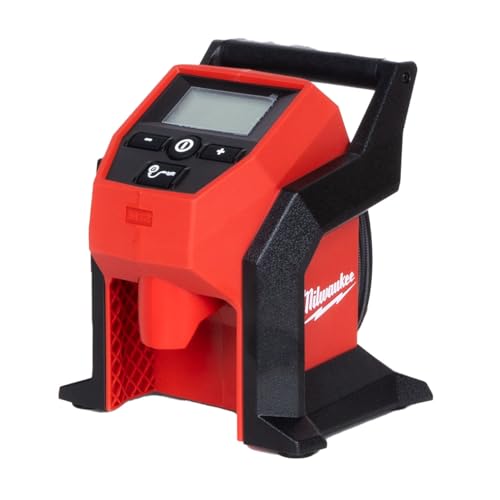
The 2475-20 is the compact end of Milwaukee air: a 3.83-pound M12 inflator built to ride in a vehicle or a small tool bag and top off tires where they stand. Its ceiling is 120 PSI, and its published delivery figures are 0.88 CFM at 0 PSI and 0.63 CFM at 35 PSI. Milwaukee’s speed claims for it are a car tire topped off from 28 to 35 PSI in under one minute and a light-truck tire filled from 30 to 45 PSI in under four minutes, which covers the realistic roadside and driveway work this size of tool is bought for.
Controls and fittings follow the same pattern as the larger inflator in miniature. The gauge is rated accurate to within three percent, the hose is 26 inches with an all-brass Schrader chuck, and the package includes a ball inflation needle, a Presta chuck, and an inflator nozzle. A reinforced cage gives the small body weather and impact resistance for vehicle storage. The honest limit is the duty cycle, rated at 50 percent: this is a top-off tool used in short runs, not a machine for inflating a fleet or seating tires all afternoon, and it has no tank and no tool outlet of any kind.
As a bare tool it makes the most sense for M12 owners, who can treat it as a small addition to a platform they already power. For a woodworker, it is the glovebox companion rather than a shop machine: the tool that keeps the truck, the trailer, and the family car at pressure so the shop compressor — Milwaukee or otherwise — can stay in the shop. Buyers choosing between the two inflators should let the battery platform decide first and tire size decide second; the M18 model is faster and stronger, and this one is smaller, lighter, and cheaper to feed if M12 packs are already on the shelf.
The 2475-21XC kit is the same M12 Compact Inflator as the pick above, sold as a complete package instead of a bare tool: the 2475-20 inflator, one M12 REDLITHIUM XC 4.0Ah battery, an M12 charger, and the same needle, Presta chuck, Schrader chuck, and inflator nozzle set. Every performance figure carries over unchanged — 120 PSI maximum, 0.63 CFM at 35 PSI, a 26-inch hose, and the same sub-one-minute car tire top-off claim — because the tool itself is identical, and this guide lists the kit separately only because the buying decision is different.
That decision matters for exactly one audience: a buyer with no M12 batteries. For that buyer, the bare 2475-20 is not a working purchase until a battery and charger are added, while this kit inflates a tire on the day it arrives, and the XC 4.0Ah pack it includes is a sensible capacity for an intermittent tool.
M12 owners should skip it and buy the bare tool above; paying for a second charger and a duplicate battery only makes sense if the extra pack earns its keep elsewhere. New buyers should also note what the kit does not change: this is still a tankless inflator with a 50 percent duty cycle, suited to tires and inflatables and to nothing with a quick-connect fitting. It is the self-contained way into Milwaukee air for tire work, presented as a kit rather than a fourth machine because that is what it is.
FAQ
Does Milwaukee make a real air compressor, or only inflators?
Both, but the compressor side of the line is a single model. The M18 FUEL 2840-20 is a genuine tank compressor with a 2-gallon tank, a regulator, and a quick-connect outlet for pneumatic tools. The 2848-20 and 2475-20 are inflators: capable tire tools with no tank and no ability to run a nailer or stapler. Any Milwaukee air buying decision starts by separating those two categories.
Can the Milwaukee M18 Inflator run a brad nailer?
No. The 2848-20 has no tank, no regulator, and no quick-connect tool outlet, and its pump delivers air directly into a tire against rising pressure. A nailer needs stored air delivered in bursts at a regulated pressure, which is the 2840-20 compressor’s design. The inflator’s 150 PSI rating is an inflation ceiling, not a tool supply figure.
How many nails can the 2840-20 drive per charge?
Milwaukee’s stated figure is up to 1,600 18-gauge brad nails per charge, specified with a high-output M18 battery. Smaller or older packs will return fewer nails, and finish nails, staples, and colder conditions all change the count, so the figure is best read as the ceiling for light trim work rather than a guarantee for every fastener type.
Which Milwaukee inflator is better, the M18 or the M12?
The M18 Inflator 2848-20 is the stronger tool: 150 PSI against 120 PSI, a longer 36-inch hose against 26 inches, programmable presets, and faster claims on large light-truck tires. The M12 Compact Inflator 2475-20 is smaller and lighter at 3.83 pounds and suits car tires and glovebox storage. For most buyers the deciding factor is simpler than the specifications — M18 and M12 batteries do not interchange, so the platform already owned should choose the inflator.
Are any of these Milwaukee air tools sold with a battery?
Only one configuration in this guide: the M12 Compact Inflator Kit 2475-21XC, which includes an XC 4.0Ah M12 battery and a charger. The 2840-20 compressor, the 2848-20 inflator, and the bare 2475-20 inflator are all tool-only purchases, and their real cost to a buyer without the platform includes a battery and charger.
Conclusion
The best Milwaukee air compressor depends on saying the job correctly. For pneumatic tools there is one answer: the M18 FUEL 2840-20, a 2-gallon, 135 PSI, 1.2 SCFM compressor whose 68 dBA rating makes it the natural trim choice for M18 owners in finished spaces. For tires, the M18 Inflator 2848-20 is the faster, higher-pressure tool, the M12 Compact Inflator 2475-20 is the small vehicle companion for M12 owners, and the 2475-21XC kit is the same M12 inflator made self-contained for a buyer with no batteries. None of the inflators substitutes for the compressor, and the compressor is an expensive way to fill a tire. Match the machine to the work, confirm the battery situation before ordering, and check the live listing for the exact package contents.
Disclosure
Disclosure: This article contains affiliate links. If you buy through those links, a commission may be earned at no additional cost to you. Product information was taken from the listings and manufacturer details available at the time of writing, and specifications should be confirmed on the live listing before purchase.
J
JD's Woodworks Editorial Team
We compare specs, warranty terms, long-term owner feedback and street pricing before anything earns a spot. Rankings are never paid.
Affiliate disclosure. As an Amazon Associate we earn from qualifying purchases at no extra cost to you. Prices accurate as of the date shown.
Four hobby TIG welders compared for home shops: AC/DC picks for aluminum, a compact DC model for steel, listed specs, included gear and honest tradeoffs.
The best Creality Falcon engravers compared: Falcon A1 10W, CR-Laser Falcon 10W, Falcon2 Pro 22W and Falcon2 Pro S 40W, by power, work area and enclosure.
The best CNC machines for manufacturing compared: large-bed routers and closed-loop desktop mills with the work area, spindle and control for batch work.

 Milwaukee M18 FUEL 2 Gallon Compact Quiet Compressor (2840-20)
 Milwaukee M18 Inflator (2848-20)
 Milwaukee M12 Compact Inflator (2475-20)
 Milwaukee M12 Compact Inflator Kit (2475-21XC)









