As an Amazon Associate I earn from qualifying purchases. This post may contain affiliate links at no extra cost to you.
A Milwaukee portable band saw is built to be carried to the work, and that freedom is what makes some cuts awkward. Cutting small brackets, tubing, threaded rod ends, and shaped metal parts is harder when one hand holds the saw, the other holds the work, and neither hand is free to guide a line. A stand changes that balance. Mounted in a conversion table, the saw stays fixed and upright, and both hands can guide the workpiece into the cut, much like a small vertical band saw.
OUR TOP PICK
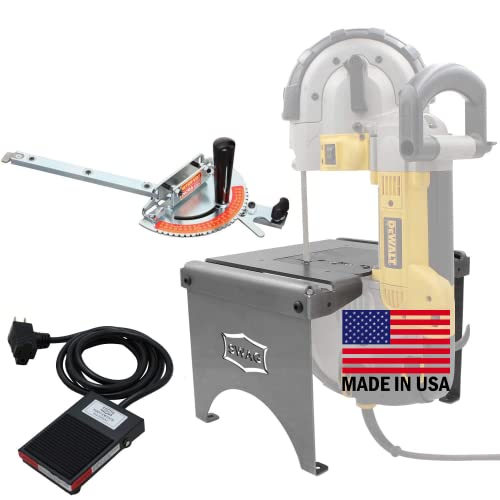
SWAG Off Road V3.0 Portaband Table With Miter Gauge
This guide covers only stands that genuinely hold Milwaukee portable band saws, a much thinner field than band saw stands in general. Milwaukee’s own portable band saw table, model 48-08-0260, is listed as discontinued by major distributors, so it is not included as a current buying option. The current, verifiable options come from SWAG Off Road, whose portaband tables are built around Milwaukee deep cut saws, including corded models and the M18 FUEL deep cut line. The three tables below differ in design, miter support, and mounting style.
As an Amazon Associate, we earn from qualifying purchases.
How to Choose
Start with exact saw compatibility
Compatibility is the first and least forgiving check. A portaband table is not a universal cradle. It bolts to specific mounting points on a specific saw body, usually after the factory foot guard is removed, so a table shaped for one saw family may not line up with another at all. For Milwaukee owners, the key split is between deep cut models and compact or sub-compact models. The tables in this guide are built for deep cut Milwaukee saws. SWAG lists Milwaukee corded deep cut models such as the 6232-20, 6232-21, 6238-20, and 6238-21 for its V4.0 table, and a longer list of earlier deep cut models for its V3.0 table, including the 6230, 6232, 6236, and 6238 families and the 0729-20 and 0729-21 cordless models. The V4.0 listing also names the Milwaukee M18 FUEL deep cut saws, models 2729-20, 2729-21, and 2729-22.
Owners of a Milwaukee compact or M12 sub-compact saw should not assume any of these tables will fit. The compact saws use a smaller frame, a shorter blade, and different mounting points, and these deep cut tables do not list them as compatible. Checking the exact model number against the fit list, before ordering, prevents the most common mistake in this category.
Decide how the stand will be mounted
The three tables here hold a saw in two different ways. The V1.0 design is a vise-mounted plate. It has no legs of its own and is meant to be clamped in a bench vise, which makes it compact to store and easy to move, but it also means cut quality depends partly on how solid that vise and bench are. The V3.0 and V4.0 designs use bolt-on steel legs, so the table stands on a bench on its own and can be shifted, leveled, or bolted down as the shop requires. A vise-mounted plate suits a small shop where bench space is shared and the saw needs to disappear into a drawer after use. A legged table suits a dedicated metal cutting corner where the saw can stay set up, aligned, and ready.
Look at the table surface and miter support
Once the saw is vertical, the table becomes the reference surface for every cut. The tables here are in the range of about 13.5 inches wide by 11 inches deep, which is enough for brackets, small plate, tubing, and bar stock, but not for large sheet work. That is the honest scale of a portaband conversion.
Miter support separates the models. Dual miter gauge slides, found on the V3.0 and V4.0 tables, let a miter gauge guide angled and repeat cuts instead of relying on a hand-drawn line. That matters for frame work, angled tube ends, and any job where the same angle is cut several times. The simpler V1.0 plate has no such slides, so angled work is guided by eye and by the layout line. Paying for miter slides only makes sense if angled or repeat cuts are part of the plan.
Consider blade access, the center section, and a foot switch
Small design details affect daily use. An improved blade slot with a narrow window, noted on the V3.0 and V4.0 tables, is intended to reduce blade binding. A removable center section, as on the V3.0, makes cleaning and blade changes easier without removing the whole saw. A fixed center section, as on the V4.0, removes a joint from the table surface.
A foot switch is the other practical consideration. It lets the saw be started and stopped while both hands stay on the workpiece, a real benefit on small parts. Several versions of these tables are sold with or without one, so buyers who want that feature should confirm whether the exact listing includes the switch, because SWAG sells the same tables in several configurations and the contents differ between them.
Be realistic about what a conversion stand can do
A stand does not change the saw itself. Cut capacity is still set by the saw’s throat and blade, and a converted portable saw is still not a floor-standing metal cutting band saw. What a stand adds is control: the work moves instead of the saw, small parts can be guided with both hands, and repeat cuts become easier to keep consistent.
SWAG Off Road V3.0 Portaband Table With Miter Gauge
Top Pick
SWAG Off Road V3.0 Portaband Table With Miter Gauge
The V3.0 is the most feature-complete of the three tables in this guide for a Milwaukee owner who wants guided, repeatable cuts. It is a legged table, CNC laser cut from steel plate, that converts a deep cut portable band saw into a small vertical band saw. Its defining features are the built-in dual miter gauge slides, the bolt-on steel legs, and a removable steel center section around the blade. The listing names a wide Milwaukee fit range covering older and newer corded deep cut models, plus the early cordless deep cut models, which makes it the natural first check for owners of an older Milwaukee deep cut saw that the newer V4.0 fit list no longer names.
In use, the dual miter slides are the reason to choose this model over the simpler V1.0. A miter gauge riding in a slide gives angled cuts a reference, so a tube end or bracket angle can be set once and repeated. The removable center section is a quieter benefit: blade changes and cleaning around the blade are routine on a vertical conversion, and removing that section makes both jobs simpler. The improved blade slot is designed to reduce blade binding, which matters most when feeding curved or thicker work.
The compromises are size and setup. At about 14 pounds before the saw is fitted, the assembled unit is a bench tool rather than something to carry around a site. Initial setup means removing the factory foot guard, fitting the center section, and securing the saw with the supplied hardware and thumb knob, the same knob that lets the saw come back off the table for handheld work.
Who It Suits
This table suits a Milwaukee deep cut owner who cuts angled or repeated parts and wants a miter gauge to guide them, and owners of older Milwaukee deep cut models whose model numbers appear on the V3.0 fit list but not on the narrower V4.0 list. It is less suited to a buyer who wants the smallest possible storage footprint, since the legged table takes up more room than the vise-mounted V1.0, and it is not a fit for compact or sub-compact Milwaukee saws.
The V4.0 is the newer design in the SWAG line and the one whose fit list speaks most directly to current Milwaukee owners. Its listing names the corded deep cut models 6232-20, 6232-21, 6238-20, and 6238-21, and the M18 FUEL deep cut models 2729-20, 2729-21, and 2729-22. For an owner of an M18 FUEL deep cut saw who wants a stand built and listed for that exact saw, this is the clearest match in this guide.
The construction follows the same formula as the V3.0, with a few changes. The table is made in the USA, CNC laser cut from 3/16 inch thick steel plate and formed on a CNC press brake. It keeps the dual miter gauge slides and uses 1/8 inch thick bolt-on steel legs, which can be removed for storage or transport. Where it differs is the center section: the V4.0 uses a fixed center section and an improved blade slot with a narrow window, intended to reduce blade binding, giving a simpler, uninterrupted table surface.
That narrower fit list is also the main caution. Owners of earlier Milwaukee deep cut models should compare their exact model number against both lists rather than assuming the newer table covers older saws. Versions of this table are also sold in powder coated and foot switch configurations under separate listings, so this plain table listing should not be assumed to include those extras.
Who It Suits
This table suits owners of a current Milwaukee M18 FUEL deep cut saw or a recent corded deep cut model named on its fit list, who want dual miter slides and a fixed center section in a legged bench table. It is a weaker choice for owners of older Milwaukee deep cut models that appear only on the V3.0 list, and it does not fit compact Milwaukee band saws.
The V1.0 is the simplest stand in this guide, and its simplicity is the point. Instead of legs, it is a heavy steel plate that clamps in a bench vise and turns a handheld deep throat band saw into a vertical saw. There are no miter gauge slides and no leg assembly. The saw bolts on with the included hardware after the factory foot guard is removed, the plate is gripped in a vise, and the cutting setup is ready. When the work is done, the plate comes out of the vise and stores flat, which no legged table in this guide can match.
That vise-mounted design shapes both its strengths and its limits. The storage footprint is tiny, the part count is low, and there is very little to assemble. The plate is CNC laser cut from alloy steel, described by its maker as a heavy-duty stand made in the USA, and its listing names Milwaukee among the compatible brands, alongside DeWalt, Makita, and Bosch. On the limiting side, stability depends on the vise and bench behind it. A light vise on a light bench will move under feed pressure in a way a legged table will not, and angled cuts are guided by a layout line rather than by a gauge. Its wider brand range can suit a mixed-brand shop, though a multi-brand plate may need minor fitting on some saws.
Who It Suits
This table suits a Milwaukee deep cut owner with limited bench space, a solid bench vise, and mostly straight or freehand-guided cuts, who wants the stand to store flat when it is not in use. It also suits a mixed-brand shop that wants one plate for more than one deep cut saw. It is less suited to work that needs repeatable angled cuts, where the miter slides on the V3.0 and V4.0 earn their place, and it is not a substitute for a legged table in a shop without a sturdy vise.
FAQ
Will these stands fit a Milwaukee M18 FUEL deep cut band saw?
The V4.0 table is the clearest fit, since its listing names the M18 FUEL deep cut models 2729-20, 2729-21, and 2729-22 directly. The V3.0 fit list covers earlier cordless deep cut models such as the 0729-20 and 0729-21, along with a long list of corded deep cut models. In both cases the exact model number on the saw should be matched against the table maker’s list before ordering, because deep cut fit is model specific and cannot be assumed from the Milwaukee name alone.
Do these stands fit Milwaukee compact or M12 band saws?
No fit for compact or sub-compact Milwaukee saws is listed for the tables in this guide. They are built for deep cut and deep throat portable band saws, which use a larger frame and different mounting points than a compact saw or an M12 sub-compact saw. Owners of those smaller saws should look for a stand whose fit list names their exact compact model, rather than adapting a deep cut table.
Does a stand change the cutting capacity of a Milwaukee portable band saw?
No. A stand changes how the saw is held and how the work is guided, not the saw’s own throat depth, blade length, or motor. Capacity stays whatever the fitted Milwaukee saw provides. What improves is control: the workpiece is fed into a fixed, upright blade with both hands, small parts are easier to guide, and a miter gauge on the V3.0 and V4.0 tables makes angled and repeat cuts easier to keep consistent.
What happened to Milwaukee’s own portable band saw table?
Milwaukee’s own table, model 48-08-0260, converted Milwaukee portable band saws into stationary units, could be bench mounted or used with pipe legs, and used a heavy-duty clamping chain to secure material. Major distributor listings now describe that model as discontinued, so it is not presented in this guide as a current option with a verified listing. Buyers who find old stock or a used example should check its fit against their saw’s model number, since it was designed around earlier Milwaukee band saw models such as the 6225, 6230, and 6236 families.
Final Verdict
For most Milwaukee deep cut owners, the SWAG V3.0 is the most complete stand in this guide. Its dual miter gauge slides, removable center section, and long fit list cover the widest range of saws and cuts, including older corded deep cut models. Owners of a current M18 FUEL deep cut saw should start instead with the V4.0, because its fit list names those exact models.
The V1.0 earns its place for a different reason: it is the stand for a small shop or shared bench, where a vise-mounted plate that stores flat is worth more than miter slides and legs. None of these tables fits a compact Milwaukee saw or increases cutting capacity. Judged on what a stand is for, holding a Milwaukee portable saw steady and upright so both hands can guide the work, all three do that job, and the right choice is the one whose fit list names the saw already in the shop.
Product and ASIN Reference
Product
ASIN
SWAG Off Road V3.0 Portaband Table With Miter Gauge
B00LBFQL9W
SWAG Off Road V4.0 Portaband Table
B00LBFQNHM
SWAG Off Road Portaband Table V1.0
B00LBFQBB0
J
JD's Woodworks Editorial Team
We compare specs, warranty terms, long-term owner feedback and street pricing before anything earns a spot. Rankings are never paid.
Affiliate disclosure. As an Amazon Associate we earn from qualifying purchases at no extra cost to you. Prices accurate as of the date shown.
Four hobby TIG welders compared for home shops: AC/DC picks for aluminum, a compact DC model for steel, listed specs, included gear and honest tradeoffs.
The best Creality Falcon engravers compared: Falcon A1 10W, CR-Laser Falcon 10W, Falcon2 Pro 22W and Falcon2 Pro S 40W, by power, work area and enclosure.
The best CNC machines for manufacturing compared: large-bed routers and closed-loop desktop mills with the work area, spindle and control for batch work.

 SWAG Off Road V3.0 Portaband Table With Miter Gauge
 SWAG Off Road V4.0 Portaband Table
 SWAG Off Road Portaband Table V1.0









