Key takeaways
- The best scroll saws for fretwork and intarsia compared on pinless blade changes, throat depth, arm tilt, vibration, and warranty for fine detail work.
What's inside
- Quick Answer
- Table of Contents
- 1. JET JWSS-18B — Best for Serious Intarsia
- 2. WEN LL2156 — Best Parallel-Arm Value
- 3. BUCKTOOL 22-Inch Scroll Saw — Deepest Throat
- 4. Shop Fox W1872 — Best Foot-Switch Control
- 5. Rikon 10-600VS — Best Budget Pick
- How to Choose a Scroll Saw for Fretwork and Intarsia
- Who Should Skip These Saws
- FAQ
- Conclusion
- Product and ASIN Reference
As an Amazon Associate I earn from qualifying purchases. This post may contain affiliate links at no extra cost to you.
Fretwork and intarsia place different demands on a scroll saw than general craft cutting. Fretwork means dozens of interior pierce cuts, so the blade has to come out and go back in quickly, without tools. Intarsia means bevel-cut segments that must fit together flush, so the way the saw tilts matters as much as the motor. Across both crafts, the features that decide the result are pinless blade support, low vibration, a variable-speed range with a slow bottom end, and enough throat depth for the panels on the pattern.
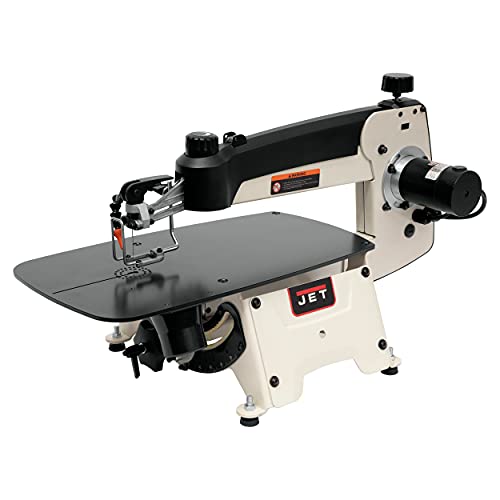

The five saws below were chosen for exactly those jobs, none of them drawn from the lineups in this site’s benchtop, beginner, or budget roundups. The JET JWSS-18B is the strongest all-round pick for serious intarsia because its arm tilts while the table stays flat. The WEN LL2156 brings parallel-arm manners and a 21-inch throat to the mid-range tier. The BUCKTOOL 22-inch offers the deepest throat here, the Shop Fox W1872 adds foot-switch control, and the Rikon 10-600VS covers the budget tier with a cast-iron base and a five-year warranty.
As an Amazon Associate, we earn from qualifying purchases.
Quick Answer
For most fretwork and intarsia work, choose the JET JWSS-18B: its tilting arm keeps intarsia segments flat, and its 2-in-1 clamp tensions pinless blades in one step. On a mid-range budget, the WEN LL2156 adds a 21-inch throat and parallel-arm action. The Rikon 10-600VS is the budget pick; the BUCKTOOL 22-inch suits oversize panels.
Table of Contents
- JET JWSS-18B
- WEN LL2156
- BUCKTOOL 22-Inch Scroll Saw
- Shop Fox W1872
- Rikon 10-600VS
- How to Choose
- Who Should Skip
- FAQ
- Conclusion
1. JET JWSS-18B — Best for Serious Intarsia
The JET JWSS-18B is a premium-tier saw built around the feature intarsia cutters value most: the arm tilts instead of the table. Because the workpiece stays flat while the blade angles, bevel-cut segments keep consistent mating angles and never slide mid-cut. JET’s manual lists the throat at 18-1/2 inches even though the saw is sold as an 18-inch model, and the thick steel table supports large panels.
The 2-in-1 upper mechanism clamps and tensions a pinless blade in a single step, and the lower holder is tool-free, so threading through drilled starter holes stays fast across a long pattern. The trade-off is that the saw takes pinless blades only, so pinned blades from a starter saw will not carry over.
Specs
- Throat depth: 18 in (manual lists 18-1/2 in)
- Motor: 1.3 A, 120 V
- Speed range: 400 to 1,550 SPM, variable
- Stroke length: 3/4 in
- Maximum cutting thickness: 2 in
- Table: steel, 11-5/8 x 21-1/4 in, 1/4 in thick
- Bevel method: arm tilts 45 degrees right and 30 degrees left, 45 degrees left with the dust port removed; table stays flat
- Blades: 5 in pinless (plain-end) only
- Weight: 54 lb
- Warranty: 5-year, 2-year for commercial use
2. WEN LL2156 — Best Parallel-Arm Value
The WEN LL2156 is a mid-range parallel-arm saw, and that linkage is why it suits fretwork: the blade stays close to vertical through the whole stroke, which keeps entry and exit points aligned on pierce cuts and reduces tapered kerf. Its 21-inch throat and wide steel table support larger plaques and panels that crowd a 16-inch saw.
Blade changes are tool-free through dual side panels, which keeps the rhythm of interior cutting moving, and the table bevels in both directions for intarsia work, 45 degrees left and 30 degrees right. Because the table tilts rather than the arm, bevel segments sit on a slope, so cutters who work mostly in bevel fits may prefer the JET or BUCKTOOL designs. The footprint is also the largest here, so bench space is a real consideration.
Specs
- Throat depth: 21 in
- Motor: 120 V, 1.2 A rated and 1.6 A maximum
- Speed range: 550 to 1,600 SPM, variable
- Cutting capacity: 2 in at 0 degrees, 3/4 in at 45 degrees
- Table: steel, 25-5/8 x 16 in, bevels 45 degrees left and 30 degrees right
- Design: parallel arm, tool-free blade changes via dual side panels
- Blades: pinless
- Weight: 53.8 lb
- Warranty: 2-year
3. BUCKTOOL 22-Inch Scroll Saw — Deepest Throat
The BUCKTOOL 22-inch, model SSA22, is the saw for fretwork panels that simply do not fit smaller machines: a 22-inch throat reaches the center of stock roughly twice that width as the work rotates. Like the JET, it bevels with its upper arm rather than the table, tilting 30 degrees left and 45 degrees right, so intarsia pieces stay flat on the cast-aluminum table. The upper arm also locks in a raised position, which speeds up threading a blade through starter holes.
The speed range starts at 360 SPM, the slowest bottom end in this group, which helps when following tight fretwork turns in thin stock. Two gaps in the published data are worth knowing: BUCKTOOL states neither a maximum cutting thickness nor a warranty term for this model, so confirm both before ordering rather than assuming figures from the smaller 18-inch saw.
Specs
- Throat depth: 22 in
- Motor: 1.3 A (1/5 HP), 120 V
- Speed range: 360 to 1,550 SPM, variable
- Table: cast aluminum, 27 x 13 in
- Bevel method: upper arm bevels 30 degrees left and 45 degrees right; table stays flat
- Blades: 5 in pinless; includes 15 TPI and 18 TPI pinless blades and a pinless blade holder
- Dust: adjustable blower, 1-1/2 in dust port
- Maximum cutting thickness: not stated
- Weight: 71.8 lb
- Warranty: not stated
4. Shop Fox W1872 — Best Foot-Switch Control
The Shop Fox W1872 is a budget-to-mid-range 16-inch saw whose headline feature for fretwork is the included foot switch. Starting and stopping the blade with a foot tap keeps both hands on the workpiece, which matters when a pattern has many short interior cuts and the piece cannot be allowed to drift at startup. A flexible rotary shaft, LED work light, and miter gauge round out a kit aimed at small-shop detail work.
The cast-aluminum table tilts from minus 5 to 45 degrees, and the saw accepts both pinned blades and pinless blades with the included pin-less adapter, so it grows with a cutter moving from pinned blades to fine pinless fretwork blades. The limits are the 16-inch throat, which caps panel size, and a shorter 9/16-inch stroke than the bigger saws here.
Specs
- Throat depth: 16 in
- Motor: 1/6 HP
- Speed range: 550 to 1,600 SPM, variable
- Maximum cutting thickness: 2-1/4 in
- Stroke length: 9/16 in
- Table: cast aluminum, tilts minus 5 to 45 degrees
- Blades: pinned and pinless, pin-less blade adapter included
- Dust port: 1-1/4 in
- Weight: 26 lb
- Warranty: 2-year
5. Rikon 10-600VS — Best Budget Pick
The Rikon 10-600VS covers the budget tier without giving up the two things fretwork cannot do without: pinless blade support and variable speed. Pinless holders are included, and the saw also accepts pinned blades, so it works with blade stock already on hand. A cast-iron base under the aluminum table adds the mass that damps vibration, which is the usual weakness of saws at this tier.
A gooseneck work lamp is built in, and there is a port for an optional flex shaft for rotary detail tools. The compromises are size: the 15-3/4-inch throat and the smallest table here limit panel dimensions, and the table tilts 45 degrees to the left only, so bevel work in the other direction means repositioning the piece. Against that, its five-year warranty matches the JET as the longest backing here.
Specs
- Throat depth: 15-3/4 in
- Motor: 1.2 A DC, 120 V, 60 Hz
- Speed range: 550 to 1,650 SPM, variable
- Maximum cutting thickness: 2 in
- Stroke length: 3/4 in
- Table: aluminum, 10-1/16 x 15-5/16 in, tilts 45 degrees left
- Base: cast iron
- Blades: 5 in pinned and pinless; pinless holders included
- Extras: gooseneck work lamp, dust port
- Weight: 28.5 lb
- Warranty: 5-year
How to Choose a Scroll Saw for Fretwork and Intarsia
Start with the blade system. Fretwork depends on pinless plain-end blades: they come in far finer sizes than pinned blades, and they pass through the small drilled starter holes that interior cuts require. A saw that only takes pinned blades closes off most serious fretwork patterns, so confirm pinless support and check how the clamps work.
Blade-change speed is the second filter. A dense fretwork panel can need the blade unclamped, threaded, and re-tensioned dozens of times, so tool-free clamps, ideally a combined clamp-and-tension mechanism or an arm that locks upright, save real time on every cut.
For intarsia, look at how the saw bevels. Arm-tilting designs keep the workpiece flat, so segments stay put and mating bevel angles stay consistent. Table-tilting saws work too, but the sloped surface fights gravity on small segments.
Throat depth sets the largest panel the saw can reach: the practical maximum width is roughly twice the throat, since the work rotates as you cut. Sixteen inches covers most plaques; large fretwork panels argue for 21 or 22 inches. Finally, heavier saws and cast bases vibrate less, and a variable-speed dial with a slow bottom end protects thin stock and fine blades.
Who Should Skip These Saws
Skip this whole category if the work is mostly straight cuts, ripping, or resawing: a band saw or table saw does that work faster and straighter. Cutters who only make occasional craft shapes in thin plywood can skip these mid-range and premium machines and start with a basic 16-inch saw.
Production shops cutting all day should look past this group toward industrial scroll saws with larger motors and service networks. And anyone whose patterns are mostly thick stock over 2 inches should note that every saw here tops out at about that thickness.
FAQ
Which blade type is best for fretwork and intarsia?
Pinless plain-end blades are the standard choice. They are made in much finer sizes than pinned blades, they leave a narrower kerf for tight fretwork turns, and they fit through the small starter holes for interior cuts. Pinned blades are quicker to swap but too coarse for fine detail.
Is an arm-tilting or table-tilting saw better for intarsia?
An arm-tilting saw is generally easier for intarsia. The workpiece stays flat on the table, so small segments do not slide on a slope, and the bevel angle stays consistent between mating pieces. Table-tilting saws produce the same bevels, but the cutter has to manage the workpiece on an incline.
How much throat depth do I actually need?
Throat depth is the distance from the blade to the frame behind it, and the widest panel a saw can handle is roughly twice that figure because the work rotates during cutting. A 16-inch throat covers most plaques and ornaments; choose 21 or 22 inches for large fretwork panels.
What speed should I run for delicate fretwork?
Run toward the slow end of the dial for thin stock, tight inside corners, and fine blades: lower speeds reduce heat, burning, and blade breakage. Thicker stock and long, open curves tolerate faster speeds. A wide variable range gives control across both kinds of work.
Conclusion
Match the saw to the pattern work. The JET JWSS-18B is the pick for dedicated intarsia and fretwork, with arm-tilt bevels and the fastest pinless blade handling here. The WEN LL2156 delivers parallel-arm smoothness and a 21-inch throat for less, and the BUCKTOOL 22-inch reaches the largest panels. The Shop Fox W1872 adds foot-switch control for stop-and-start fretwork, while the Rikon 10-600VS keeps the budget tier honest with a cast-iron base, both blade types, and a five-year warranty.
Product and ASIN Reference
| Product | ASIN |
|---|---|
| JET JWSS-18B 18-Inch Scroll Saw | B07H1BBC6Y |
| WEN LL2156 21-Inch Scroll Saw | B096G8SFC8 |
| BUCKTOOL 22-Inch Scroll Saw SSA22 | B0DWHL23YK |
| Shop Fox W1872 16-Inch Scroll Saw | B07YJ4QCF9 |
| Rikon 10-600VS 16-Inch Scroll Saw | B003GXFZ9E |
Related guides
More from Amazon
Programs that pair well with the guide above. Offers and eligibility are set by Amazon and may change.
A free business account with business pricing and bulk-buying tools for work, shop or home office.
Create a business accountFree shipping on eligible items, Prime Video and more. Eligible new members can start with a free trial.
Start a Prime free trialAudiobooks and podcasts to listen to on the go. Eligible new members can start with a free trial.
Try Audible freeAd-free music streaming. Eligible new subscribers can start with a free trial.
Try Music Unlimited freeAs an Amazon Associate we earn from qualifying purchases.